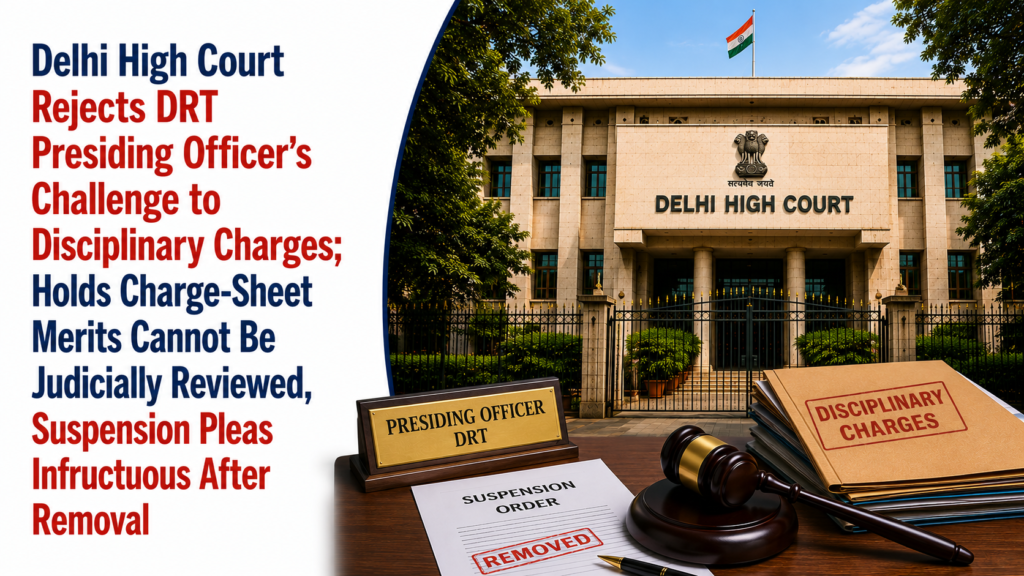
Delhi High Court Rejects DRT Presiding Officer’s Challenge to Disciplinary Charges; Holds Charge-Sheet Merits Cannot Be Judicially Reviewed, Suspension Pleas Infructuous After Removal

Delhi High Court Dismisses Former DRT Presiding Officer’s Appeal; Says Courts Cannot Examine Truth of Disciplinary Charges at Charge-Sheet Stage Under Article 226
Facts
The appellant, M.M. Dhonchak, was appointed as the Presiding Officer of Debts Recovery Tribunal-II, Chandigarh. While serving in that capacity, disciplinary proceedings were initiated against him. He was placed under suspension by an order dated 13 February 2024, followed by issuance of a charge-sheet dated 26 February 2024 and appointment of an Inquiry Officer.
The appellant filed W.P.(C) 5143/2024 challenging both the original suspension order and the disciplinary charge-sheet.
His suspension was subsequently extended on multiple occasions. A separate writ petition challenging the extension from 13 May 2024 to 9 November 2024 was also filed. Other extensions had separately travelled through the Delhi High Court and ultimately to the Supreme Court, which dismissed his Special Leave Petition on 29 August 2025.
The two writ petitions relevant to the present appeal were dismissed by the learned Single Judge on 26 September 2025. The appellant therefore instituted the present Letters Patent Appeal.
Meanwhile, the disciplinary inquiry itself concluded. The Inquiry Officer submitted the report on 3 June 2025, and by order dated 18 November 2025, the appellant was ultimately removed from his post. He separately challenged the removal before the Punjab & Haryana High Court.
Issues
The principal issues before the Division Bench were:
- Whether the challenge to the appellant’s suspension and its extension survived after completion of the disciplinary proceedings and his subsequent removal from office.
- Whether, while exercising jurisdiction under Article 226 of the Constitution, the High Court could examine the truth, correctness or merits of allegations contained in a disciplinary charge-sheet.
- Whether the Union of India/Central Government was competent to issue the charge-sheet against a DRT Presiding Officer.
- Whether the statutory procedure governing initiation of disciplinary proceedings against the appellant had been properly followed.
- Whether any jurisdictional or procedural defect justified interference with the learned Single Judge’s decision.
Appellant’s Arguments
The appellant appeared in person before the Division Bench.
His challenge broadly concerned the legality of his suspension and disciplinary charge-sheet.
On the charge-sheet, he questioned the jurisdiction and competence of the authority which had initiated disciplinary proceedings against him.
His position was that the disciplinary authority was not the Central Government in the manner asserted by the respondent and that the process adopted for issuance of the charge-sheet suffered from jurisdictional defects.
He also sought judicial scrutiny of the disciplinary action initiated against him.
Respondent’s Arguments
The Union of India opposed the appeal and supported the judgment of the learned Single Judge.
Its position was that the suspension-related challenges had become academic because the disciplinary proceedings had already concluded and the appellant had subsequently been removed from office.
Regarding the charge-sheet, the Union maintained that the prescribed statutory procedure had been followed and that the Central Government was the competent authority.
The respondent relied upon the relevant framework under the Recovery of Debts and Bankruptcy Act, Tribunals Reforms Act, Tribunal (Conditions of Service) Rules, CCS Rules and Government of India (Transaction of Business) Rules.
Analysis of the Law
The Division Bench drew an important distinction between judicial review of the legality of a charge-sheet and judicial determination of whether the factual allegations contained in that charge-sheet are true.
Under Article 226, a disciplinary charge-sheet can be scrutinised on recognised judicial review grounds such as lack of jurisdiction or procedural illegality.
However, at the charge-sheet stage, the High Court ordinarily cannot enter into the factual merits of the allegations or determine whether the charges are ultimately true or false.
The Court expressly held that while a charge-sheet may be subjected to judicial scrutiny under Article 226, the Court “cannot go into the veracity or truthfulness or otherwise of the charges or allegations.”
The proper forum for determining the truth of the disciplinary allegations is the departmental inquiry itself, subject to judicial review at the appropriate subsequent stage.
Precedent Analysis
The Division Bench did not undertake a substantial independent survey of Supreme Court precedents. Instead, it affirmed the learned Single Judge’s detailed analysis concerning the limited scope of judicial review of disciplinary charge-sheets.
The judgment principally turned upon the applicable statutory framework, including:
- Recovery of Debts and Bankruptcy Act, 1993;
- Tribunals Reforms Act, 2021;
- Tribunal (Conditions of Service) Rules, 2021;
- Central Civil Services (Classification, Control and Appeal) Rules, 1965;
- Central Civil Services (Conduct) Rules, 1964; and
- Government of India (Transaction of Business) Rules, 1961.
The Court therefore approached the controversy primarily as one concerning jurisdiction, statutory competence and the limits of Article 226 review, rather than factual adjudication of the disciplinary allegations.
Court’s Reasoning
Suspension Challenge
The Court first dealt with the suspension-related relief.
Since the disciplinary proceedings had already concluded and the appellant had been removed from office on 18 November 2025, there was no surviving challenge concerning the earlier suspension or its extension.
The appellant had already separately challenged his removal before the Punjab & Haryana High Court in CWP No. 6521/2026. Accordingly, the earlier suspension controversy had become infructuous.
Merits of the Charge-Sheet
The Division Bench agreed completely with the Single Judge that the Court could not test the truthfulness or correctness of the disciplinary allegations at the charge-sheet stage.
Article 226 does not permit the Court to effectively conduct the disciplinary inquiry itself.
Accordingly, the appellant’s attempt to challenge the charge-sheet on the merits of the underlying allegations could not succeed.
Competence of the Central Government
The Court separately examined the appellant’s jurisdictional objection.
The Single Judge had analysed the relevant statutory framework and found no jurisdictional or procedural defect.
In particular, Rule 9 of the Tribunal (Conditions of Service) Rules did not support the appellant’s argument that the Search-cum-Selection Committee itself was the disciplinary authority. The Rule contemplated submission of a report to the Central Government, which was the designated authority.
Section 4 of the Tribunals Reforms Act vested the power to remove a Chairperson or Member in the Central Government.
Further, Rules 12(2) and 13 of the CCS (CCA) Rules vested disciplinary authority over a government servant in the President. Even assuming some silence in the Tribunals Reforms Act or Tribunal Rules, Rule 16 operated to fill that gap.
The President’s powers had been vested in the concerned Ministry under Rule 3 of the Government of India (Transaction of Business) Rules, 1961.
An Office Memorandum dated 16 April 1969 further clarified that where the President is the disciplinary authority, initiation of disciplinary proceedings should receive approval from the concerned Minister. That procedure had been followed in the appellant’s case.
The Division Bench noted that the appellant had placed nothing before it capable of dislodging these findings.
Conclusion
The Delhi High Court found no ground to interfere with the Single Judge’s judgment.
It held that:
- challenges to the original suspension and its extension had become infructuous following conclusion of disciplinary proceedings and removal of the appellant;
- the High Court cannot determine the truth or falsity of disciplinary allegations while judicially reviewing a charge-sheet under Article 226;
- the Central Government was competent to initiate disciplinary proceedings against the DRT Presiding Officer; and
- no jurisdictional or procedural defect was demonstrated in issuance of the charge-sheet.
Accordingly, the Letters Patent Appeal was dismissed, along with all pending applications, with no order as to costs.
Case Details
Case: M.M. Dhonchak v. Union of India
Court: High Court of Delhi at New Delhi
Case Number: LPA 703/2025 with CM APPL. 72503/2025
Judge: Chief Justice Devendra Kumar Upadhyaya and Justice Tejas Karia
Date: 17 August 2026; judgment reserved on 30 July 2026
Result: Appeal dismissed; suspension challenges held infructuous following removal from office, while the disciplinary charge-sheet and Central Government’s competence to issue it were upheld