


Court’s decision
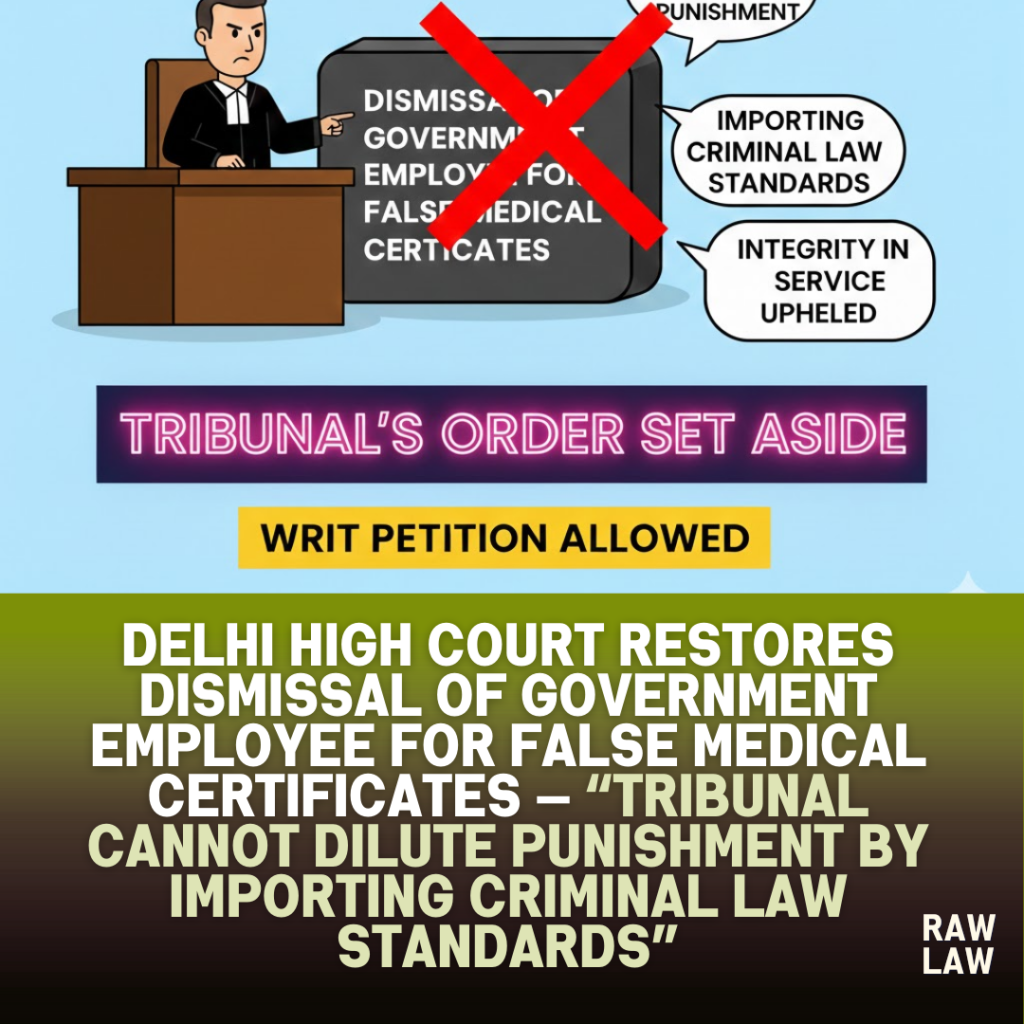
The Delhi High Court set aside the Central Administrative Tribunal’s order that had quashed disciplinary proceedings against a government employee and directed imposition of a lesser penalty. Restoring the punishment of dismissal from service, the Court held that submission of false medical and fitness certificates to regularise prolonged unauthorised absence constitutes grave misconduct striking at the root of integrity in public service. The Court ruled that the Tribunal exceeded its jurisdiction by reappreciating evidence, applying criminal law standards of proof, and interfering with punishment that was neither disproportionate nor shocking to the conscience.
Facts
The respondent joined government service in the early 1990s and was subsequently promoted to clerical cadre. In September 2000, he absented himself from duty without authorisation and remained absent continuously for nearly three years, returning only in April 2003. Upon rejoining, he submitted a medical certificate and a fitness certificate purportedly issued by a Chief Medical Officer under the Central Government Health Scheme, claiming illness during the period of absence.
Subsequent verification by CGHS authorities revealed that the certificates had not been issued by the concerned dispensary. It was also found that the doctor named on the certificates was not on duty on the relevant dates and had, in fact, retired from government service before issuing a later “confirmation certificate” relied upon by the employee. A departmental inquiry was initiated, culminating in findings that the certificates were false and that the employee had made deliberate misrepresentations to regularise his absence.
Issues
The primary issue before the High Court was whether the Central Administrative Tribunal was justified in quashing the charge memoranda and directing reconsideration of punishment on the ground that forgery was not proved through expert evidence or criminal prosecution. Ancillary issues included the scope of judicial review in disciplinary matters, the applicable standard of proof in departmental proceedings, and whether dismissal from service was disproportionate to the misconduct proved.
Petitioners’ arguments
The employer contended that the Tribunal had grossly exceeded the limits of judicial review by acting as an appellate authority over disciplinary findings. It was argued that departmental proceedings operate on the standard of preponderance of probabilities, not proof beyond reasonable doubt. The Inquiry Officer and Disciplinary Authority had returned detailed, reasoned findings establishing that the employee knowingly relied on false certificates and made incorrect statements regarding the status of the doctor concerned.
The petitioners emphasized that the misconduct was not a mere technical lapse but involved deliberate dishonesty and abuse of trust to legitimise nearly three years of unauthorised absence. Relying on settled Supreme Court precedent, it was argued that courts and tribunals cannot interfere with punishment unless it is shockingly disproportionate, which was not the case here.
Respondent’s arguments
The employee supported the Tribunal’s order, contending that at the relevant time there was no statutory requirement that a medical certificate must be issued by a CGHS dispensary. It was argued that the doctor’s signature was not disputed and that, at worst, the issue related to incorrect institutional attribution rather than fabrication. The respondent submitted that in the absence of criminal prosecution for forgery, the disciplinary authority could not brand the certificates as false and impose the extreme penalty of dismissal.
Analysis of the law
The High Court undertook an extensive analysis of the settled principles governing judicial review of disciplinary action. It reiterated that courts do not sit in appeal over departmental findings and cannot reappreciate evidence so long as there is some material supporting the conclusion. Departmental proceedings are governed by the civil standard of proof, and strict rules of evidence or criminal law concepts are inapplicable.
The Court further emphasised that the power to determine appropriate punishment vests primarily with the disciplinary authority. Interference is permissible only when the penalty imposed is so disproportionate that it shocks the conscience of the court, or where the inquiry is vitiated by violation of statutory rules or principles of natural justice.
Precedent analysis
Relying on B.C. Chaturvedi v. Union of India, the Court reiterated that judicial review is confined to the decision-making process and does not extend to reassessment of evidence or substitution of penalty. The Court also drew support from Indian Oil Corporation Ltd. v. Rajendra D. Harmalkar, where dismissal for submission of false certificates was upheld on the ground that such conduct destroys employer trust.
The Court further relied on Devendra Kumar v. State of Uttarakhand and State of Odisha v. Ganesh Chandra Sahoo, to hold that medical certificates unsupported by contemporaneous treatment records cannot justify prolonged unauthorised absence, and that fraud or misrepresentation vitiates all service benefits.
Court’s reasoning
Applying these principles, the High Court found that the Tribunal committed a manifest error by applying criminal law concepts such as proof of forgery beyond reasonable doubt and by faulting the employer for not initiating criminal prosecution. The Court clarified that the charge was not of criminal forgery but of submitting false certificates and making false statements in breach of conduct rules.
The Court noted multiple incriminating circumstances: the extraordinary length of unauthorised absence, absence of any contemporaneous leave applications or medical records, certificates lacking serial numbers or beneficiary details, issuance by a doctor not on duty, and a demonstrably false assertion that the doctor was still serving at the relevant time. These factors, taken cumulatively, clearly established misconduct on a balance of probabilities.
The Court held that such conduct reflects deliberate dishonesty and lack of integrity, core values essential to public service, and fully justified the penalty of dismissal.
Conclusion
The Delhi High Court concluded that the Central Administrative Tribunal had exceeded its jurisdiction by quashing the charge memoranda and directing imposition of a lesser penalty without recording how the punishment was disproportionate. Setting aside the Tribunal’s order, the Court restored the dismissal from service imposed by the disciplinary authority and upheld by appellate and revisional authorities.
Implications
This judgment reinforces strict judicial discipline in service jurisprudence and sends a clear message that submission of false medical certificates will attract the severest consequences. It clarifies that tribunals cannot dilute disciplinary punishment by importing criminal law standards into departmental proceedings. For government employers, the ruling affirms that integrity-related misconduct, especially involving misrepresentation and abuse of trust, warrants firm action and will receive judicial backing.
Case law references
- B.C. Chaturvedi v. Union of India
Held: Courts cannot reappreciate evidence or substitute punishment unless it shocks the conscience.
Applied: Used to limit tribunal’s interference. - Indian Oil Corporation Ltd. v. Rajendra D. Harmalkar
Held: Submission of false certificates is grave misconduct justifying dismissal.
Applied: Supported restoration of dismissal. - State of Odisha v. Ganesh Chandra Sahoo
Held: Belated, unsupported medical certificates cannot justify prolonged absence.
Applied: Undermined employee’s defence.
SEO-friendly FAQs
Q1. Can a tribunal interfere with punishment imposed in departmental proceedings?
Only in rare cases where the punishment is shockingly disproportionate or the inquiry is vitiated by illegality or procedural unfairness.
Q2. Is criminal prosecution necessary to prove misconduct in service law?
No. Departmental proceedings operate on the standard of preponderance of probabilities and do not require criminal prosecution.
Q3. Do false medical certificates justify dismissal from government service?
Yes. Courts consistently hold that submission of false certificates reflects lack of integrity and warrants dismissal.