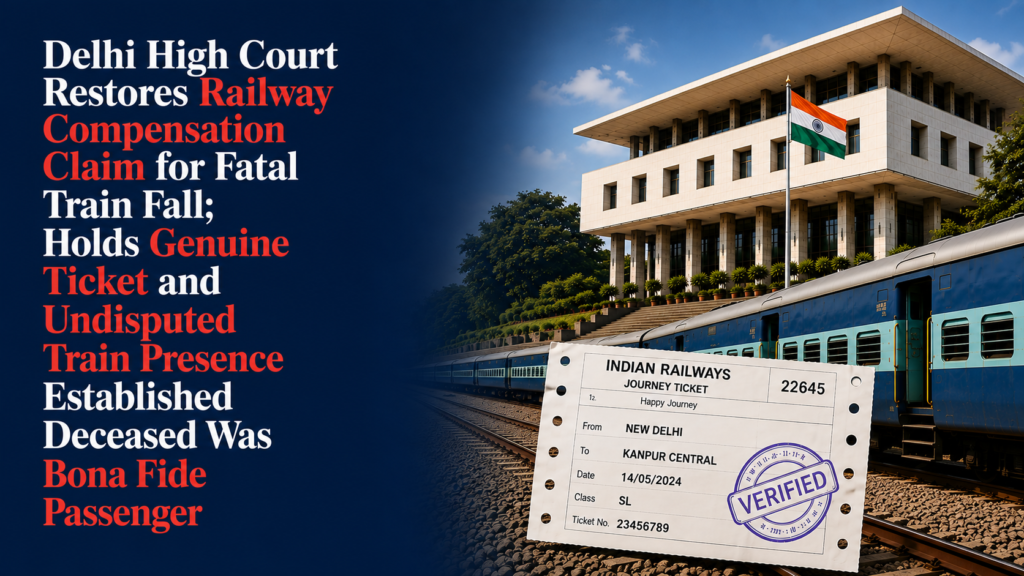
Delhi High Court Restores Railway Compensation Claim for Fatal Train Fall; Holds Genuine Ticket and Undisputed Train Presence Established Deceased Was Bona Fide Passenger

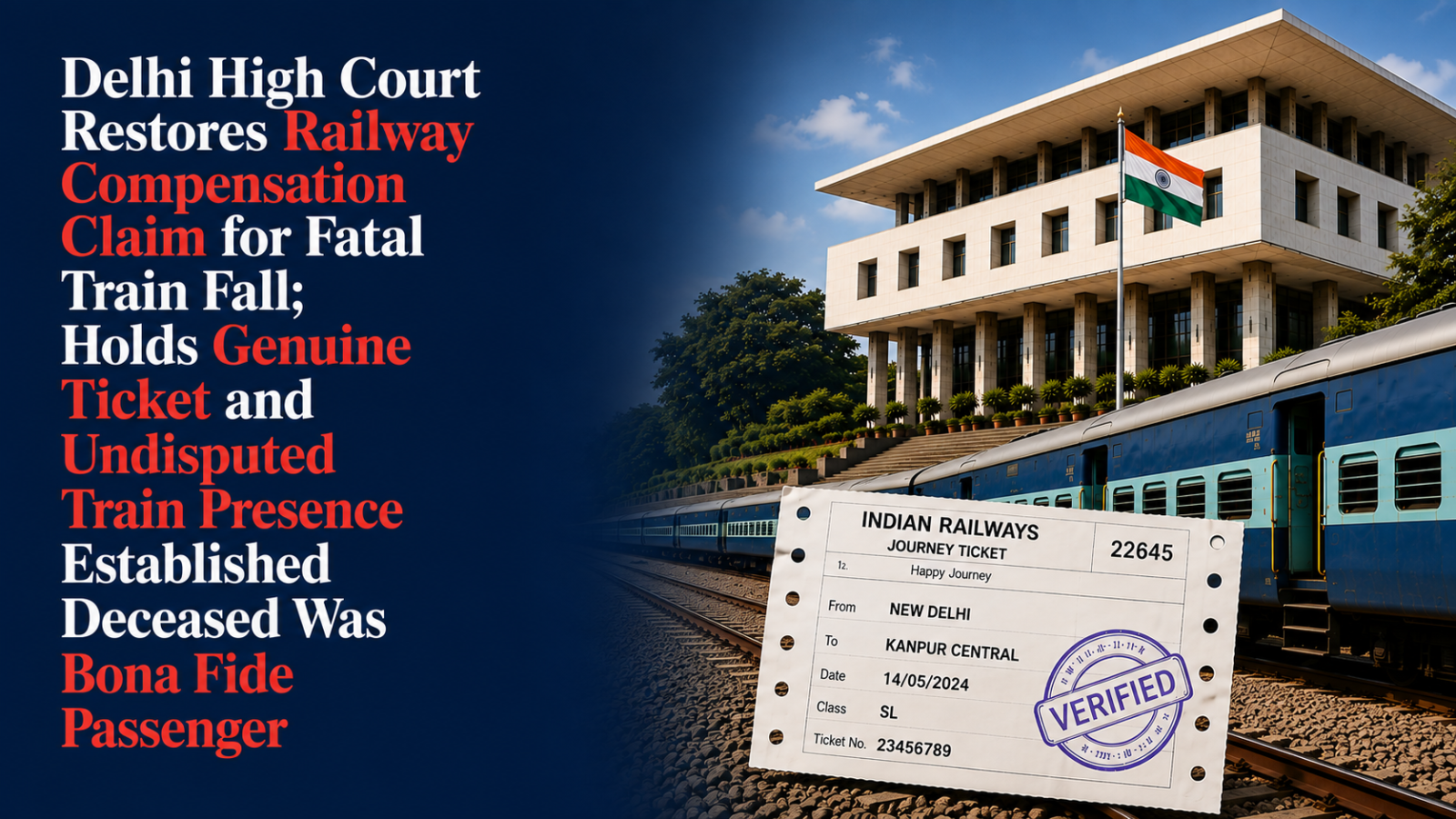
Delhi High Court Restores Fatal Railway Accident Claim; Says Genuine Ticket, Undisputed Train Presence and Weak Co-Passenger Testimony Shifted Burden to Railways
Facts
The Delhi High Court heard an appeal filed by Jaykumar and another under Section 23 of the Railway Claims Tribunal Act, 1987, challenging the Railway Claims Tribunal’s judgment dated 20 March 2026. The High Court delivered its judgment on 14 August 2026.
The claim arose from the death of Astik Kumar, who on 14 November 2024 was travelling from Mandrak to Chamrola by a passenger train. According to the appellants, while the train was passing near Sasni Railway Station, Astik accidentally fell from the running train at Km. No. 1306/28-30 and suffered fatal injuries.
The Tribunal accepted that Astik had died as a result of an “untoward incident” within the meaning of the Railways Act, 1989.
However, it dismissed the compensation claim because the deceased had allegedly not been proved to be a bona fide passenger.
The High Court was therefore principally concerned with whether Astik had been travelling with a valid ticket.
Issues
The principal issues before the Court were:
- Whether non-recovery of a journey ticket from the deceased during jamatalashi was sufficient to hold that he was not a bona fide passenger.
- Whether genuine journey ticket No. UCD-12880641, issued from Mandrak to Chamrola on the date of the accident, supported the appellants’ case.
- Whether the Tribunal was justified in accepting co-passenger Vivek Pratap Singh’s assertion that the ticket belonged exclusively to him.
- Whether inconsistencies in Vivek’s statements required his testimony to be treated with greater caution.
- Whether the appellants had discharged the initial burden of establishing bona fide passenger status under Union of India v. Rina Devi.
- Whether the Railways thereafter discharged the shifted burden of proving that the deceased was travelling without a ticket.
Appellants’ Arguments
The appellants argued that ticket No. UCD-12880641 was genuine and had been duly verified by the Railway authorities.
The ticket was issued at Mandrak on 14 November 2024 at 16:17 hours for travel from Mandrak to Chamrola.
They further pointed out that Astik was travelling with Vivek Pratap Singh, who had also informed the Railway authorities about the incident.
The appellants relied upon the Supreme Court judgment in Union of India v. Rina Devi to argue that non-recovery of a ticket from the deceased cannot, standing alone, establish that he was not a bona fide passenger.
Respondent’s Arguments
The Railways argued that no ticket had been recovered from Astik during jamatalashi.
It further contended that the ticket relied upon by the appellants had actually been found with Vivek Pratap Singh.
According to Vivek, Astik had not purchased a ticket for himself and the genuine ticket produced in the proceedings belonged to Vivek alone.
The Railways therefore maintained that the deceased was travelling ticketless.
Analysis of the Law
Non-Recovery of Ticket Is Not Conclusive
The High Court began by reiterating that mere non-recovery of a railway ticket from a deceased passenger cannot by itself establish that the person was not a bona fide passenger.
Relying on Rina Devi, the Court held that the initial evidentiary burden on claimants in railway accident cases is not unduly onerous.
The claimants may discharge it by establishing relevant facts and surrounding circumstances, after which the burden shifts to the Railways.
The Court noted that this principle had recently been reiterated by the Supreme Court in Lata v. Union of India.
Journey Ticket Was Genuine
There was no dispute regarding the authenticity of ticket No. UCD-12880641.
The Railway authorities themselves verified it and found it to be genuine.
It had been issued:
- from Mandrak;
- to Chamrola;
- on 14 November 2024; and
- at 16:17 hours.
Thus, there was a genuine ticket corresponding with the relevant journey and date.
The dispute was only whether that ticket belonged to the deceased or exclusively to Vivek.
Co-Passenger’s Testimony Required Greater Scrutiny
The Tribunal had principally relied upon Vivek’s testimony to conclude that the ticket belonged to him.
The High Court found an important contextual circumstance that the Tribunal had inadequately considered.
The deceased’s father had lodged a police complaint against Vivek and his brother, alleging that they had murdered Astik and placed his body near the railway track.
Against that background, Vivek’s testimony concerning purchase of only one ticket required greater scrutiny rather than unquestioning acceptance.
Later “Ticket Snatching” Explanation Was Missing From Earlier Statement
The High Court identified another material inconsistency.
During cross-examination, Vivek claimed that associates of the deceased had snatched the ticket from him at the hospital.
However, this allegation did not appear in his earlier statement before the Railway authorities.
Nor did the DRM Report contain any reference to the ticket having been forcibly taken from Vivek.
The Court considered this later explanation significant in evaluating the reliability of his claim that the ticket exclusively belonged to him.
Beneficial Legislation Requires Cumulative Assessment
The High Court emphasised the beneficial character of the Railways Act.
It held that the legislation should not be interpreted so as to defeat a legitimate claim of dependants merely because of an evidentiary doubt, particularly where the surrounding circumstances cumulatively support the claim.
The Court specifically cautioned against reducing the entire evidentiary inquiry to the single question of where the ticket was ultimately found.
Instead, the evidence had to be evaluated as a whole.
Here, the record showed:
- a valid and officially verified journey ticket;
- issued on the date of the accident;
- covering the relevant journey;
- the deceased’s undisputed presence inside the train with Vivek; and
- weaknesses in Vivek’s version concerning ownership and subsequent possession of the ticket.
Taken cumulatively, these circumstances made the appellants’ version more probable than the contrary conclusion.
Burden Shifted to Railways
Once these circumstances were established, the High Court held that the appellants had discharged their initial burden under Rina Devi.
The evidentiary burden therefore shifted to the Railways to establish that Astik was actually travelling without a ticket.
The Railways failed to produce sufficient material to do so.
Accordingly, the High Court expressly held that Astik Kumar was a bona fide passenger at the time of the incident.
Untoward Incident Was Already Established
Unlike several railway compensation cases where both passenger status and the nature of the accident are disputed, the Tribunal had already decided the second question in favour of the appellants.
It had expressly held that Astik’s death resulted from an “untoward incident” under the Railways Act.
The High Court therefore did not need to reconsider that finding.
Once the High Court reversed the Tribunal’s finding regarding bona fide passenger status, the substantive basis for rejecting the compensation claim disappeared.
Precedent Analysis
Union of India v. Rina Devi
This Supreme Court precedent was central to the judgment.
It establishes that mere absence or non-recovery of a ticket from the body of a deceased passenger does not automatically prove ticketless travel.
The claimant’s initial burden is not excessively onerous and may be discharged through the surrounding facts and circumstances.
Once that burden is discharged, the Railways must rebut the claimant’s case.
The High Court applied this burden-shifting framework and found that the appellants succeeded at the first stage while the Railways failed at the second.
Lata v. Union of India
The High Court also referred to the Supreme Court’s recent decision in Lata v. Union of India, 2026 SCC OnLine SC 1350.
The Court noted that Lata reiterated the principle laid down in Rina Devi concerning the evidentiary burden in determining bona fide passenger status.
Court’s Reasoning
The High Court found that the Tribunal had placed excessive emphasis on the fact that the ticket was not physically recovered from the deceased.
That approach failed to account for the complete evidentiary picture.
There was a genuine and officially verified ticket corresponding precisely with the journey and date in question. Astik’s presence in the train with Vivek was undisputed.
Meanwhile, Vivek’s testimony required caution because of the police complaint against him and his brother, and because his later assertion that the ticket had been snatched at the hospital was absent from his earlier Railway statement and the DRM Report.
The Court therefore found the appellants’ case more probable.
Since the Railways failed to establish that Astik was travelling without a ticket, the deceased had to be treated as a bona fide passenger.
Conclusion
The Delhi High Court set aside the Railway Claims Tribunal’s judgment insofar as it rejected the compensation claim for failure to establish bona fide passenger status.
It held that Astik Kumar was a bona fide passenger at the time of the fatal untoward incident.
The matter was remanded to the Tribunal for determination of the amount of compensation payable.
The Tribunal was directed to assess compensation according to law and direct its disbursal within two months from receipt of the High Court’s order. The parties were directed to appear before the Tribunal on 31 August 2026.
The appeal was accordingly allowed.
Case Details
Case: Jaykumar & Anr. v. Union of India
Court: Delhi High Court
Case Number: FAO 221/2026
Judge: Justice Manoj Kumar Ohri
Date: 14 August 2026
Result: Appeal allowed; deceased held to be a bona fide passenger; Tribunal’s rejection of compensation claim set aside and matter remanded for assessment and disbursal of compensation within two months.