Delhi High Court Restores Railway Compensation Claim for Passenger Killed After Train Fall; Holds Valid Platform Ticket Can Establish Passenger Status Despite Missing Journey Ticket

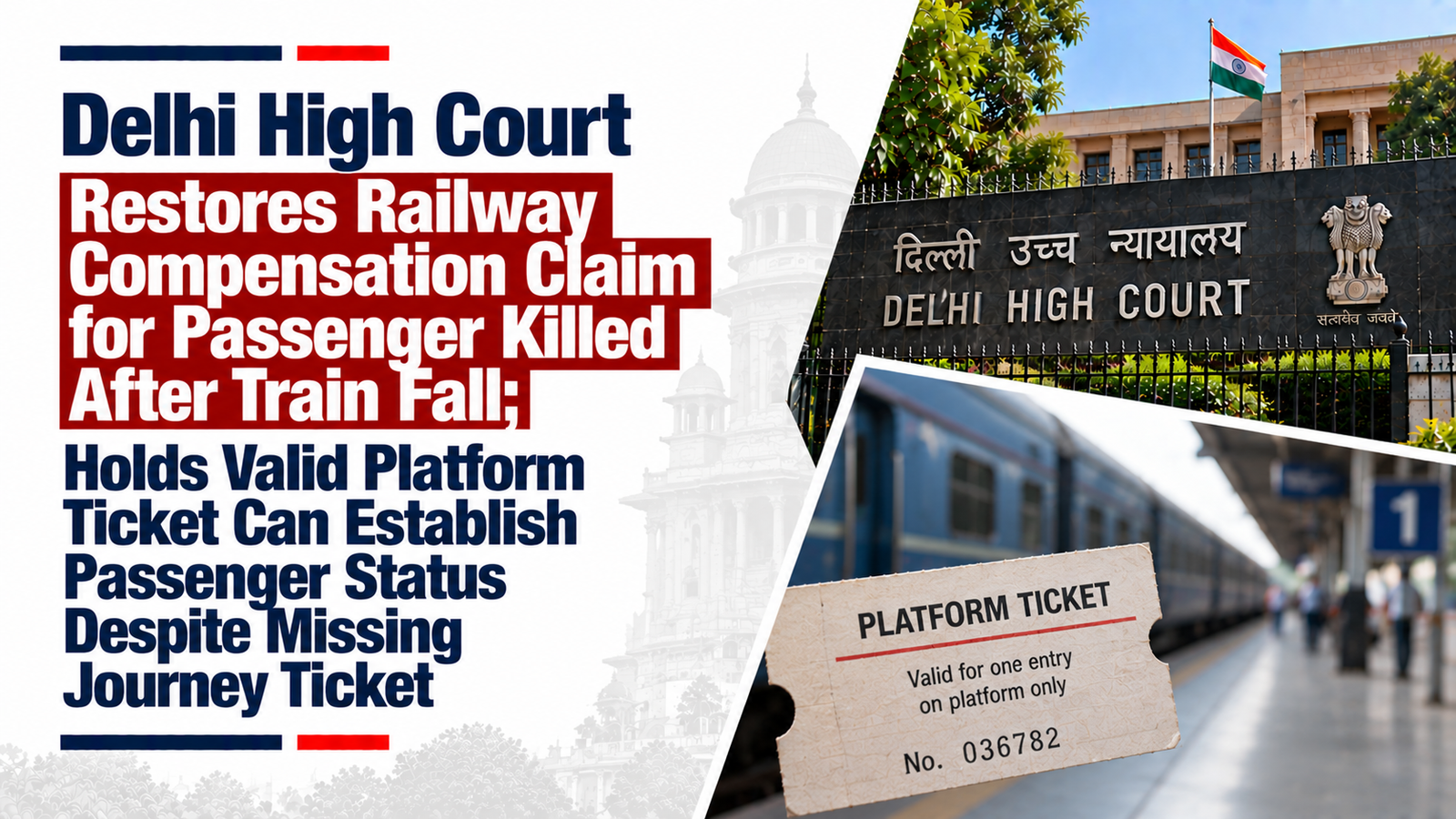
Delhi High Court Restores Family’s Railway Compensation Claim; Finds Deceased’s Valid Platform Ticket and Mother’s Evidence Established Bona Fide Passenger Status
Facts
The appellants, Manju Devi and another, challenged the Railway Claims Tribunal’s judgment dated 2 December 2024 dismissing their compensation claim arising from the death of Aman Kumar. The appeal was filed under Section 23 of the Railway Claims Tribunal Act, 1987.
On 15 August 2023, Aman Kumar was travelling in Train No. 04446 from New Delhi towards Faridabad. After the train departed Tilak Bridge Railway Station, he was standing near the gate because he was feeling nauseous. He lost his balance and fell from the moving train. His friends attempted to pull the emergency chain but could not immediately stop the train. When they returned to the spot, Aman Kumar was found unconscious and was subsequently taken to Lady Hardinge Medical College, where he was declared brought dead.
Significantly, although no journey ticket was recovered from him, a valid platform ticket bearing No. UAG-67050302 was found during his personal search. It had been issued at New Delhi Railway Station at 6:59 PM, while the accident occurred at approximately 7:38 PM.
Issues
The principal issue was whether Aman Kumar could be treated as a bona fide passenger for the purpose of compensation under the Railways Act despite non-recovery of his journey ticket, particularly when a valid platform ticket was recovered from him.
The question whether his death resulted from an “untoward incident” had already been decided by the Railway Claims Tribunal in favour of the appellants and was not challenged by the Railways.
Appellants’ Arguments
The appellants argued that the Tribunal wrongly treated non-recovery of the journey ticket as determinative of the deceased’s passenger status.
They relied upon the platform ticket recovered from Aman Kumar, which was verified by the Railway Authorities and remained valid at the time of the accident.
His mother, Manju Devi, had also given sworn testimony that Aman Kumar and his friends purchased journey tickets at New Delhi Railway Station and that his journey ticket was lost during the accident.
The appellants therefore argued that the missing journey ticket could not, by itself, defeat their claim.
Respondent’s Arguments
The Union of India contended that the platform ticket merely authorised Aman Kumar to enter the railway platform and did not authorise him to travel aboard a train.
It further pointed out that none of the persons allegedly travelling with the deceased had been examined before the Tribunal to prove that he had actually purchased a journey ticket before boarding the train.
Analysis of the Law
The High Court applied the Supreme Court’s decision in Union of India v. Rina Devi, (2019) 3 SCC 572.
Under Rina Devi, mere absence of a railway ticket from an injured or deceased person does not by itself negate bona fide passenger status. The claimant can discharge the initial burden by placing an affidavit containing the relevant facts on record, after which the burden shifts to the Railways to rebut the case from the surrounding circumstances.
The Court also referred to Lata v. Union of India, 2026 INSC 715, which reiterated both the evidentiary burden laid down in Rina Devi and that railway compensation claims are to be examined on the standard of preponderance of probabilities.
More importantly, the Court examined the statutory language of Section 124-A of the Railways Act.
The Explanation to Section 124-A expressly includes within the expression “passenger”:
a person holding a valid train ticket or a valid platform ticket who becomes the victim of an untoward incident.
Thus, the Tribunal’s reasoning that a platform ticket did not authorise train travel did not conclusively answer the statutory compensation question.
Precedent Analysis
Union of India v. Rina Devi was central to the Court’s reasoning. It establishes that non-recovery of a ticket does not automatically establish that the victim was travelling without one. Once the claimant places sufficient foundational facts on record, the evidentiary burden shifts to the Railway Administration.
Lata v. Union of India, 2026 INSC 715 reinforced this approach and clarified that the matter must be determined on a preponderance of probabilities, rather than by insisting upon proof comparable to a criminal prosecution.
The present judgment goes further on its particular facts because there was objective contemporaneous material—the verified platform ticket—connecting the deceased with New Delhi Railway Station shortly before the accident.
Court’s Reasoning
The Court found that this was not a case resting solely upon the family’s assertion that the deceased possessed a ticket.
The platform ticket was actually recovered from Aman Kumar during his personal search and verified by the Railways. It was issued at 18:59 hours, was valid for two hours, and the DRM report recorded the accident at 19:38 hours. Thus, the platform ticket was indisputably valid when the accident occurred.
The Court rejected the Tribunal’s reasoning that the platform ticket could be disregarded simply because it authorised entry onto the platform rather than train travel. Section 124-A itself expressly includes a valid platform-ticket holder within the statutory concept of a passenger for an untoward-incident compensation claim.
The mother’s affidavit additionally stated that Aman Kumar had purchased a journey ticket and that it was lost during the accident.
The High Court considered that explanation consistent with the circumstances: Aman Kumar had fallen from a moving train, while another railway document—the platform ticket—remained on his person.
The appellants had therefore discharged their initial burden under Rina Devi, whereas the Railways failed to rebut their evidence.
As to the nature of the accident, the Tribunal had already found from the General Diary entry and Station Master’s memo that Aman Kumar died in an untoward incident. Since the Railways had not challenged that finding, the High Court expressly affirmed it rather than reopening the issue.
Conclusion
The Delhi High Court held that Aman Kumar was a bona fide passenger. Since his death had already been found to result from an untoward incident, his family was entitled to pursue compensation under the Railways Act.
The Court accordingly set aside the Tribunal’s judgment and remanded the matter for assessment of compensation.
The Tribunal was directed to determine the compensation payable and ensure its disbursement within two months from receipt of the High Court’s order. The matter was directed to be listed before the Tribunal on 30 September 2026.
Case Details
Case: Manju Devi & Anr. v. Union of India
Court: Delhi High Court
Case Number: FAO 24/2025
CNR: DLHC010043672025
Judge: Justice Manoj Kumar Ohri
Reserved: 1 September 2026
Pronounced: 9 September 2026
Result: Appeal allowed; deceased held a bona fide passenger, Tribunal’s untoward-incident finding affirmed, and matter remanded for assessment and disbursement of compensation within two months.