Delhi High Court Restores Railway Compensation Claim for Passenger Run Over by Rajdhani; Holds Wrong-Side Deboarding Was Unproved and Death Was an Untoward Incident

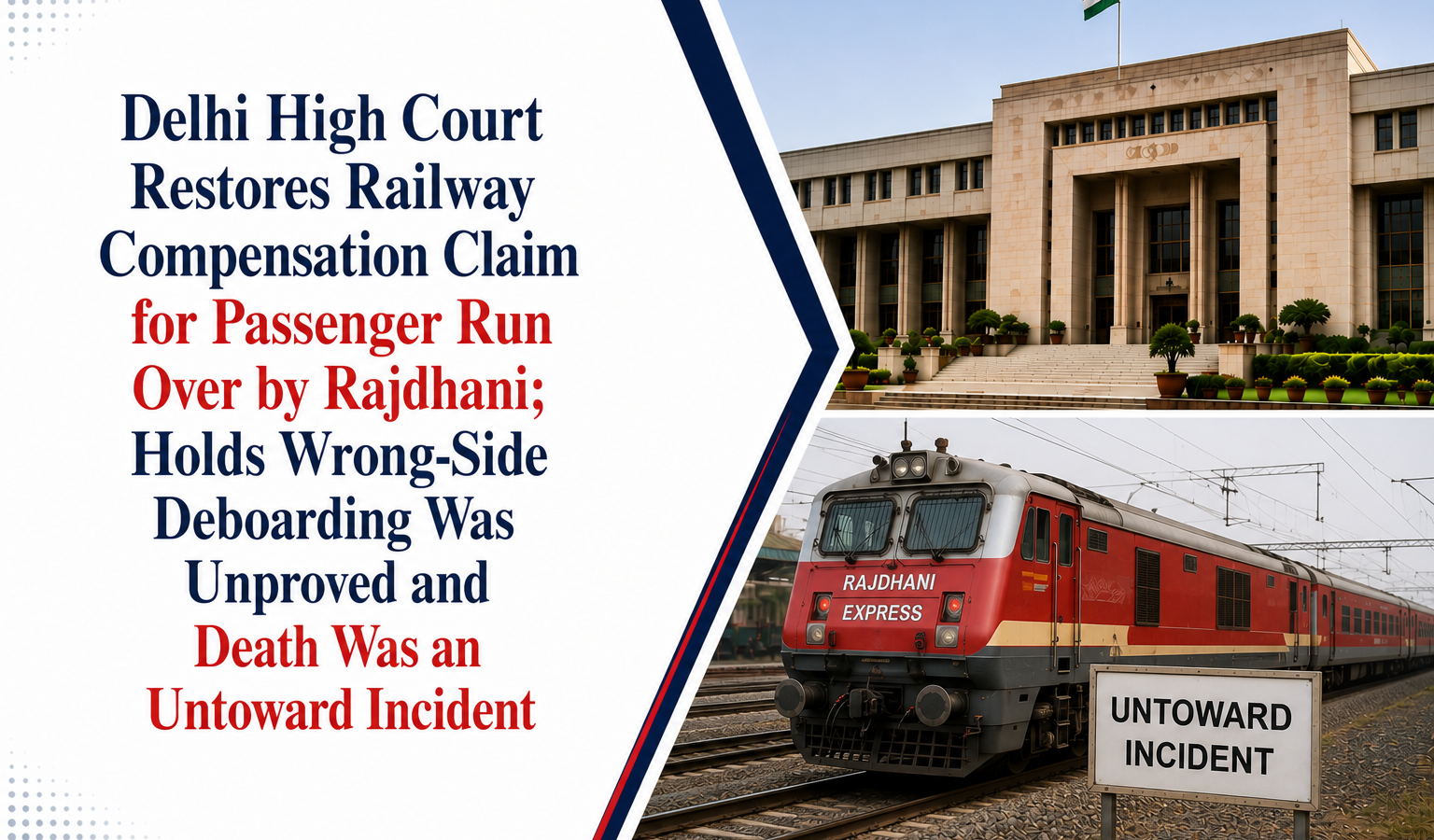
Delhi High Court Allows Railway Accident Appeal After Passenger Was Run Over; Holds Wrong-Side Deboarding Unproved and Death Qualifies as Untoward Incident
Facts
The appellants, Jawahar Lal & Anr., filed an appeal under Section 23 of the Railway Claims Tribunal Act, 1987, challenging the Railway Claims Tribunal’s judgment dated 24 February 2023 in Claim Application No. OA/II(u)/DLI/285/2019.
The claim arose from the death of Lalchand, who was travelling on 9 June 2019 from Kanpur Central to Surat by Train No. 19038, Awadh Assam Express, on the strength of a valid journey ticket.
According to the appellants, when the train stopped at Balrai Railway Station on 10 June 2019, Lalchand and other passengers were made to deboard from the off-side of the train by the TTE. They thereafter came onto the wrong side and were run over by Train No. 12313, Rajdhani Express, passing on the adjacent track.
Four persons died in the incident, resulting in four separate compensation claims. Since they arose from the same accident and involved common evidence, the claims were consolidated.
The Railway Claims Tribunal found that Lalchand was a bona fide passenger, but dismissed the compensation claim on the ground that his death did not constitute an “untoward incident” under Section 123(c) of the Railways Act, 1989.
Issues
The principal issues were:
- Whether Lalchand’s death after being run over by Rajdhani Express constituted an “untoward incident” under Section 123(c) of the Railways Act, 1989.
- Whether the Railways had established through cogent evidence that Lalchand voluntarily deboarded from the off-side of Awadh Assam Express and thereafter walked along the railway track.
- Whether the mere fact that the deceased’s body was ultimately found on the track could establish voluntary wrong-side deboarding.
- Whether inconsistencies between eyewitnesses regarding precisely how the passengers came out of the train justified rejection of the compensation claim.
- Whether the Tribunal correctly relied upon the DRM enquiry, panchnama and Loco Pilot’s statement.
- Whether alleged negligence in deboarding from the wrong side could itself exclude the incident from the compensatory scheme under the Railways Act.
Petitioner/Appellants’ Arguments
The appellants argued that the Tribunal had failed to properly appreciate the evidence of AW-2 Neelu Devi and AW-3 Rohit, both of whom were travelling on the same train.
They contended that the deceased’s presence on the track and the fact that he was ultimately run over by Rajdhani Express could not, by themselves, take the incident outside the scope of Section 123(c).
Their case was that the passengers had been asked to move or change their coach by the TTE, resulting in their deboarding from the train. Thus, their presence on the track could not simply be treated as voluntary conduct.
The appellants relied principally upon the Supreme Court judgments in Union of India v. Rina Devi, (2019) 3 SCC 572 and Union of India v. Prabhakaran Vijaya Kumar, (2008) 9 SCC 527.
Respondent’s Arguments
The Union of India supported the Railway Claims Tribunal’s judgment.
The Railways argued that Lalchand and the other passengers had deboarded from the side opposite the platform at Balrai Station and thereafter entered the railway track.
Reliance was placed upon the panchnama, statements recorded during the DRM enquiry and the statement of the Loco Pilot of Rajdhani Express.
According to the Railways, the deceased had been seen walking along the railway track before being run over, demonstrating that his death did not result from an untoward incident covered by the Act.
Analysis of the Law
Bona Fide Passenger Status Was Undisputed
The High Court first clarified that Lalchand’s status as a bona fide passenger was no longer in dispute.
The Tribunal had itself held that he possessed a valid ticket from Kanpur to Surat and was travelling in Awadh Assam Express.
Since the Union of India had not challenged that finding, it had attained finality.
The entire controversy was therefore confined to whether the manner of his death constituted an untoward incident.
Mere Presence on Railway Track Was Insufficient
The High Court found that Awadh Assam Express was standing at Balrai Station when Rajdhani Express passed through and struck the deceased.
The DRM report proceeded on the assumption that the deceased had deboarded from the off-side and was thereafter walking along the track.
However, the Court emphasised that the circumstances explaining how the passengers came out of the train could not be ignored.
Neither the Loco Pilot of Rajdhani Express nor the TTE stated that they had actually witnessed Lalchand voluntarily deboarding from the train and proceeding towards the track.
Consequently, the deceased’s eventual position on the railway track could not itself establish the Railways’ version of voluntary deboarding.
Variations in Eyewitness Evidence Were Not Fatal
The Court noticed some discrepancy between the eyewitness accounts.
AW-2 Neelu Devi stated that the TTE had pushed only one passenger, Pintu, while the others got down themselves. AW-3 Rohit stated that the passengers were pushed out by the TTE.
The High Court held that these inconsistencies created some doubt regarding the precise manner in which the passengers exited the train, but they could not justify a positive conclusion that Lalchand had voluntarily gone onto the railway track.
Precedent Analysis
Union of India v. Rina Devi, (2019) 3 SCC 572
The appellants relied upon Rina Devi in support of their contention that the Tribunal had adopted an unduly restrictive approach towards an untoward incident under the Railways Act.
The judgment records Rina Devi as one of the Supreme Court authorities specifically relied upon by the appellants in challenging the Tribunal’s finding.
Union of India v. Prabhakaran Vijaya Kumar, (2008) 9 SCC 527
This Supreme Court authority was also relied upon by the appellants to support a broader interpretation of the statutory compensation regime for railway accidents and untoward incidents.
The order, however, does not separately undertake a detailed doctrinal analysis of these two Supreme Court judgments.
Gyasu & Anr. v. Divisional Railway Manager & Anr.
The High Court expressly referred to this decision while considering the Railways’ contention that the deceased had deboarded from the wrong side and entered the railway track.
The precedent recognised that even where a passenger may have been negligent in deboarding from the wrong side or became involved in an accident while crossing the track, such conduct does not automatically establish the type of criminal act that would defeat railway compensation.
This reasoning supported the High Court’s refusal to treat the deceased’s ultimate presence on the track as sufficient to deny compensation.
Court’s Reasoning
The Court identified a crucial evidentiary gap in the Railways’ case.
It was established that Lalchand was run over by Rajdhani Express. What was not established through cogent evidence was the further proposition that he had voluntarily deboarded from the off-side and thereafter deliberately walked along the railway track.
The Railways relied substantially upon the deceased’s ultimate position on the track. But neither the TTE nor the Loco Pilot had witnessed him voluntarily leaving the train and proceeding towards the track.
The appellants’ explanation—that the passengers were being required to move or change coaches—therefore had to be considered when determining how they came to be outside the train.
Although the eyewitnesses differed regarding whether all passengers were physically pushed out by the TTE, that discrepancy did not affirmatively prove the Railways’ competing theory of voluntary deboarding and track walking.
The Tribunal had therefore gone too far in treating the DRM report’s version as established fact.
The High Court consequently held that Lalchand’s death did occur in an “untoward incident” within Section 123(c) of the Railways Act and set aside the Tribunal’s contrary finding.
Conclusion
The Delhi High Court allowed the appeal and set aside the Railway Claims Tribunal’s judgment dismissing the claim.
The Court conclusively held that Lalchand’s death constituted an untoward incident under Section 123(c) of the Railways Act, 1989 because the Railways had failed to establish through cogent evidence that he voluntarily deboarded from the off-side and thereafter walked along the track.
The matter was remanded to the Railway Claims Tribunal solely for assessment of compensation payable to the appellants.
The Tribunal was directed to determine the compensation in accordance with law and ensure its disbursement within two months from receipt of the High Court’s order. The matter was directed to be listed before the Tribunal on 16 September 2026.
Case Details
Case: Jawahar Lal & Anr. v. Union of India
Court: High Court of Delhi at New Delhi
Case Number: FAO 211/2024
Judge: Hon’ble Mr. Justice Manoj Kumar Ohri
Date: 24 August 2026
Result: Appeal Allowed; Tribunal’s dismissal set aside; death held to be an “untoward incident”; matter remanded for assessment and disbursement of railway compensation within two months.