Delhi High Court Restores Railway Compensation for Passenger’s Fatal Train Fall; Holds Blood-Stained Ticket and Eyewitness Evidence Proved Bona Fide Travel and Untoward Incident

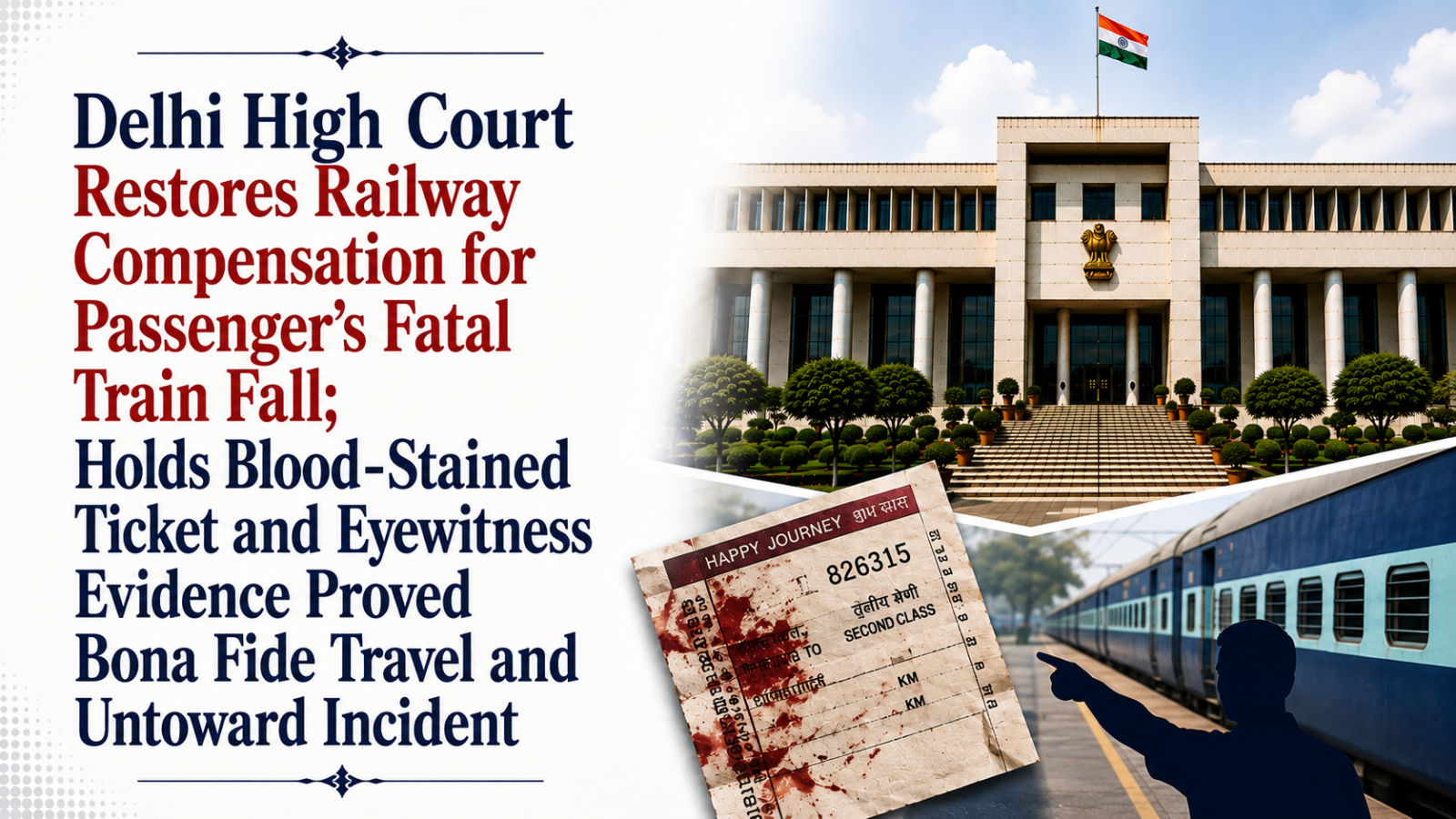
Delhi High Court Allows Railway Accident Appeal After 883-Day Delay; Finds Deceased Was Bona Fide Passenger and Death Resulted From Accidental Fall
Facts
The appellants were the legal heirs of Mahesh Kumar, who was allegedly travelling from Sikandarpur to Aligarh by an EMU train on 24 February 2019.
According to the family, Mahesh Kumar accidentally fell from the train during the journey, suffered fatal injuries and was subsequently found dead alongside the railway track.
The family filed a compensation claim before the Railway Claims Tribunal, Principal Bench, Delhi.
By judgment dated 16 November 2023, the Tribunal rejected the claim, holding that:
- Mahesh Kumar had not been proved to be a bona fide passenger; and
- his death had not been established as an “untoward incident” under the Railways Act, 1989.
The family challenged the decision before the Delhi High Court under Section 23 of the Railway Claims Tribunal Act, 1987.
There was a delay of 883 days in filing the appeal. The appellants explained that they were poor and illiterate residents of a village in Bulandshahar, Uttar Pradesh, and lacked the financial means to obtain timely legal advice.
Considering the beneficial nature of railway compensation legislation, the High Court condoned the entire delay.
Issues
The principal issues before the High Court were:
- Whether Mahesh Kumar was travelling as a bona fide railway passenger at the time of the incident.
- Whether his death resulted from an accidental fall from a train, constituting an “untoward incident” under the Railways Act.
- Whether the subsequent non-production of the physical railway ticket justified rejection of the claim despite the panchnama recording recovery of a blood-stained ticket.
- Whether the Railways had established its alternative case that the deceased was walking between the railway tracks and was run over by an unknown train.
- What evidentiary value could be attached to an RPF inquiry statement where the alleged eyewitness subsequently disowned that version before the Tribunal.
- Whether negligence or contributory negligence could defeat compensation under the strict-liability framework of Section 124-A of the Railways Act.
- Whether the 883-day delay in filing the appeal deserved condonation considering the claimants’ financial and social circumstances.
Appellants’ Arguments
The appellants relied principally upon the evidence of AW-2 Danveer, the deceased’s brother.
Danveer specifically testified that he had accompanied Mahesh Kumar to Sikandarpur Railway Station and personally witnessed him board the EMU train.
Therefore, his evidence was not based upon information subsequently received about the accident but upon his own direct observation.
The appellants further relied upon the panchnama, which specifically recorded recovery of a blood-stained railway journey ticket from the deceased’s person.
They also challenged the Railways’ reliance upon the RPF inquiry.
AW-3 Ram Babu, whom the Railways treated as supporting its theory that Mahesh Kumar was walking on the railway tracks, did not support that account when examined before the Tribunal.
Instead, he categorically stated that he had seen Mahesh Kumar fall from the train.
The appellants therefore argued that both the bona fide passenger status and the accidental fall stood established.
Respondent’s Arguments
The Railways defended the Tribunal’s judgment.
It relied upon railway records allegedly showing that no EMU train operated between Sikandarpur and Khurja after approximately 11:30 a.m., whereas the accident was reported at around 2:00–2:30 p.m.
It further relied upon the RPF inquiry report, according to which Mahesh Kumar had allegedly been walking between the railway tracks and was run over by an unknown train.
Accordingly, the Railways argued that the deceased was neither shown to be a bona fide passenger nor proved to have died in an untoward railway incident.
Analysis of the Law
The Court examined the case within the beneficial and compensatory framework of the Railways Act, 1989.
Under Section 124-A, railway liability for death or injury caused by an “untoward incident” is essentially one of strict liability, subject to the statutory exceptions.
Therefore, once the claimant establishes the foundational facts showing bona fide travel and an accidental fall from a train, ordinary negligence principles do not defeat the claim.
The Court also reiterated that production of the original railway ticket is not an absolute prerequisite for establishing bona fide passenger status.
The claimant may discharge the initial burden through:
- affidavit or oral evidence;
- circumstances surrounding the journey;
- documentary evidence; and
- other corroborative material.
Once sufficient foundational material is produced, the evidentiary burden shifts to the Railways.
Precedent Analysis
Union of India v. Rina Devi
The Court relied upon Union of India v. Rina Devi, (2019) 3 SCC 572.
The Supreme Court held that mere absence of a railway ticket does not by itself establish that the deceased was not a bona fide passenger.
The claimant may discharge the initial burden by affidavit and surrounding circumstances, following which the burden shifts to the Railways.
In the present case, the evidentiary position was stronger because there was not merely oral testimony regarding the journey.
The panchnama itself recorded that a blood-stained railway ticket had been recovered from the deceased.
The subsequent inability to produce the physical ticket could therefore not, by itself, destroy the appellants’ case.
Lata v. Union of India
The High Court noted that the principle in Rina Devi had recently been reiterated by the Supreme Court in Lata v. Union of India, 2026 SCC OnLine SC 1350.
Thus, a compensation claim cannot mechanically be rejected solely because the physical railway ticket is unavailable where credible evidence otherwise establishes bona fide travel.
Union of India v. Prabhakaran Vijaya Kumar
The Court also relied upon Union of India v. Prabhakaran Vijaya Kumar, (2008) 9 SCC 527.
The Supreme Court recognised the strict-liability nature of Section 124-A and held that negligence or contributory negligence of the victim does not by itself defeat a claim arising from an untoward incident.
The crucial question, therefore, was whether the deceased was a passenger who accidentally fell from the train—not whether some carelessness on his part contributed to the fall.
Mohsina v. Union of India and Brijesh Kumar v. Union of India
On limitation, the Court relied upon Mohsina v. Union of India, 2017 SCC OnLine Del 10003, where an 804-day delay had been condoned considering the claimant’s weak economic circumstances.
It also referred to Brijesh Kumar & Ors. v. Union of India, where a delay of 1,326 days was condoned on account of financial hardship and surrounding circumstances.
The Court emphasised that railway compensation legislation is beneficial and social-welfare legislation and should therefore receive a liberal, justice-oriented approach when delay threatens to defeat a genuine claim on purely technical grounds.
Court’s Reasoning
The Court considered the questions of bona fide passenger status and untoward incident together because the evidence concerning both was closely connected.
Bona Fide Passenger Status
The Court attached significant weight to Danveer’s testimony.
He claimed to have personally accompanied his brother to Sikandarpur Railway Station and witnessed him board the EMU train.
His evidence therefore constituted a direct account of boarding, rather than hearsay.
More importantly, this evidence was corroborated by the panchnama recording recovery of a blood-stained railway journey ticket from Mahesh Kumar’s body.
The Court consequently held that subsequent non-production of the physical ticket could not justify completely rejecting the appellants’ version.
Railways’ “Walking on Tracks” Theory
The Court found serious deficiencies in the Railways’ alternative version.
The RPF inquiry attributed a statement to AW-3 Ram Babu suggesting that Mahesh Kumar was walking between the tracks and had been run over.
However, Ram Babu did not support that statement before the Tribunal.
He stated that he did not know what the Inquiry Officer had actually recorded, that the statement had not been read over to him and that he could not even recollect whether it bore his thumb impression.
Most importantly, he testified before the Tribunal that he had seen the deceased fall from the train.
The Inquiry Officer—the person best placed to explain the alleged prior statement—was not examined.
Nor had the Inquiry Officer examined the drivers of trains that passed the location.
There was therefore no independent railway official or eyewitness supporting the Railways’ theory that Mahesh Kumar had been walking on the track.
Location of Body Was Insufficient
The Court rejected the proposition that because the body was found alongside the railway line, it necessarily followed that the deceased had been walking on the tracks and was run over.
The location and condition of the body could give rise to several possibilities.
Without positive evidence, they could not establish the specific version advanced by the Railways.
In contrast, there was direct testimony that the deceased had fallen from the train.
The Court therefore concluded that the Railways’ run-over theory was insufficient to displace the appellants’ affirmative evidence.
Conclusion
The Delhi High Court held that the appellants had successfully discharged their initial burden of establishing that Mahesh Kumar was a bona fide railway passenger and died as a result of an accidental fall from the train.
The Tribunal had erred in rejecting the claim merely because the physical ticket was subsequently unavailable and in placing reliance upon an RPF inquiry version that was not supported by the alleged eyewitness before the Tribunal.
The Court also emphasised that railway compensation under Section 124-A is based on strict liability, and negligence or contributory negligence does not by itself defeat compensation for an untoward incident.
Accordingly, the Tribunal’s judgment dated 16 November 2023 was set aside.
The matter was remanded to the Railway Claims Tribunal solely for assessment of the compensation payable, with a direction that the amount be disbursed within two months from receipt of the High Court’s order. The matter was directed to be listed before the Tribunal on 8 September 2026.
Case Details
Case: Savita Devi & Ors. v. Union of India through General Manager, North Central Railway
Court: High Court of Delhi at New Delhi
Case Number: FAO 243/2026
Judge: Justice Manoj Kumar Ohri
Date: 18 August 2026; reserved on 4 August 2026.
Result: Appeal allowed; Tribunal judgment set aside. Deceased held to be a bona fide passenger whose death resulted from an accidental fall from the train. Matter remanded only for assessment and disbursement of compensation within two months