


Court’s decision
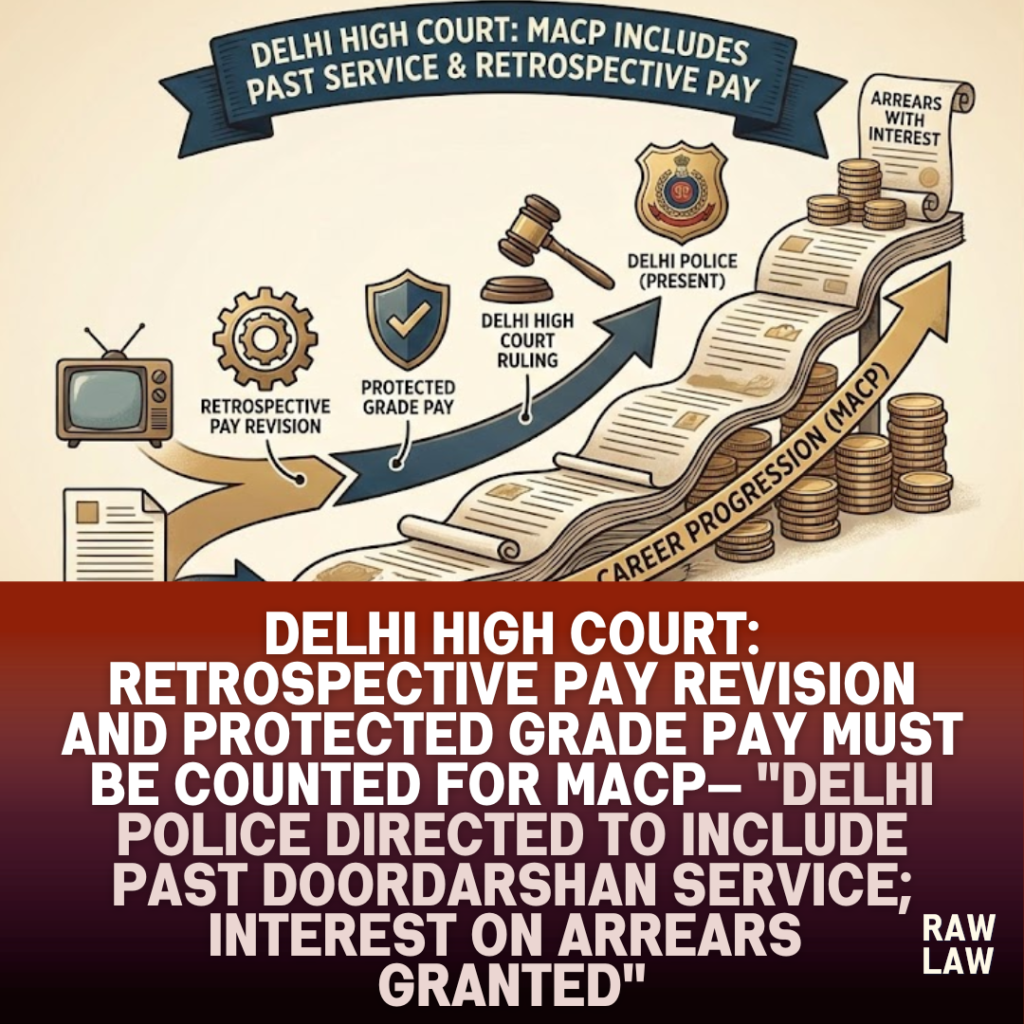
The Delhi High Court dismissed a writ petition filed by the Commissioner of Police and upheld the Central Administrative Tribunal’s direction to re-determine an officer’s pay and ACP/MACP benefits by including his past service rendered in Doordarshan from 16.06.1989 to 31.07.1991.
The Court held that once the employee’s pay was retrospectively revised and protected at the same grade pay in the new post, the past service could not be excluded for MACP computation. The authorities were directed to pass consequential orders within three months and pay arrears with interest at GPF rates from 11.02.2020.
Facts
The respondent was appointed as Engineering Assistant in the Ministry of Information & Broadcasting on 16.06.1989 and served till 31.07.1991. He thereafter tendered a technical resignation and joined Delhi Police as ASI (Radio Technician) on 01.08.1991.
Subsequently, the pay scale of Engineering Assistant was retrospectively revised with effect from 01.01.1986. The respondent’s pay was re-fixed at ₹2,120/- as on 01.06.1991 and arrears were paid.
Following litigation before the Tribunal in 2001, his pay in Delhi Police was re-fixed at ₹2,120/- with effect from 01.08.1991, thereby granting pay protection.
However, while granting ACP and later MACP benefits, Delhi Police counted service only from 01.08.1991, excluding the earlier two years of service. The Tribunal directed reconsideration, which was challenged before the High Court.
Issues
The principal issue was whether past service rendered in another government department, protected under Rule 26(2) of the CCS (Pension) Rules and accompanied by retrospective pay revision, must be counted for ACP/MACP benefits.
The Court also examined whether the respondent’s movement to Delhi Police constituted a shift from a lower to higher pay grade, thereby disentitling him from counting past service.
Petitioners’ arguments
The Delhi Police contended that the respondent joined in a higher pay scale in Delhi Police than his earlier post and, therefore, past service could not be counted for MACP benefits.
Reliance was placed on P.S. Rajput v. Union of India, where it was held that service in a lower grade cannot be counted after direct recruitment to a higher grade.
The petitioners argued that the Tribunal erred in directing reconsideration of ACP/MACP benefits.
Respondent’s arguments
The respondent submitted that his earlier pay scale had been retrospectively revised and upgraded. His last drawn pay in the previous post was ₹2,120/-, which was protected in Delhi Police.
It was contended that once pay protection was granted and the grade pay remained the same, the movement could not be treated as from a lower to higher grade.
Reliance was placed on Para 9 of the MACP Scheme and DoPT clarifications, which allow counting of past continuous regular service in another government department carrying the same grade pay.
The respondent also relied on earlier Tribunal orders granting continuity of service for all intents and purposes.
Analysis of the law
The Court examined Para 9 of the MACP Scheme, which provides that past continuous regular service in another government department in a post carrying the same grade pay shall be counted towards qualifying service for MACP.
It was undisputed that the respondent’s resignation was technical and that past service was preserved under Rule 26(2) of the CCS (Pension) Rules.
The Court held that once retrospective revision and pay protection resulted in the same effective pay, the movement could not be viewed as one from a lower to higher grade in substance.
The assessment under MACP must consider the actual pay structure as settled by the employer, not the pre-revision scale.
Precedent analysis
The Court distinguished P.S. Rajput v. Union of India, where the employee had clearly moved from a lower pay scale to a higher one through direct recruitment.
In contrast, the present case involved retrospective revision and protected pay, resulting in identical effective grade pay.
The Court relied on the coordinate bench judgment in Anil Kumar v. Jawaharlal Nehru University (2023:DHC:1994), where it was held that once grade pay is protected and equal in both posts, past service must be counted for MACP benefits.
The principle that authorities cannot approbate and reprobate after granting pay protection was reiterated.
Court’s reasoning
The Court noted that continuity of service stood protected and that the respondent’s pay in both posts was ₹2,120/- after revision and fixation.
Excluding the earlier service would effectively nullify the benefit of retrospective revision and pay protection already granted.
The Court held that MACP eligibility cannot be divorced from the finalised pay structure. Since both conditions under Para 9—continuity and same grade pay—were satisfied, past service must be counted.
The Tribunal’s direction was found legally sound and consistent with beneficial interpretation of financial upgradation schemes.
Conclusion
The writ petition was dismissed. The Delhi Police were directed to pass consequential orders within three months, include the respondent’s service from 16.06.1989 to 31.07.1991 for ACP/MACP benefits, and pay arrears with interest at GPF rates from 11.02.2020 until actual payment.
Implications
This judgment clarifies that:
- Retrospective pay revision and pay protection impact MACP eligibility.
- Past service preserved under Rule 26(2) cannot be ignored for financial upgradation.
- Authorities cannot deny MACP benefits after protecting identical grade pay.
- Beneficial service schemes must be interpreted pragmatically, not technically.
The ruling strengthens employees’ rights in cases of inter-departmental mobility with protected service continuity.
Case law references
- P.S. Rajput v. Union of India (2019 SCC OnLine Del 7081)
Held that service in a lower pay grade cannot be counted after direct recruitment to a higher grade; distinguished in present case. - Anil Kumar v. Jawaharlal Nehru University (2023:DHC:1994)
Held that where grade pay is protected and identical, past service must be counted for MACP benefits.
FAQs
1. Can past service in another government department be counted for MACP?
Yes, if it is continuous regular service and carries the same grade pay, as per Para 9 of the MACP Scheme.
2. Does technical resignation break continuity of service?
No. Under Rule 26(2) of CCS (Pension) Rules, past service is preserved.
3. Can authorities deny MACP after granting pay protection?
No. Once pay is retrospectively revised and protected at the same grade, past service must be considered.