Delhi High Court Reverses Acquittal in 1990 Sword-and-Knife Assault; Convicts Two for Attempted Murder but Limits Sentence to Period Already Undergone in Custody

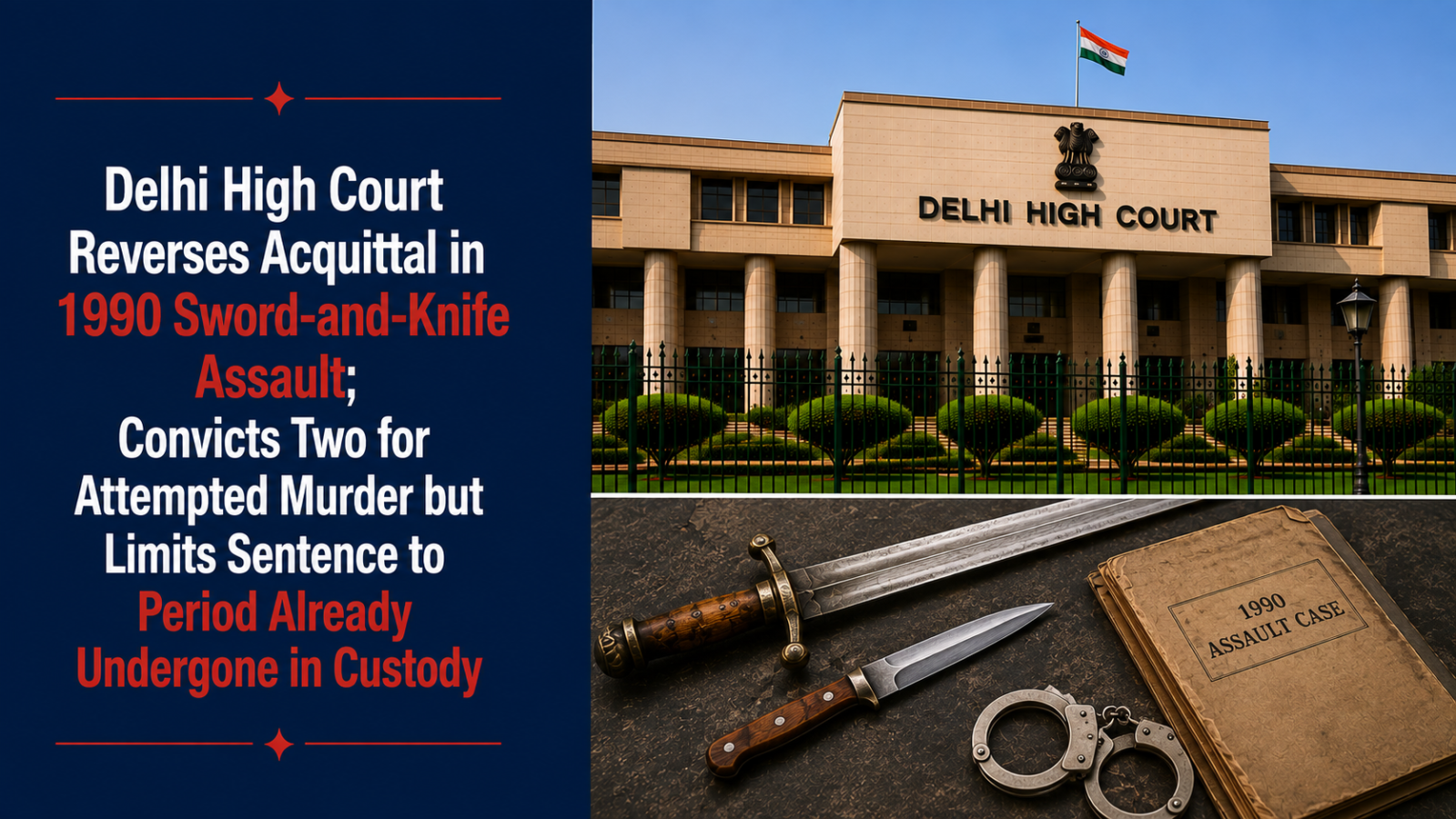
Delhi High Court Holds Fortuitous Escape From Head and Abdomen Blows Cannot Negate Section 307 Intent; Convicts Tikka Ram and Digamber
Facts
The State challenged the judgment dated 10 March 2000 by which the Trial Court had acquitted Tikka Ram and the other accused of charges under Sections 307/149 IPC, while Digamber had also been acquitted under Section 27 of the Arms Act. During the pendency of the State’s appeal, three respondents died and the proceedings against them abated.
The prosecution case arose from an incident dated 13 March 1990 at Sawan Park, Ashok Vihar. According to complainant Shahid Ali, the accused confronted his father Rahat Ali over a dispute concerning jhuggis and local leadership. Digamber was allegedly carrying a sword, Tikka Ram a knife, and the remaining accused lathis. Digamber allegedly aimed a sword blow at Rahat Ali’s head; Rahat Ali warded it off with his right hand and suffered an injury. Other persons who intervened were also allegedly assaulted.
The Trial Court acquitted the accused primarily because two independent witnesses did not support the prosecution, there were contradictions among the witnesses, and false implication arising from political rivalry could not be ruled out.
The Delhi High Court re-examined the evidence in the State’s appeal against acquittal.
Issues
The principal issues before the Court were:
- Whether the Trial Court’s acquittal was based on a proper appreciation of the evidence or suffered from perversity warranting appellate interference.
- Whether the testimonies of injured witnesses Rahat Ali, Shahid Ali, Mahesh and Satish Kumar were sufficiently reliable despite some independent witnesses turning hostile.
- Whether the medical evidence corroborated the specific roles attributed to Tikka Ram and Digamber.
- Whether non-recovery or doubtful recovery of the actual weapon of offence was fatal to the prosecution case.
- Whether the sword blow allegedly aimed at Rahat Ali’s head and the knife blow allegedly aimed at Mahesh’s abdomen established the requisite intention under Section 307 IPC, despite the blows ultimately landing on non-vital parts.
- What sentence should be imposed where the incident had occurred more than 36 years earlier and the respondents had already undergone substantial custody.
State’s Arguments
The State argued that the Trial Court had treated minor discrepancies as material contradictions and had failed to give proper weight to the testimony of injured witnesses.
It submitted that multiple victims had sustained injuries and that an injured witness’s testimony carries enhanced evidentiary value because his presence at the scene is ordinarily established by the injury itself.
The State specifically argued that Tikka Ram’s individual role had been ignored. Mahesh had suffered a sharp injury on the back of his leg, and the prosecution evidence attributed that injury to a knife attack by Tikka Ram. According to the State, the Trial Court failed to independently assess this evidence.
The State further relied upon the alleged recovery of a sword at Digamber’s instance and submitted that the ocular testimony was corroborated by the medical evidence.
Respondents’ Arguments
The respondents defended the acquittal by stressing inconsistencies between the prosecution witnesses.
They pointed out that the original version suggested that the accused held Rahat Ali while Digamber attacked him, whereas Rahat Ali spoke of being surrounded. They also relied upon Satish Kumar’s broader assertion that all accused assaulted Rahat Ali with their respective weapons, which appeared inconsistent with medical evidence recording only a single incised injury.
They argued that the recovery of the sword was unreliable because:
- it was not sent for forensic examination;
- no medical opinion connected it with the injury; and
- no reliable independent witness supported the recovery.
The respondents also relied upon previous political rivalry between the parties and contended that the prosecution had not revealed the true genesis of the occurrence.
Analysis of the Law
Scope of Appeal Against Acquittal
The High Court acknowledged that an appellate court must exercise caution before reversing an acquittal.
However, this restraint does not prevent interference where the Trial Court:
- ignores material evidence;
- draws conclusions inconsistent with the evidence; or
- records a finding that is perverse.
The Court therefore undertook a detailed reassessment of the injured witnesses and medical evidence.
Injured Witnesses Given Significant Evidentiary Weight
Rahat Ali, PW-4, gave a detailed account that Digamber aimed a sword blow at his head, which he warded off with his right hand. The High Court found his presence at the scene unquestionable because he was himself injured and taken to hospital.
The material aspects of his deposition had remained substantially unchallenged in cross-examination. The Court therefore found his testimony straightforward, cogent and trustworthy.
Shahid Ali, PW-7, substantially corroborated his father. He explained that although the sword was aimed at Rahat Ali’s head, the blow landed on his hand because he attempted to ward it off.
PW-7 further stated that Tikka Ram attempted to stab Mahesh in the abdomen, but Mahesh avoided the blow and it landed on the back of his leg.
Mahesh, PW-9, independently testified that Tikka Ram inflicted a knife blow on his right leg. His evidence matched the MLC, which recorded a simple injury caused by a sharp weapon. The High Court held that PW-7 and PW-9 were complementary rather than contradictory.
Medical Evidence Corroborated the Ocular Version
The MLC relating to Rahat Ali recorded an incised injury to his right hand, while medical evidence further showed a fracture, making the injury grievous.
The Court held that this medical evidence supported the account that Rahat Ali had used his hand to block a sword attack aimed towards his head.
Similarly, Mahesh’s injury was recorded as simple and caused by a sharp weapon, thereby supporting the allegation that Tikka Ram attacked him with a knife.
The High Court therefore concluded that the Trial Court had failed to appreciate important corroborative medical evidence.
Hostile Witness Did Not Destroy the Prosecution Case
The Court noted that PW-1 Leela Dhar had turned hostile.
However, it reiterated that the testimony of a hostile witness is not automatically wiped off the record. A court may rely upon portions found credible and corroborated by other evidence.
Leela Dhar admitted that he sustained a lathi injury in the same quarrel, and medical evidence showed a fracture of his right ulna. The Court therefore treated that part of his evidence as corroborative.
Precedent Analysis
Akhtar v. State of Uttaranchal
The High Court relied on this Supreme Court decision to reiterate that injured eyewitness testimony has considerable evidentiary value because the witness’s presence at the scene is generally beyond serious doubt.
Where such testimony is consistent and corroborated by medical evidence, it should not be discarded without compelling reasons.
State of M.P. v. Mansingh
The Court similarly relied upon Mansingh for the proposition that statements of injured witnesses possess greater evidentiary value and should not lightly be rejected.
Ambika Prasad v. State
The High Court relied upon this precedent while considering the failure to prove recovery of the actual weapon.
It held that non-recovery of the weapon of offence is not necessarily fatal where otherwise convincing ocular evidence clearly establishes the participation of the accused.
Roshan Lal v. State of Haryana
The Court referred to the Supreme Court’s 2026 decision explaining the intention required under Section 307 IPC.
The crucial inquiry is whether the accused possessed the intention contemplated by Section 300 IPC. The actual consequence—whether the injury is simple, grievous, fatal or even absent—is not determinative once the requisite intention and overt act are established.
Recovery of Sword Found Inconsequential
Interestingly, the High Court did not accept the prosecution’s reliance on the recovered sword.
It noted that:
- the sword was not sent to FSL;
- no blood examination connected it to the offence;
- it was not shown to the doctor for an opinion regarding compatibility with Rahat Ali’s injuries; and
- the injured witnesses did not identify it.
The Court therefore held that the prosecution had failed to prove that the recovered sword was the weapon actually used in the assault.
But that deficiency did not entitle the respondents to acquittal because the injured eyewitness evidence independently established their roles.
Section 307 IPC — Blow Need Not Actually Land on Vital Part
This was one of the important legal findings.
The Court held that Section 307 focuses on the intention and act of the accused, not merely the ultimate injury.
A single blow with a deadly weapon may constitute attempted murder depending on:
- the weapon used;
- the part of the body targeted;
- the manner and force of attack;
- the surrounding words and conduct; and
- the circumstances of the assault.
Here, Digamber allegedly aimed a sword at Rahat Ali’s head, while Tikka Ram allegedly aimed a knife at Mahesh’s abdomen.
The fact that Rahat Ali blocked the sword with his hand and Mahesh avoided the abdominal blow, causing the knife instead to hit his leg, was merely fortuitous.
The accused could not derive an advantage from the fact that the intended blows did not ultimately land on the targeted vital organs.
The Court therefore inferred the requisite intention for Section 307 IPC.
Court’s Reasoning
On cumulative appreciation, the High Court concluded that the Trial Court had placed disproportionate emphasis on discrepancies while failing to adequately assess the consistent core of the injured witnesses’ evidence.
The Court found it proved that:
- Digamber attacked Rahat Ali with a sword aimed at his head;
- Tikka Ram attacked Mahesh with a knife aimed at his abdomen;
- both injuries were independently supported by medical evidence; and
- the two respondents participated as part of a concerted assault.
Their acts were therefore referable to common intention under Section 34 IPC.
The Trial Court’s acquittal of Tikka Ram and Digamber was consequently held unsustainable.
The High Court convicted them for offences punishable under Sections 307/325/324/34 IPC.
Sentencing
Despite reversing the acquittal, the High Court declined to send the respondents back to prison.
Several exceptional circumstances influenced sentencing:
- the incident was more than 36 years old;
- the respondents were approximately 61 and 55 years old;
- both had already undergone more than two years’ incarceration during trial;
- they had no prior criminal antecedents;
- there was no evidence of subsequent criminal conduct;
- they appeared to have reformed and settled in life; and
- the complainant and respondents had entered into an amicable settlement dated 14 May 2026.
The Court invoked the reformative theory of punishment, relying upon Mohammad Giasuddin v. State of Andhra Pradesh, and held that no useful purpose would be served by re-incarcerating the respondents decades after the incident.
Conclusion
The Delhi High Court partly allowed the State’s challenge by setting aside the acquittal of Tikka Ram and Digamber and convicting them under Sections 307/325/324 read with Section 34 IPC.
However, considering the extraordinary passage of time, their age, earlier custody, absence of subsequent criminality, reform and settlement with the complainant, the Court sentenced both respondents only to the period already undergone in custody.
Each was additionally directed to pay a fine of ₹20,000, with six months’ rigorous imprisonment in default. Four weeks were granted to deposit the fine.
The State’s appeal was accordingly disposed of.
Key Ratio
An acquittal may be reversed where the Trial Court overlooks reliable injured-eyewitness testimony corroborated by medical evidence; and for Section 307 IPC, an accused cannot escape liability merely because a blow aimed at a vital part is fortuitously deflected to a non-vital part.
Case Details
Case: State v. Tikka Ram & Ors.
Court: High Court of Delhi at New Delhi
Case Number: CRL.A. 905/2004 & CRL.M.A. 84/2010
Judges: Justice Navin Chawla and Justice Ravinder Dudeja
Judgment by: Justice Ravinder Dudeja
Reserved on: 20 May 2026
Date: 19 August 2026
Result: Acquittal of Tikka Ram and Digamber set aside; both convicted under Sections 307/325/324/34 IPC and sentenced to imprisonment already undergone with ₹20,000 fine each.