


Headnote
Delhi Rent Control Act, 1958 – Sections 4, 6, 6A, 9, 50 – Code of Civil Procedure, 1908 – Order VII Rule 11(d) – Rejection of plaint – Recovery of rent – Market rent – Jurisdiction of civil court – Statutory vacuum.
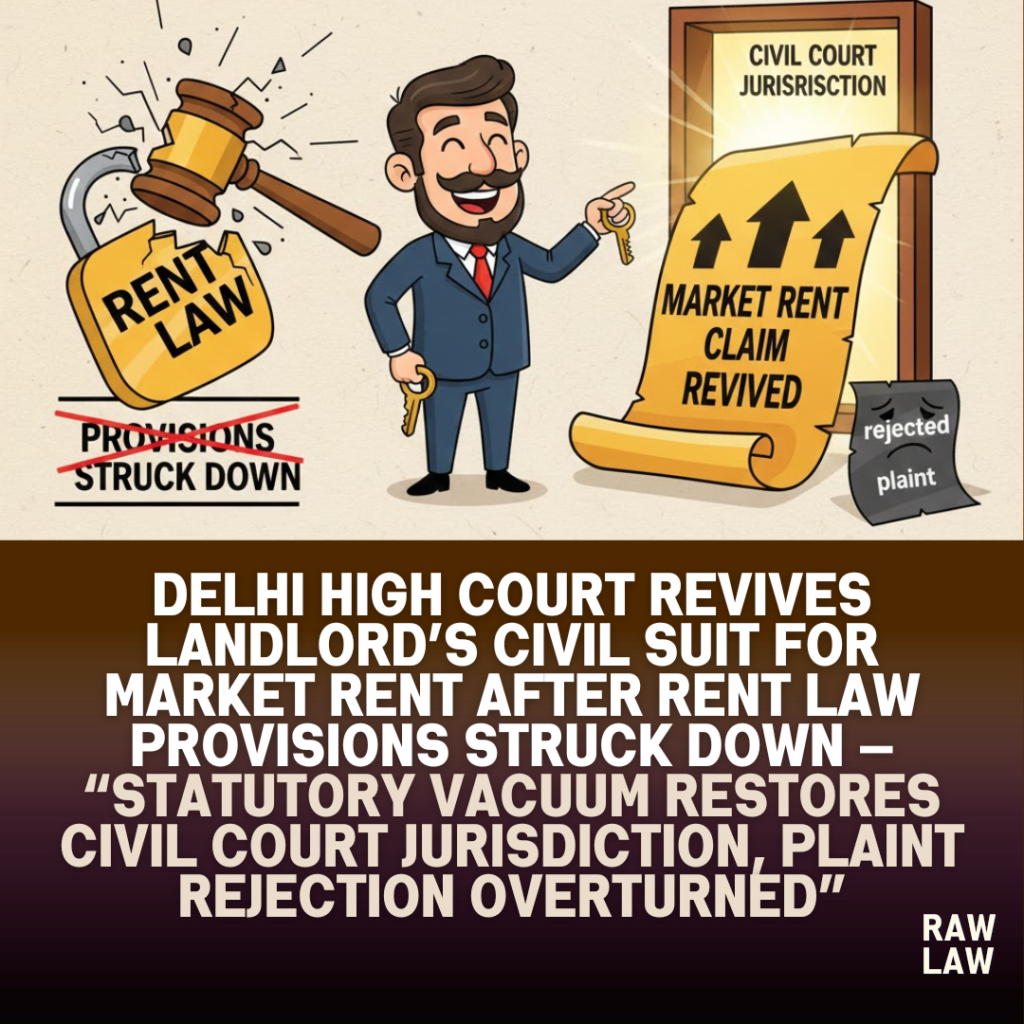
Held, where provisions governing fixation of standard rent and adjudicatory mechanism under the Delhi Rent Control Act have been struck down as unconstitutional, resulting in a statutory vacuum, the jurisdiction of civil courts to entertain suits for recovery of reasonable or market rent stands revived. Section 6A of the Act, which merely provides for periodic increase of agreed rent, does not supply a complete mechanism for determination or recovery of enhanced rent in the absence of Sections 6 and 9. In such circumstances, the bar under Section 50 of the Act is inapplicable. Rejection of a plaint at the threshold under Order VII Rule 11(d) CPC is permissible only where the suit is clearly barred on a plain reading of the plaint; disputed questions regarding entitlement to market rent require adjudication after trial. The rejection of the plaint was set aside and the suit restored.
Court’s decision
The Delhi High Court allowed the landlord’s appeal and set aside the order rejecting the plaint under Order VII Rule 11(d) CPC. The Division Bench held that the civil suit seeking recovery of market rent was maintainable and not barred by the Delhi Rent Control Act. The Court restored the suit to its original number and directed the parties to appear before the Single Judge for trial.
Facts
The appellant-landlord instituted two civil suits relating to commercial properties situated in Connaught Place, New Delhi, including premises in Atma Ram Mansion. The tenants had been occupying the properties for decades at extremely low rents fixed prior to the enactment of the Delhi Rent Control Act. Following the Division Bench judgment in Raghunandan Saran Ashok Saran (HUF) v. Union of India, which struck down Sections 4, 6 and 9 of the Act as unconstitutional, the landlord sought recovery of rent at prevailing market rates.
In one of the suits, the landlord claimed arrears and future rent at ₹10 lakh per month, asserting that the statutory mechanism governing standard rent no longer survived. The tenant opposed the suit, contending that rent revision and recovery fell exclusively within the jurisdiction of the Rent Controller under the Act.
Issues
The principal issue before the Court was whether a civil suit for recovery of market rent was barred under Section 50 of the Delhi Rent Control Act, and whether the plaint could be rejected at the threshold under Order VII Rule 11(d) CPC. Ancillary issues included the scope of Section 6A of the Act and the effect of striking down Sections 4, 6 and 9 on jurisdiction.
Appellant’s arguments
The landlord argued that rejection of the plaint was impermissible as the suit was not barred on a plain reading of the pleadings. It was contended that Section 6A only provides for a mechanical increase of agreed rent and does not empower any authority to determine reasonable or market rent, particularly after the striking down of Sections 6 and 9. The appellant submitted that a statutory vacuum had arisen, restoring plenary jurisdiction of civil courts to adjudicate claims for reasonable rent. Reliance was placed on principles governing exclusion of civil court jurisdiction and the decision in Raghunandan Saran.
Respondents’ arguments
The tenant contended that Section 50 of the Act barred civil court jurisdiction in all matters relating to rent, and that Section 6A continued to govern rent revision. It was argued that the landlord’s claim for market rent was merely an attempt to circumvent the rent control regime, and that any grievance ought to be pursued before the Rent Controller. The tenant supported the rejection of the plaint as barred by law.
Analysis of the law
The Court examined the scheme of the Delhi Rent Control Act in light of the provisions already struck down. It noted that “standard rent” as defined under the Act was intrinsically linked to Sections 6 and 9, both of which no longer survived. Section 6A, though still on the statute book, merely allows a percentage increase and does not provide a mechanism for computation, fixation, or recovery of enhanced rent.
The Court reiterated settled principles that exclusion of civil court jurisdiction is not to be readily inferred and arises only where the statute creates a complete code with an effective adjudicatory forum.
Precedent analysis
The Bench relied on Dhulabhai v. State of Madhya Pradesh to reaffirm that where statutory remedies are illusory or non-existent, civil court jurisdiction survives. The Court also relied on Raghunandan Saran Ashok Saran (HUF) v. Union of India, which created the statutory vacuum by striking down key rent-fixation provisions, thereby altering the jurisdictional landscape under the Act.
Court’s reasoning
Applying these principles, the Court held that the landlord had not sought eviction but only recovery of rent, a relief not exclusively vested in the Rent Controller. Whether the landlord was entitled to market rent or only to enhanced rent under Section 6A was a matter requiring evidence and adjudication, not summary rejection. The bar under Section 50 was therefore held inapplicable, and rejection of the plaint under Order VII Rule 11(d) was found to be erroneous.
Conclusion
The appeal was allowed, the impugned judgment rejecting the plaint was set aside, and the civil suit was restored for trial. The Court clarified that entitlement to market rent would be determined on merits after adjudication.
Implications
The judgment is significant for landlords of old commercial tenancies in Delhi. It clarifies that in the absence of a functioning rent-fixation mechanism under the Rent Control Act, civil courts retain jurisdiction to adjudicate claims for reasonable or market rent. The ruling also reinforces the narrow scope of plaint rejection under Order VII Rule 11 CPC and discourages premature dismissal of suits involving disputed legal and factual questions.
Case-law references
- Raghunandan Saran Ashok Saran (HUF) v. Union of India – Struck down key rent-fixation provisions of the DRC Act.
- Dhulabhai v. State of Madhya Pradesh – Principles governing exclusion of civil court jurisdiction.
FAQs
1. Can landlords file civil suits for market rent in Delhi?
Yes, where the statutory rent-fixation mechanism is absent, civil courts can entertain such suits.
2. Does Section 6A of the Delhi Rent Control Act bar civil suits?
No. Section 6A only provides for periodic increase and does not oust civil court jurisdiction.
3. When can a plaint be rejected under Order VII Rule 11 CPC?
Only when the suit is clearly barred by law on a plain reading of the plaint, without requiring trial.