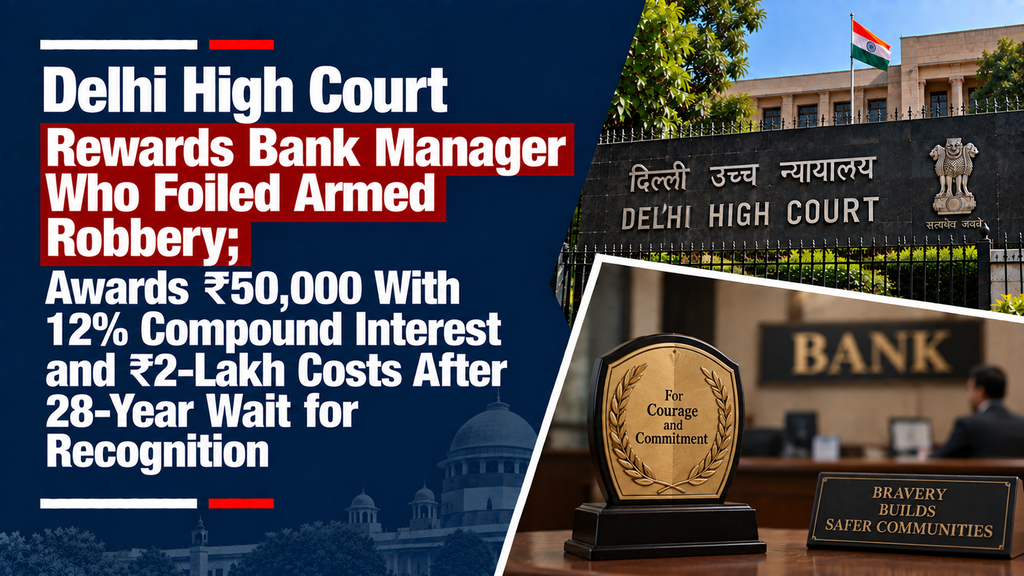
Delhi High Court Rewards Bank Manager Who Foiled Armed Robbery; Awards ₹50,000 With 12% Compound Interest and ₹2-Lakh Costs After 28-Year Wait for Recognition

Delhi High Court Says System Owes Apology to Bank Manager Who Risked Life During Robbery; Grants Compensation After 28-Year Fight
Facts
The petitioner, Surjit Singh, was serving as a Senior Manager (Scale III) with Punjab & Sind Bank and was posted at its Roshan Pura, Najafgarh Branch in 1998. He approached the Delhi High Court under Article 226 seeking benefits under the Government of India Guidelines dated 14 October 1991 concerning bank employees who actively resist robberies and terrorist attacks.
On 28 December 1998, five robbers armed with automatic weapons entered the branch. The two armed security guards surrendered their weapons, while the robbers began collecting approximately ₹40 lakh available at the branch.
Two robbers confronted the petitioner at gunpoint. Despite the threat to his life, he attempted to telephone for help and then pressed the emergency alarm. When the robbers attempted to escape with the cash, he pushed the door to obstruct them. Their bag became caught, the currency bundles spilled onto the floor, and they ultimately escaped with only ₹75,000.
His conduct was appreciated by police, media, bank officials and the officers’ union, and his superiors recommended him for an award and out-of-turn promotion. Despite repeated representations, the Bank rejected his claim on the ground that he had not “actively resisted” the robbery.
Issues
The principal issue was whether Surjit Singh’s conduct during the armed robbery constituted “active resistance” within Clause (vi) of the Government of India Guidelines dated 14 October 1991.
The Court also considered whether the Bank was justified in treating his actions as merely part of his ordinary managerial duties and consequently refusing the reward and other benefits contemplated by the Guidelines.
Petitioner’s Arguments
The petitioner contended that his actions went far beyond the ordinary responsibilities of a bank manager.
Despite two armed robbers pointing weapons at him, he attempted to summon assistance, pressed the emergency alarm and physically obstructed the robbers’ escape. His actions resulted in almost the entire amount of approximately ₹40 lakh being saved.
He relied upon the recommendations made by his senior officers and the All India Punjab & Sind Bank Officers’ Union and sought an award, out-of-turn promotion or compensation under the 1991 Guidelines, together with consequential benefits.
Respondents’ Arguments
Punjab & Sind Bank contended that the petitioner, being the branch manager, had overall administrative responsibility for the branch and was merely performing his duty when he pressed the alarm.
According to the Bank, his actions were what a reasonable and prudent manager would have done in those circumstances and therefore could not be characterised as extraordinary bravery.
The Bank further argued that the 1991 Guidelines were merely guidelines and that the petitioner did not satisfy the conditions for an out-of-turn promotion. Significantly, however, the factual account of the robbery and the fact that the robbers escaped with only ₹75,000 were not disputed.
Analysis of the Law
Clause (vi) of the Government Guidelines dated 14 October 1991 provides that bank employees and members of the public who actively resist bank robberies or terrorist attacks may be considered for a cash reward not exceeding ₹50,000.
In addition, an eligible bank employee may receive an out-of-turn promotion if the minimum eligibility requirements prescribed for direct recruits to the post are satisfied, without reference to length of service. Employees who do not satisfy that criterion may be granted three advance increments on a permanent basis.
The High Court held that pressing the emergency alarm in the circumstances of this case could not be dismissed as an ordinary or routine act. The petitioner did so while armed robbers had guns trained upon him and thereafter physically attempted to obstruct their escape.
Accordingly, his conduct squarely amounted to active resistance to the robbery within Clause (vi).
Precedent Analysis
The judgment was principally decided on the interpretation and application of the Government of India Guidelines dated 14 October 1991 to the undisputed factual circumstances.
The Court did not base its conclusion on a substantial line of judicial precedents. Instead, it examined whether the Bank’s own factual record demonstrated conduct falling within the express language and object of Clause (vi).
The decision therefore turns primarily on administrative fairness, faithful implementation of governmental guidelines, and the irrationality of characterising extraordinary conduct as routine official duty.
Court’s Reasoning
The Court strongly rejected the Bank’s attempt to characterise the petitioner’s actions as ordinary performance of duty.
It observed that the security guards themselves had surrendered their weapons and other bank officials had complied with the robbers’ demands. In contrast, the petitioner, despite guns being pointed at him, pressed the alarm and physically obstructed the fleeing robbers.
The Court described his conduct as demonstrating “presence of mind and unprecedented courage” and observed that resistance could easily have resulted in him being shot.
It held that calling such bravery merely part of his duty amounted to a trivialisation of extraordinary courage and was virtually an insult to someone who had put his life at risk.
The Court was particularly critical of the institutional delay. It noted that instead of recognising and rewarding the petitioner, the Bank and authorities had forced him to pursue his entitlement for approximately 28 years.
In unusually strong language, the Court observed that “the entire system who has failed the Petitioner needs to apologise to the petitioner”, and held that a meaningful apology required acknowledgment of the wrong together with reparation, restitution and compensation.
Conclusion
The Delhi High Court allowed the writ petition.
It awarded Surjit Singh ₹50,000 compensation under Clause (vi) of the 1991 Guidelines, together with interest at 12% compounded annually from 28 December 1998 until actual payment.
Additionally, the Court awarded ₹2 lakh as litigation costs.
Punjab & Sind Bank and the other respondents were directed to disburse the amounts within three months.
Importantly, although the original writ sought an out-of-turn promotion, the operative relief granted by the Court was ₹50,000 compensation with compound interest and ₹2 lakh costs; the judgment does not ultimately direct an out-of-turn promotion.
Case Details
Case: Surjit Singh v. Punjab & Sind Bank & Ors.
Court: Delhi High Court
Case Number: W.P.(C) 17556/2005
CNR: DLHC010664922005
Judge: Justice Neena Bansal Krishna
Reserved: 14 August 2026
Pronounced: 9 September 2026
Result: Writ petition allowed; ₹50,000 compensation with 12% compound annual interest from the 1998 robbery, plus ₹2 lakh litigation costs, payable within three months.