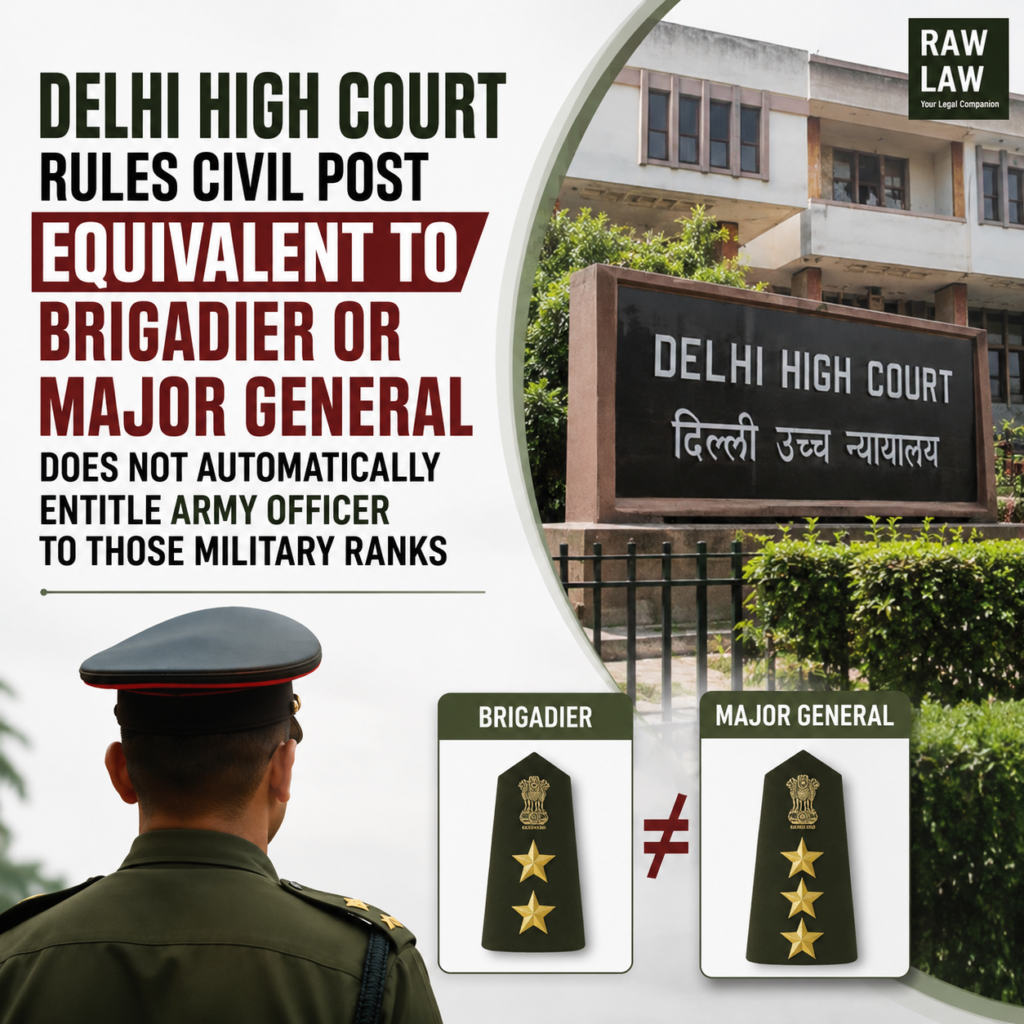
Delhi High Court Rules Civil Post Equivalent to Brigadier or Major General Does Not Automatically Entitle Army Officer to Those Military Ranks

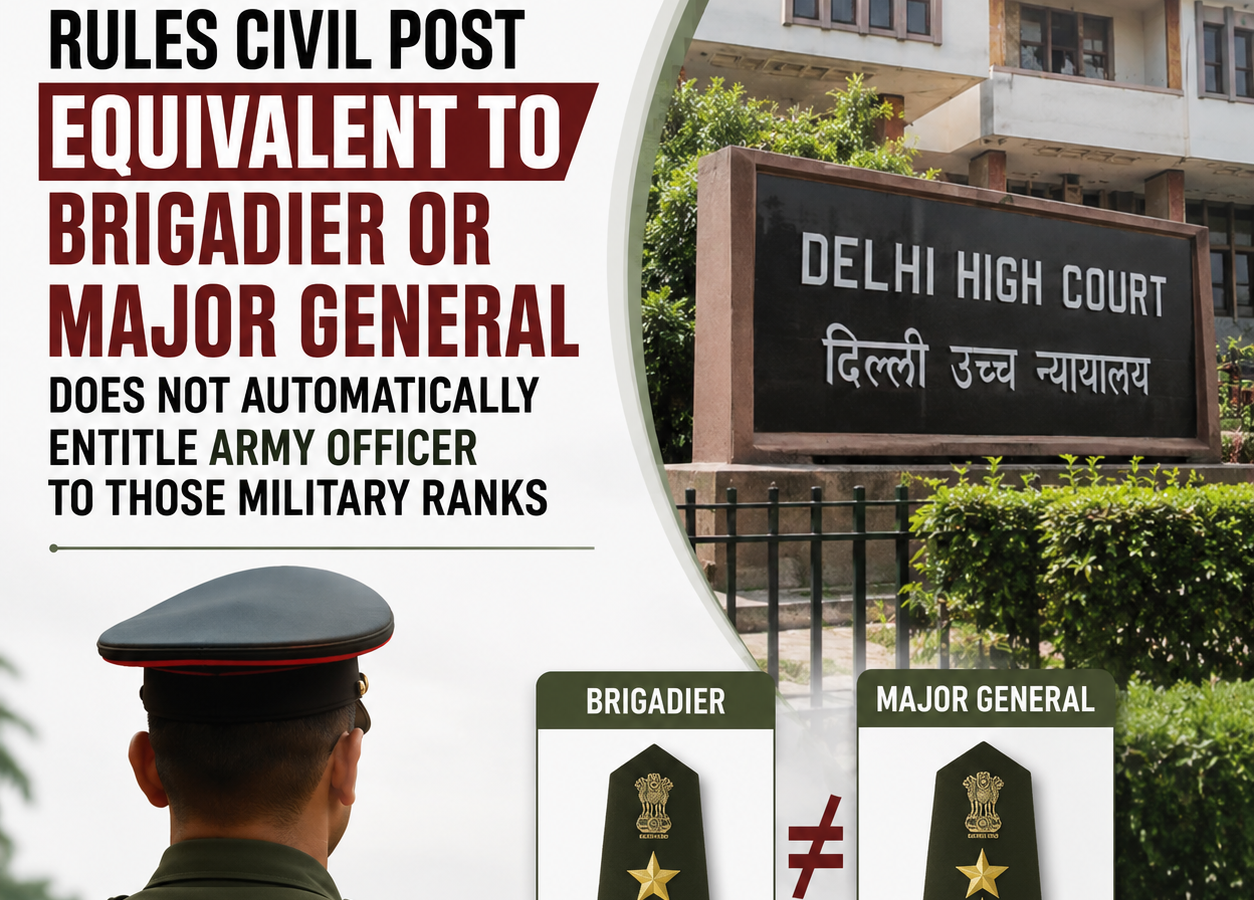
Delhi High Court Holds Civil Post Equivalence Does Not Automatically Confer Substantive Military Rank Without Satisfying Army Promotion and Medical Standards
Facts
Colonel Amardeep Singh was initially commissioned in the Corps of Engineers of the Indian Army. In April 2005, after selection through the Union Public Service Commission, he was permanently seconded to the Defence Stream of the Survey of India Group ‘A’ Service.
His service in the Survey of India was governed by the Survey of India (Group ‘A’) Service Rules, 1989. These Rules provide for an integrated service comprising Civil and Defence Streams and prescribe equivalence between specified civil posts and military ranks.
Under the equivalence framework:
- the post of Director in Level 13 corresponds to the rank of Brigadier, subject to completion of the prescribed commissioned service; and
- the post of Additional Surveyor General in Level 14 corresponds to the rank of Major General.
Colonel Amardeep Singh was promoted to the post of Director on 26 December 2012.
Thereafter, following the recommendation of the competent authorities and approval of the Appointments Committee of the Cabinet, he was promoted to the post of Additional Surveyor General in Level 14 with effect from 5 February 2020. The promotion was notified in the Gazette of India on 28 August 2020 in the name of the President of India.
He completed 23 years of commissioned service on 12 June 2020 and 25 years of commissioned service on 12 June 2022. He claimed that, on the basis of the equivalence prescribed under the 1989 Rules, he became entitled to the substantive military ranks of Brigadier and Major General respectively.
The Army authorities declined to confer these ranks on the ground that he was placed in a low medical category and did not satisfy the medical and promotional standards applicable to higher substantive military ranks.
His claim was reconsidered pursuant to an earlier order of the Delhi High Court. However, by a reasoned order dated 6 February 2023, the competent authority again rejected the claim after obtaining medical opinion.
Colonel Amardeep Singh challenged the rejection before the Armed Forces Tribunal. On 11 October 2023, the Tribunal allowed his application and directed the Union of India and the Army authorities to confer upon him the substantive ranks of Brigadier and Major General with retrospective seniority and consequential benefits.
The Union of India challenged the Tribunal’s order before the Delhi High Court.
Issues
- Whether promotion to a civil post in the Survey of India carrying equivalence with a higher military rank automatically entitles a Defence Stream Officer to the corresponding substantive Army rank.
- Whether the Survey of India (Group ‘A’) Service Rules, 1989 override the Army Regulations and promotion policies governing substantive military ranks.
- Whether a low medical category constitutes a relevant consideration while deciding eligibility for promotion to the ranks of Brigadier and Major General.
- Whether the Armed Forces Tribunal could direct conferment of substantive military ranks without requiring compliance with the applicable Army promotion and medical standards.
- Whether denial of the higher ranks amounted to discrimination because certain allegedly similarly placed officers had been reverted to the Army while holding higher substantive ranks.
Petitioner’s Arguments
The Union of India argued that equivalence between a civil post and a military rank does not result in automatic conferment of substantive military rank.
It submitted that promotion to the ranks of Brigadier and Major General is governed by:
- the Defence Service Regulations;
- applicable Military Secretary Branch policies;
- medical fitness standards;
- comparative suitability;
- batch-wise promotion requirements; and
- the cadre and command structure of the Army.
The petitioners relied on Paragraph 67 of the Defence Service Regulations, 1987, which requires assessment of overall suitability, including medical fitness, for substantive promotion.
It was argued that the 1989 Rules merely create equivalence for administrative and functional purposes within the Survey of India. They do not establish an independent military promotion channel or override Army promotion policies.
The Union further submitted that Defence Stream Officers are maintained in supernumerary posts outside the regular substantive cadre strength of Lieutenant Colonel and above. Granting higher substantive rank therefore has consequences for Army seniority, cadre management and promotion opportunities of regular officers.
Colonel Amardeep Singh belonged to the 1997 batch, whereas officers of the 1994 batch had only recently entered the zone of consideration for promotion to Major General. Granting him the rank ahead of seniors would disrupt batch-wise progression and the settled hierarchy.
It was also submitted that he had relied before the Tribunal upon a Government of India letter dated 24 February 1992, under which the military ranks of Defence Stream Officers were described as largely symbolic and the officers were maintained in supernumerary strength. Having sought the benefit of that framework, he could not reject the attached conditions concerning eligibility and medical standards.
The petitioners argued that courts and tribunals should ordinarily defer to specialised military authorities in matters of promotion, operational suitability and force structure.
Respondent’s Arguments
Colonel Amardeep Singh argued that after permanent secondment, his service conditions were governed by the statutory 1989 Rules framed under Article 309 of the Constitution.
He submitted that the Rules expressly equated the post of Director with Brigadier and the post of Additional Surveyor General with Major General.
His promotion to Additional Surveyor General had been approved by the Appointments Committee of the Cabinet and notified in the Gazette of India in the name of the President. According to him, internal Army policies could not dilute the legal effect of that promotion.
He contended that once a Defence Stream Officer:
- occupied the equivalent civil post; and
- completed the prescribed commissioned service,
the corresponding substantive military rank followed without a fresh Army selection process.
He argued that the 1989 Rules did not prescribe a separate medical fitness condition for the equivalent rank. Therefore, the Army authorities could not introduce such a condition through non-statutory administrative policies.
The respondent further submitted that Paragraph 67 of the Defence Service Regulations did not impose an absolute prohibition on promotion of an officer in SHAPE-2 medical category. It permitted promotion in exceptional cases depending upon suitability and functional employability.
Reliance was placed upon Union of India v. Brigadier Javed Iqbal to contend that SHAPE-2 medical categorisation does not, by itself, constitute an absolute bar to promotion.
It was also argued that similarly placed officers holding equivalent Level-14 posts had been reverted to the Army with higher substantive ranks, whereas the respondent was reverted as Colonel. This, according to him, amounted to discriminatory treatment.
Analysis of the Law
The High Court drew a distinction between:
- administrative equivalence of posts; and
- substantive promotion within the military hierarchy.
Equivalence between a Survey of India civil post and a military rank serves the purpose of organisational parity and functional coordination between the Civil and Defence Streams.
Substantive military rank, however, determines:
- command authority;
- operational responsibility;
- seniority;
- eligibility for military appointments;
- cadre placement; and
- integration into the Army hierarchy.
It therefore cannot be treated as a merely symbolic or ministerial consequence of appointment to an equivalent civil post.
The Court found that the 1989 Rules did not expressly provide that promotion to an equivalent civil post automatically results in conferment of the corresponding substantive military rank.
Nor did the Rules establish an independent channel for promotion to Brigadier or Major General outside the promotion system governing Army officers.
The Rules and the Army promotion framework were required to be harmoniously construed. The 1989 Rules governed civil appointments and equivalence within the Survey of India, while substantive military promotion continued to be governed by Army Regulations and promotion policies.
The Court held that medical fitness is a legitimate and material component of military promotability. Although SHAPE-2 may not be an absolute bar in every case, the competent Army authorities retain discretion to assess whether the officer satisfies the prescribed standards.
An officer holding higher substantive rank may be deployed across the full spectrum of responsibilities attached to that rank. Medical fitness therefore cannot be confined merely to suitability for the officer’s current civil or administrative assignment.
Precedent Analysis
Union of India v. Brigadier Javed Iqbal
The respondent relied upon this decision to argue that an officer in SHAPE-2 medical category could not automatically be denied promotion.
The Delhi High Court held that the precedent did not establish that medical requirements and selection standards become irrelevant.
The decision only recognised that SHAPE-2 may not operate as an absolute bar where promotion is otherwise permissible under the applicable rules.
In the present case, the dispute concerned whether the respondent possessed an enforceable entitlement to substantive rank despite not satisfying the Army’s promotional requirements. The precedent therefore did not support automatic conferment of rank.
Principles of Judicial Review in Military Matters
The Court reiterated that judicial review in military service matters is supervisory.
Courts may interfere where a decision is:
- arbitrary;
- mala fide;
- perverse;
- contrary to statutory provisions; or
- based on a misinterpretation of the governing regulations.
However, courts should not substitute their assessment for that of specialised military authorities regarding:
- medical fitness;
- operational suitability;
- promotion standards;
- cadre management; and
- force structure.
Court’s Reasoning
The High Court found that the Tribunal had incorrectly assumed that promotion to a civil post under the 1989 Rules necessarily carried an entitlement to the equivalent substantive military rank.
The 1989 Rules recognised equivalence but did not state that military promotion was automatic.
The Court observed that the respondent’s case had been reconsidered by the Military Secretary Branch pursuant to earlier judicial directions. The competent authority obtained medical opinion and passed a reasoned order dated 6 February 2023 holding that he did not satisfy the requirements for promotion to Brigadier.
The Tribunal failed to adequately consider the Military Secretary Branch policy letters dated 14 December 2012 and 31 March 2015 concerning medical categorisation, promotability and eligibility for promotion to select ranks of Colonel and above.
The question whether relaxation could be granted despite a low medical category fell within the domain of the competent Army authorities. The Tribunal could not bypass that assessment by directly ordering promotion.
The Court further noted that Defence Stream Officers occupied supernumerary positions distinct from the regular promotional cadre. Conferment of substantive rank could affect seniority and promotion opportunities of officers who were not parties to the proceedings.
The respondent belonged to the 1997 batch. Granting him the rank of Major General when officers of the 1994 batch had only recently entered the relevant promotion zone would disturb the batch-wise hierarchy.
The discrimination argument was also rejected. Different outcomes concerning other officers did not establish hostile discrimination without proof that they were identically situated in terms of:
- medical eligibility;
- service record;
- promotional assessment;
- batch seniority; and
- applicable policy.
Article 14 does not permit a claim based on negative equality.
The Court also held that the respondent could not rely upon the 1992 policy to claim the benefit of symbolic or supernumerary military rank while simultaneously rejecting the eligibility conditions attached to that framework.
No arbitrariness, perversity or illegality was found in the Army’s reasoned decision declining the ranks.
Conclusion
The Delhi High Court held that promotion to a civil post in the Survey of India carrying equivalence with Brigadier or Major General does not automatically confer the corresponding substantive military rank.
Substantive military promotion remains governed by the Army’s independent regulatory and policy framework, including:
- medical eligibility;
- suitability assessment;
- selection requirements;
- cadre management; and
- batch-wise seniority.
The Armed Forces Tribunal erred in treating civil equivalence as an enforceable right to military promotion and in bypassing the assessment of the competent Army authorities.
The Tribunal’s order directing conferment of the ranks of Brigadier and Major General was set aside.
The Court clarified that:
- the competent military authorities may reconsider the respondent’s case in the future if he becomes eligible or circumstances change; and
- the judgment would not reduce the pay or financial benefits otherwise admissible to him by virtue of the civil post held in the Survey of India.
Case: Union of India and Others v. Colonel Amardeep Singh
Court: Delhi High Court
Case Number: W.P. (C) No. 2531 of 2024 with CM Applications Nos. 10355 of 2024, 10356 of 2024 and 33565 of 2024
Judge: Justice Anil Kshetrapal and Justice Amit Mahajan
Date: 1 July 2026
Result: Writ petition allowed; Armed Forces Tribunal’s direction granting retrospective substantive ranks of Brigadier and Major General set aside.