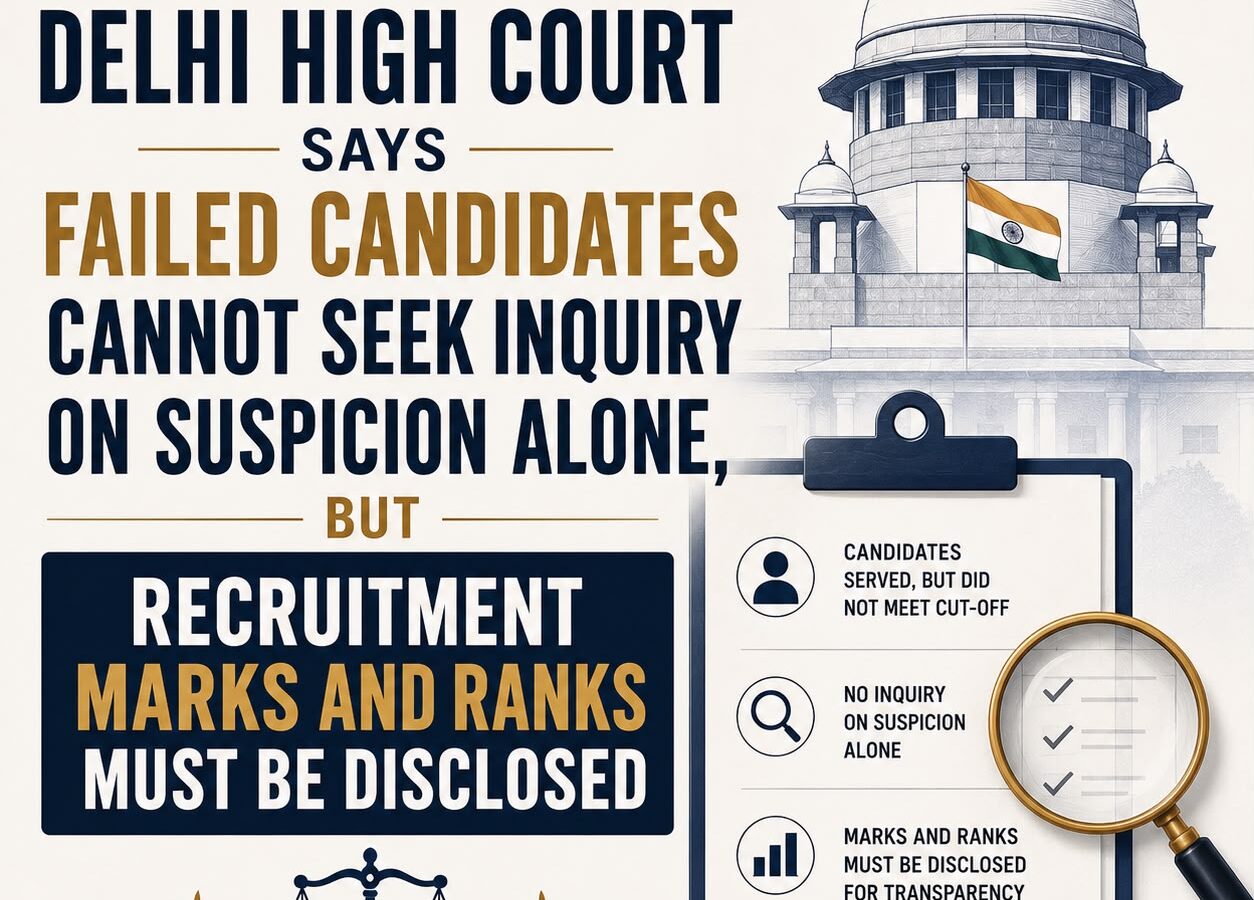
Delhi High Court Says Failed Candidates Cannot Seek Inquiry on Suspicion Alone, But Recruitment Marks and Ranks Must Be Disclosed

Court Declines Inquiry Into Alleged EWS Certificate Irregularities After Finding Petitioners Were Rejected for Scoring Below the Prescribed Cut-Off
The Delhi High Court has directed the Sashastra Seema Bal to disclose the marks and ranks secured by three candidates in the 2020 recruitment process for constable posts, along with the marks obtained by candidates selected under the Economically Weaker Section category.
A Division Bench comprising Justice V. Kameswar Rao and Justice Manmeet Pritam Singh Arora directed the SSB to complete the disclosure within four weeks.
The Court, however, declined to order an inquiry into allegations that certain selected candidates had submitted invalid or belated EWS certificates. It found that the petitioners themselves had been considered under the EWS category but were not selected because their marks were below the applicable cut-offs.
Background
The Sashastra Seema Bal issued an advertisement on 28 July 2020 for recruitment to Group C constable posts in different trades, including cook, driver and water carrier.
The selection process comprised:
- Physical Standard and Physical Efficiency Tests;
- written examination or Common Entrance Test;
- document verification and trade or skill test; and
- medical and review medical examination.
The three petitioners applied under the EWS category for the posts of Constable (Cook), Constable (Driver) and Constable (Water Carrier), respectively.
They qualified the physical tests, written examination, document verification, trade test and medical examination. However, the SSB did not disclose their marks at the intermediate stages of the recruitment process.
When the final EWS result was declared in January 2024, none of the petitioners was selected.
Candidates Seek Disclosure of Marks
The petitioners approached the High Court seeking disclosure of:
- their marks and ranks in the written examination;
- their marks in the skill or trade test;
- the marks obtained by the last selected EWS candidates; and
- the category-wise cut-off marks.
They argued that non-disclosure of marks prevented them from understanding their position in the merit list and assessing whether the selection process had been conducted fairly.
The petitioners relied on government instructions requiring recruitment bodies to publish the scores and ranks of candidates and retain such information on their websites for a specified period.
They also alleged that some selected candidates had been permitted to submit fresh or corrected EWS certificates long after the deadline prescribed in the recruitment advertisement.
Allegations Concerning EWS Certificates
The advertisement required EWS candidates to possess an Income and Asset Certificate based on income for the financial year preceding the year of application.
For the recruitment in question, the relevant income period was the financial year 2019-20, with the certificate remaining valid for 2020-21.
During scrutiny, the SSB found that the certificates submitted by several candidates did not conform to the prescribed financial year or format.
The authorities therefore granted affected candidates an opportunity to submit compliant certificates in December 2023 and January 2024.
Two of the three petitioners also submitted fresh EWS certificates after being asked to do so. Their revised certificates were accepted, while the certificate of the third petitioner had already been found valid.
The petitioners nevertheless alleged that certain selected candidates had produced certificates issued much later than the original application deadline and should have been disqualified.
They contended that allowing fresh certificates years after the cut-off date amounted to changing the rules of the selection process midway.
SSB Says Petitioners Fell Below Cut-Off
The SSB informed the Court that all three petitioners had been considered under the EWS category after verification of their certificates.
Their non-selection was not attributable to any defect in their EWS documents but to their marks.
The position disclosed before the Court was:
- Constable (Cook): The petitioner secured 68 marks against an EWS cut-off of 71 marks.
- Constable (Driver): The petitioner secured 60 marks against an EWS cut-off of 61 marks.
- Constable (Water Carrier): The petitioner secured the written cut-off of 65 marks but obtained 31 marks in the trade test against the required 33 marks.
The third petitioner was placed first in the non-selected list for the post of Water Carrier but still failed to meet the trade-test cut-off.
The SSB further stated that the candidates whose EWS certificates were questioned by the petitioners had secured marks above the relevant cut-offs and were selected after their documents were scrutinised by a Board of Officers.
Disclosure of Marks Directed
The High Court observed that the principal relief sought by the petitioners was disclosure of their marks and ranks and the marks obtained by selected candidates.
The Court found this request justified.
It accordingly directed the SSB to declare:
- the marks and ranks obtained by each petitioner for the post applied for;
- their position in the EWS category; and
- the marks obtained by selected candidates for the posts of Constable (Cook), Constable (Driver) and Constable (Water Carrier).
The exercise was directed to be completed within four weeks from receipt of the judgment.
The Court also granted the petitioners liberty to pursue any further remedy available in law after examining the disclosed information.
No Grounds to Order Further Inquiry
The Court refused to direct an inquiry into the alleged irregularities concerning the EWS certificates.
It noted that two petitioners had themselves been permitted to submit fresh certificates, which were accepted by the SSB.
All three petitioners were thereafter considered on merit, but failed to secure the required marks.
The Court held that the petitioners had not placed any compelling material on record warranting a judicially ordered investigation into the recruitment process.
It also noted that the petitioners had not sought a direct order for their appointment to the respective posts. Their prayers were primarily confined to disclosure of marks and examination of the alleged certificate irregularities.
Supreme Court Rulings on EWS Certificates Distinguished
The petitioners relied on Supreme Court decisions holding that a candidate claiming EWS reservation must possess a valid Income and Asset Certificate for the relevant financial year by the prescribed cut-off date.
Those decisions also held that a certificate relating to a different financial year goes to the root of eligibility and cannot ordinarily be corrected after the deadline.
The High Court held that those rulings did not decide the present case because the petitioners’ candidature had not been rejected due to defective EWS certificates.
Their certificates had been accepted and they were considered under the reserved category. They were unsuccessful solely because they scored below the required cut-offs.
The Court therefore did not adjudicate upon the broader legality of permitting candidates to submit corrected EWS certificates after the original deadline.
Candidate Cannot Challenge Selection Conditions After Participating
The petitioners also sought to question aspects of the selection criteria and the failure to prescribe or publish minimum qualifying marks in the recruitment advertisement.
The Court rejected this argument as belated.
It reiterated the settled principle that a candidate who knowingly participates in a selection process under the prescribed conditions cannot subsequently challenge those conditions after being unsuccessful.
Participation without objection ordinarily results in acquiescence and waiver.
Decision
The Delhi High Court disposed of the petition by directing the SSB to disclose the petitioners’ marks and ranks and the marks obtained by the selected EWS candidates within four weeks.
The Court declined to:
- order an inquiry into the alleged irregularities concerning EWS certificates;
- interfere with the final selection list; or
- grant any appointment-related relief to the petitioners.
The petitioners were granted liberty to seek an appropriate legal remedy if any surviving grievance emerged after the disclosure of the recruitment data.
Key Legal Principle
Candidates participating in public recruitment are entitled to transparency regarding their marks, ranks and the applicable selection cut-offs.
However, a court will not order an inquiry into alleged recruitment irregularities merely on suspicion, particularly where the petitioners were duly considered and were unsuccessful because they scored below the prescribed cut-offs.
A candidate who participates in a selection process with knowledge of its conditions is also ordinarily barred from challenging those conditions after the result.
Why the Judgment Matters
The ruling reinforces transparency in public recruitment while maintaining judicial restraint in reviewing selection processes.
Recruitment authorities should disclose sufficient information to enable candidates to understand their merit position and verify whether the selection has been conducted according to the declared criteria.
At the same time, non-selection does not automatically establish arbitrariness. Candidates alleging irregularities must place specific and compelling material before the Court, particularly when their own marks fall below the selection threshold.
Case: Saket Kumar Sonu and Others v. Sashastra Seema Bal and Another
Court: High Court of Delhi
Case Number: W.P.(C) 3500/2024
Bench: Justice V. Kameswar Rao and Justice Manmeet Pritam Singh Arora
Date of Judgment: 19 June 2026
Result: Petition disposed of with directions to disclose marks and ranks within four weeks

READ ALSO: Temporary Job Does Not Become Permanent Merely Because It Was Extended for Years: Delhi High Court