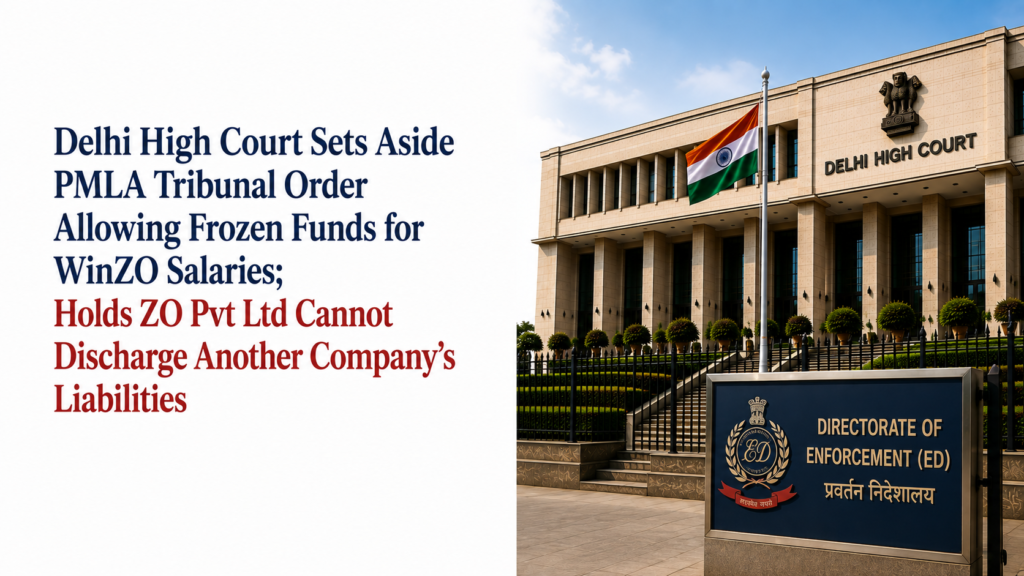
Delhi High Court Sets Aside PMLA Tribunal Order Allowing Frozen Funds for WinZO Salaries; Holds ZO Pvt Ltd Cannot Discharge Another Company’s Liabilities

Delhi High Court Sets Aside PMLA Interim Order for Salaries and Statutory Dues; Tribunal to Decide Main Appeal Without Being Influenced by Observations
Facts
The Delhi High Court considered an appeal filed by the Deputy Director, Directorate of Enforcement under Section 42 of the Prevention of Money Laundering Act, 2002 against an interim order dated 31 July 2026 passed by the Appellate Tribunal under SAFEMA in proceedings concerning M/s ZO Pvt. Ltd. The judgment was delivered on 14 August 2026.
The Appellate Tribunal had permitted limited use of funds lying in a bank account frozen by the Enforcement Directorate. It directed ZO Pvt. Ltd. to furnish details of outstanding employee salaries for FY 2025-26 and statutory dues, required ED to verify them, and thereafter directed the banks to enable payment of verified amounts.
The crucial factual feature was that the salaries and statutory dues sought to be paid were not liabilities of ZO Pvt. Ltd. itself. They related to M/s WinZO Games Private Limited, described by ED as the primary accused.
ED therefore challenged the Tribunal’s interim order before the Delhi High Court.
Issues
The principal issues before the High Court were:
- Whether the PMLA Appellate Tribunal could permit funds alleged by ED to constitute proceeds of crime to be utilised for payment of another company’s liabilities.
- Whether the fact that the proposed payments related to salaries and statutory dues justified such interim relief on equitable considerations.
- Whether the Tribunal was justified in relying upon a similar earlier arrangement directed by the Karnataka High Court.
- What effect had to be given to the fact that the Supreme Court had already set aside that earlier Karnataka High Court direction.
- Whether the interim order should remain operative pending final adjudication of ZO Pvt. Ltd.’s appeal before the Tribunal.
Appellant’s Arguments
The Enforcement Directorate argued that the Tribunal had committed an error in allowing funds which ED alleged were proceeds of crime to be utilised for discharging liabilities which did not belong to ZO Pvt. Ltd. at all.
According to ED, the salaries and statutory dues were liabilities of WinZO Games Private Limited, the primary accused.
ED also relied upon earlier proceedings before the Karnataka High Court.
A similar direction permitting use of the frozen funds had initially been passed by the Karnataka High Court in W.P. No. 962/2026 and affirmed by its Division Bench in W.A. No. 492/2026.
However, the Supreme Court subsequently set aside that direction by order dated 15 May 2026 in SLP (C) No. 12671/2026, Directorate of Enforcement v. M/s ZO Private Limited.
ED therefore contended that the Tribunal erred in essentially recreating an interim arrangement which had already been set aside by the Supreme Court.
Respondent’s Arguments
Senior counsel appearing for ZO Pvt. Ltd. argued that the Tribunal had properly balanced the equities.
It was submitted that the proposed use of funds was narrowly restricted to:
- unpaid salaries of WinZO employees; and
- statutory dues payable by WinZO Games Private Limited.
The respondent further contended that WinZO had advanced a loan to ZO Pvt. Ltd., and there was an understanding that the money would be used for payment of WinZO’s salaries and statutory obligations.
It was therefore argued that permitting such payments would not prejudice ED and would merely ensure that employees and governmental dues were protected pending adjudication.
Analysis of the Law
Frozen Funds Were Alleged to Be Proceeds of Crime
The High Court attached significance to the character of the funds from ED’s perspective.
ED’s case was that ZO Pvt. Ltd. was in possession of proceeds of crime, that the account had consequently been frozen, and that the freezing action had been affirmed by the Adjudicating Authority.
At the interim stage, the Court did not decide whether the money was ultimately proved to be proceeds of crime.
However, that allegation and the subsisting freeze could not simply be disregarded while balancing interim equities.
Liability Was Not That of ZO Pvt. Ltd.
The decisive consideration was that the proposed expenditure did not relate to ZO Pvt. Ltd.’s own liabilities.
The salary and statutory obligations belonged to WinZO Games Private Limited.
The Court specifically noted that WinZO was stated by ED to be the primary accused.
Accordingly, the Court was not persuaded that funds frozen in ZO Pvt. Ltd.’s account should presently be released merely because another company owed money to its employees or to the Government.
Salary Claims Did Not Automatically Override the Freeze
The respondent sought to present the Tribunal’s order as a limited humanitarian and equitable arrangement because it dealt only with employee salaries and statutory liabilities.
The High Court nevertheless declined to accept that submission at the interim stage.
The nature of the expenditure alone did not answer the fundamental objection that the money being used was frozen under the PMLA and the liabilities being discharged were those of another entity.
Thus, employee salary claims did not, by themselves, justify diversion of disputed frozen assets.
Earlier Karnataka High Court Relief Had Been Set Aside by Supreme Court
The Tribunal’s interim arrangement was broadly aligned with relief earlier granted by the Karnataka High Court.
That history was important.
The Karnataka High Court had permitted a similar use of the funds, and its Division Bench had affirmed the direction.
However, the Supreme Court set aside those directions on 15 May 2026.
ED argued that the Tribunal could not subsequently recreate materially similar interim relief.
Although the Delhi High Court’s brief judgment does not undertake an extended doctrinal analysis of the Supreme Court order, the prior procedural history materially reinforced its conclusion that the Tribunal’s interim direction could not stand.
Interim Order Set Aside by Consent
After hearing the parties, the Court recorded that it was not inclined to accept the respondent’s submission supporting continuation of the interim arrangement.
The Court then set aside the Tribunal’s interim order with the consent of learned Senior Counsel for the respondent.
This is important: the High Court did not finally adjudicate the entire substantive PMLA controversy.
Its order was directed specifically against the interim dispensation permitting release/utilisation of frozen funds.
Main PMLA Appeal Left Open
The High Court expressly protected the merits of the pending proceedings.
It directed the Appellate Tribunal to decide ZO Pvt. Ltd.’s substantive appeal as expeditiously as possible, preferably within two months.
The Court further clarified that its observations in the present appeal would not influence the Tribunal’s adjudication on merits.
Accordingly, questions such as whether the funds actually constituted proceeds of crime and whether the freezing action was ultimately sustainable remained open.
Precedent Analysis
The four-page judgment does not undertake a detailed precedent survey.
The only earlier judicial proceedings materially discussed were the connected litigation involving the same respondent:
Karnataka High Court Proceedings
The Karnataka High Court had earlier directed a similar arrangement permitting use of funds for salaries and statutory dues in W.P. No. 962/2026.
That direction was affirmed in W.A. No. 492/2026.
Supreme Court — Directorate of Enforcement v. M/s ZO Private Limited
The Supreme Court subsequently set aside the Karnataka High Court arrangement by order dated 15 May 2026 in SLP (C) No. 12671/2026.
This procedural history was specifically relied upon by ED while challenging the Tribunal’s attempt to grant substantially similar interim relief.
Court’s Reasoning
The High Court’s reasoning was narrow and interim in character.
The Court proceeded on three central considerations.
First, ED claimed that the funds in ZO Pvt. Ltd.’s account represented proceeds of crime and the freeze had already been affirmed by the Adjudicating Authority.
Second, the expenditure permitted by the Tribunal related not to ZO Pvt. Ltd.’s own liabilities but to the salaries and statutory obligations of WinZO Games Private Limited.
Third, a materially similar interim arrangement previously granted by the Karnataka High Court had already been set aside by the Supreme Court.
In these circumstances, the Court found no sufficient basis to allow the frozen account to be utilised pending final adjudication.
Conclusion
The Delhi High Court set aside the PMLA Appellate Tribunal’s interim order dated 31 July 2026 which had permitted use of the frozen funds for payment of WinZO Games Private Limited’s outstanding employee salaries and statutory dues.
At the same time, the High Court did not decide the substantive merits of the underlying PMLA dispute.
The Appellate Tribunal was directed to dispose of ZO Pvt. Ltd.’s appeal preferably within two months, independently and without being influenced by the High Court’s interim observations.
The ED’s appeal was accordingly allowed, with no order as to costs.
Case Details
Case: The Deputy Director, Directorate of Enforcement v. M/s ZO Pvt. Ltd.
Court: Delhi High Court
Case Number: MISC. APPEAL (PMLA) 112/2026; CNR No. DLHC010377522026
Judges: Justice Navin Chawla and Justice Ravinder Dudeja
Date: 14 August 2026
Result: ED appeal allowed; Tribunal’s interim order permitting frozen funds to be used for WinZO salaries and statutory dues set aside; main appeal directed to be decided preferably within two months.