


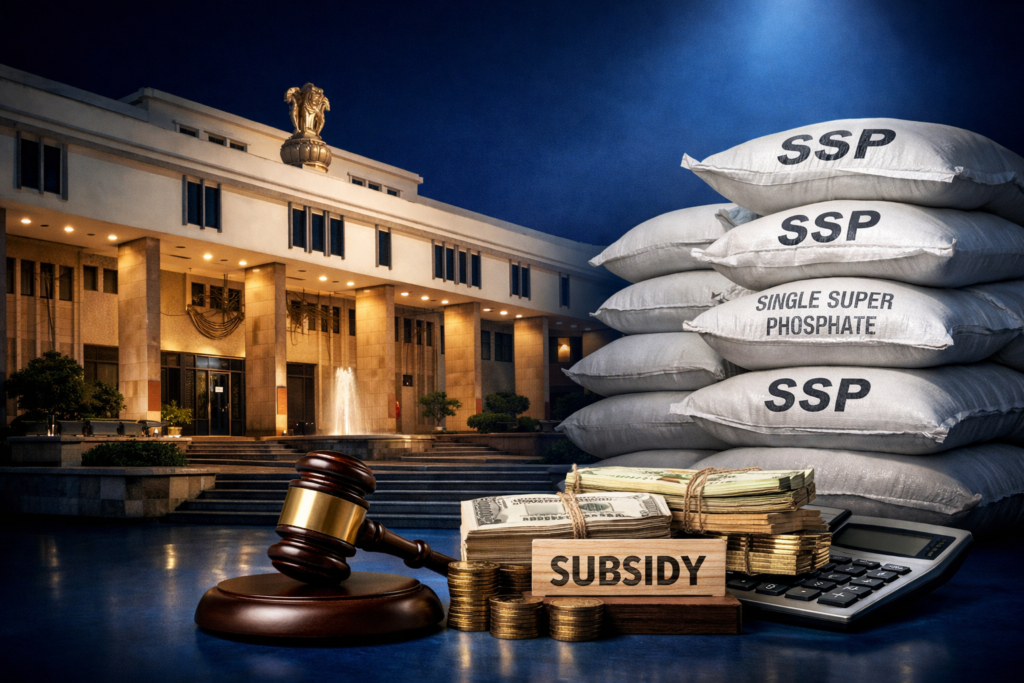
Court’s decision
The Delhi High Court set aside the communication dated 24.07.2024 and the accompanying “Oral Hearing Report” whereby M/s Sai Fertilizers Pvt. Ltd. had been continued outside the Nutrient Based Subsidy (NBS) Scheme.
Justice Sachin Datta held that the post-hearing exercise suffered from serious procedural infirmities, including an unsigned hearing report and reliance on grounds beyond the show cause notice. The Court directed the Department of Fertilizers to undertake a fresh determination regarding the petitioner’s entitlement to subsidy for the period 13.03.2024 to 09.09.2024 .
Facts
The petitioner, an MSME manufacturing Single Super Phosphate (SSP), was registered under the Fertilizer Control Order, 1985 and inducted into the NBS Scheme. Following an inspection in December 2023, a show cause notice dated 03.01.2024 was issued.
On 23.02.2024, even before expiry of response time, the petitioner was removed from the NBS Scheme. This was kept in abeyance by earlier court orders.
Subsequently, an order dated 13.03.2024 again removed the petitioner from NBS. This order was set aside on 10.05.2024 with directions for oral hearing before a neutral officer.
An “Oral Hearing Report” dated 24.07.2024 upheld the earlier removal, prompting the present writ petitions .
Issues
The Court examined:
- Whether the “Oral Hearing Report” complied with principles of natural justice.
- Whether removal from the NBS Scheme was proportionate under applicable guidelines.
- Whether action was taken beyond the scope of the show cause notice.
- Whether subsidy for the intervening period could be denied despite procedural defects.
Petitioner’s arguments
The petitioner contended that the order dated 13.03.2024 had been expressly set aside, yet the unsigned hearing report purported to “uphold” it. The report bore no name, signature, or designation of the decision-maker.
It was argued that additional submissions were obtained from the Department after conclusion of hearing without notice to the petitioner.
The petitioner further relied on the Department’s own circular dated 08.06.2023 prescribing a graded penalty regime, under which first violation attracted only recovery of subsidy equivalent to one day’s production capacity, not removal from the NBS Scheme.
The action was described as disproportionate and ultra vires.
Respondent’s arguments
The Union of India argued that the petitioner committed serious violations of the 21.09.2022 guidelines, including stock management discrepancies, non-compliance with automation norms, and filler usage.
It was contended that removal from NBS was justified under the Fertilizer Control Order and executive powers governing subsidy management.
The respondent maintained that the petitioner was not barred from business under the FCO but merely denied subsidy benefits.
It was also submitted that reinstatement into NBS after re-inspection did not automatically entitle the petitioner to subsidy for the disputed period .
Analysis of the law
The Court emphasised that administrative decisions affecting financial entitlements must strictly adhere to principles of natural justice. An unsigned decision lacking identification of the adjudicating authority undermines transparency and accountability.
It also reiterated that action cannot travel beyond the show cause notice. If recourse to specific provisions of the Fertilizer Control Order was intended, the same had to be clearly disclosed.
The Court scrutinised the 08.06.2023 circular, which contemplated proportionate sanctions—recovery for first and second violations, and removal only upon repeated violations.
Precedent analysis
Though not relying extensively on case citations, the judgment reaffirmed settled principles that:
• An order passed in violation of natural justice is unsustainable.
• Administrative authorities must adhere to their own guidelines.
• Proportionality is integral to judicial review under Article 226.
The Court implicitly applied doctrines evolved in service and administrative law regarding fairness, reasoned orders, and proportional sanctioning.
Court’s reasoning
The Court found “considerable procedural and substantive lacunae.” The “Oral Hearing Report” neither disclosed the author nor bore a signature.
It recorded that after oral hearing concluded on 29.05.2024, additional submissions were obtained from the Department without notifying the petitioner.
Crucially, the report purported to uphold the 13.03.2024 order, despite that order having been expressly set aside earlier.
The Court also noted that the show cause notice did not explicitly propose action under the Fertilizer Control Order, yet removal was later justified on that basis.
Further, the proportional penalty regime under the 08.06.2023 circular was not considered at all .
Conclusion
The Court set aside the communication dated 24.07.2024 and the accompanying hearing report.
It directed the Department to conduct a fresh exercise to determine the petitioner’s eligibility for subsidy under the NBS Scheme during the period 13.03.2024 to 09.09.2024, uninfluenced by the earlier flawed exercise .
Implications
This ruling reinforces critical principles in subsidy regulation and administrative governance:
• Natural justice requires identifiable, signed, reasoned decisions.
• Authorities cannot expand grounds beyond the show cause notice.
• Proportional penalty frameworks must be respected.
• Removal from government subsidy schemes demands strict procedural compliance.
The decision is significant for fertilizer manufacturers operating under the NBS regime and underscores judicial vigilance over executive action affecting subsidy entitlements.
Case law references
While the judgment primarily rests on administrative law principles, it reflects established doctrines concerning:
• Natural justice and reasoned orders.
• Proportionality in administrative sanctions.
• Binding nature of executive guidelines on authorities issuing them.
The Court applied these principles in the context of NBS Scheme governance and Fertilizer Control Order compliance.
FAQs
1. Can a fertilizer manufacturer be removed from the NBS Scheme without following proportional penalty guidelines?
No. If departmental guidelines prescribe graded penalties, authorities must consider them before imposing the extreme penalty of removal.
2. Is an unsigned hearing report legally valid?
No. Orders affecting rights or financial entitlements must disclose the decision-maker and bear proper authentication.
3. Does re-introduction into the NBS Scheme automatically entitle a manufacturer to past subsidy?
Not automatically. Entitlement for the disputed period must be separately determined in accordance with law and procedural fairness.