Delhi High Court Upholds ₹6.15 Crore Arbitral Award to Shanti Developers; Finds WhatsApp Records Proved Factory Work Completion and Rejects TMB Electronics’ Section 37 Challenge

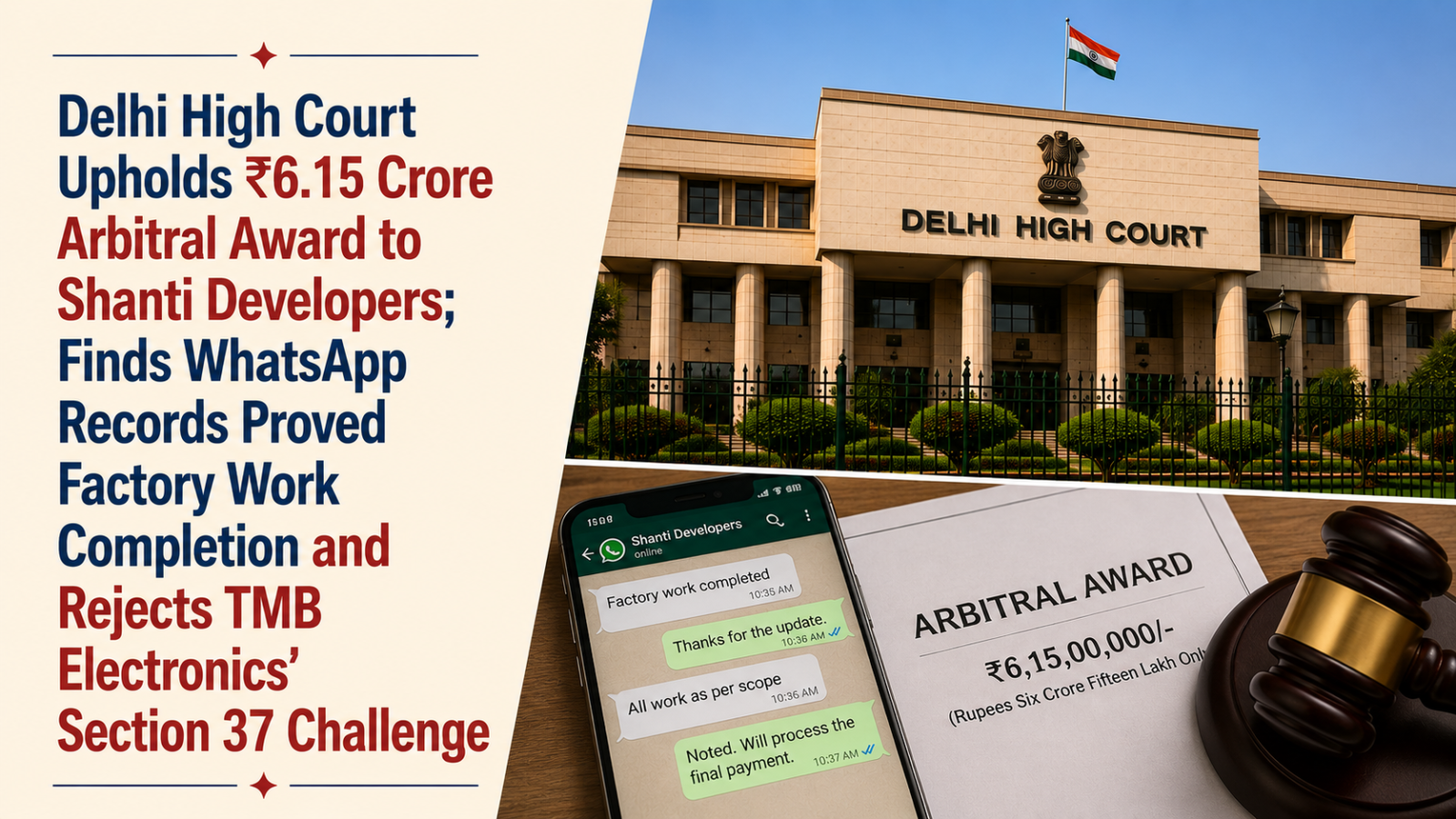
Delhi High Court Dismisses TMB Electronics’ Appeal Against Construction Award; Holds Arbitration Findings Cannot Be Disturbed Merely Because Another View Is Possible
Facts
TMB Electronics engaged Shanti Developers for construction of a proposed factory building at Kundli, Sonipat, Haryana, under an agreement dated 13 March 2018. The project architect was impleaded as Respondent No. 2. Clause 30 contemplated completion within 12 months, while disputes were referable to arbitration under Clause 36.
Shanti Developers claimed that it completed the original as well as additional work by August–September 2020 and handed over the site without objection. Its final bill dated 7 August 2021 was for ₹13,37,98,982, against which it acknowledged receipt of approximately ₹5.16 crore and claimed the balance along with loss of profit, interest and costs.
TMB Electronics disputed the claim, alleging incomplete and defective work, delay, non-compliance with contractual requirements, defects in the basement and GST-related irregularities.
The parties agreed before the Sole Arbitrator not to lead oral evidence, and no counterclaim was filed by TMB Electronics. The Arbitrator partly allowed the principal claim and awarded ₹6,14,97,594 towards work done under the original agreement, while rejecting claims for price escalation, excess steel, additional work, miscellaneous items and loss of profits. Interest at 14% was awarded from 7 September 2021 till payment, along with costs.
TMB Electronics challenged the award under Section 34 of the Arbitration and Conciliation Act, 1996. The Single Judge dismissed that petition. TMB then preferred the present Section 37 appeal.
Issues
The principal issues before the Division Bench were:
- Whether the Arbitrator’s finding that Shanti Developers had completed the contractual work by August–September 2020 was unsupported by evidence or patently illegal.
- Whether the absence of a formal completion certificate under Clause 23 prevented the contractor from recovering payment.
- Whether the final bill and the working area relied upon by the Arbitrator had been sufficiently proved.
- Whether the Arbitrator impermissibly shifted the burden of proof to TMB Electronics.
- Whether the award of a GST component was invalid because Shanti Developers had allegedly not deposited GST on the final bill.
- Whether TMB’s plea that the contractor had abandoned the work and a third party completed the remaining construction was established.
- Whether the award could be interfered with within the narrow scope available under Sections 34 and 37 of the Arbitration Act.
Appellant’s Arguments
TMB Electronics argued that Shanti Developers had neither complied with Clause 23 nor established that a completion certificate had been issued by the architect. It submitted that the Arbitrator could therefore not have held that the contractual work stood completed.
TMB further attacked the final bill, pointing out that different figures had appeared in the contractor’s communications: ₹12.40 crore in December 2020, ₹12.17 crore in July 2021 and ₹13.37 crore in the final bill dated August 2021. According to the appellant, these variations required strict proof of the actual work executed.
It argued that the Arbitrator relied excessively upon the final bill and WhatsApp messages without requiring adequate proof of measurements, and effectively treated weaknesses in TMB’s defence as proof of the contractor’s affirmative claim.
TMB also contended that approximately ₹1.72 crore of GST formed part of the calculation even though Shanti Developers had allegedly not deposited that GST with the authorities.
Another argument was that the contractor had abandoned the project and the remaining work had to be completed through a third party.
Lastly, TMB challenged the award of 14% interest, contending that it lacked contractual foundation under Section 31(7)(a) of the Arbitration Act.
Respondents’ Arguments
Shanti Developers emphasised the narrow scope of interference under Section 37 and argued that TMB was essentially inviting the Division Bench to reappreciate evidence.
It contended that the original structural work was payable on a lump-sum/per-square-foot basis and therefore the measurement-book objection was misplaced.
The contractor relied upon admitted WhatsApp group communications involving itself, TMB and the architect. Those exchanges contained regular progress updates, drawings and photographs showing that construction continued well beyond the date on which TMB alleged abandonment.
Shanti Developers further argued that TMB never identified:
- the precise date on which work was allegedly abandoned;
- the stage of construction at abandonment;
- the third-party contractor supposedly engaged thereafter; or
- the amount allegedly spent on completing the remaining work.
No counterclaim was filed seeking recovery of any expenditure on completion or rectification.
On GST, the contractor argued that whether tax had actually been deposited was a question for the competent tax authorities and could not invalidate an otherwise crystallised contractual entitlement.
Analysis of the Law
Scope of Interference Under Sections 34 and 37
The Division Bench reiterated the limited nature of judicial review of arbitral awards.
A court under Section 34 does not sit as an appellate forum over the Arbitrator’s factual conclusions. Consequently, the scope under Section 37 is even narrower because the appellate court is reviewing a Section 34 decision within the same statutory constraints.
Interference can be justified where a finding is based on no evidence, is palpably perverse, irrational or contrary to the contractual framework, but not merely because another factual view might also have been possible.
The Court found that this was not a case of a finding based on no evidence or one so perverse that no reasonable adjudicator could have reached it.
Evidence of Completion
The Arbitrator had not accepted the final bill mechanically.
The record included admitted WhatsApp messages from the project group “TMB 113 Kundli”, in which the contractor regularly updated the progress of work and the architect supplied drawings.
The messages showed construction continuing beyond November 2019, including photographs from July 2020 and requests for front-elevation drawings as late as 21 September 2020. The Arbitrator therefore found support for Shanti Developers’ case that the work continued until August–September 2020.
The Single Judge had independently found that the Arbitrator relied not merely on the final bill but on the WhatsApp communications and pleadings forming part of the arbitral record.
The Division Bench agreed that these materials constituted evidence capable of supporting the factual finding of completion.
Abandonment Defence Rejected
TMB’s allegation that Shanti Developers had abandoned the project was found to be vague and unsupported.
There was no contemporaneous communication complaining that the contractor had abandoned the work.
There was also no evidence showing that another contractor had been engaged to complete it. TMB neither identified the alleged third party nor disclosed the expenditure incurred for the supposed remaining work. No counterclaim was filed for any such expenditure.
The Court therefore treated the Arbitrator’s rejection of the abandonment defence as a factual finding that could not be reopened under Section 37.
Final Bill and ₹6.15 Crore Award
The Arbitrator analysed the components of the final bill rather than granting the entire amount claimed.
After considering the contractual rates and adjusting the claimed working area, the value of the relevant work was assessed at ₹9,59,46,266. Adding GST brought the figure to ₹11,32,16,594.
The Arbitrator then deducted ₹5,17,19,000 already paid by TMB, resulting in the award of ₹6,14,97,594 for work falling within the original contractual scope.
The Court considered this exercise to be a reasoned assessment based on the contractual material and evidence rather than an unproved adoption of the contractor’s final bill.
GST Objection
The Division Bench rejected TMB’s attempt to use the alleged non-deposit of GST to invalidate the arbitral award.
The Court observed that the final contractual liability had been crystallised only through the arbitral award dated 29 August 2023. The relevant bill, including GST, had earlier been disputed by TMB itself.
Since TMB had not yet paid the awarded sum, the Court held that it could not presently draw an adverse inference against Shanti Developers merely because the GST component had allegedly not been deposited.
However, the Court introduced an important safeguard: after paying the awarded amount together with up-to-date interest, TMB would be entitled to seek proof that the GST component had been deposited. Any violation of GST law would remain a matter for the competent statutory authorities.
Thus, a tax-compliance dispute was kept distinct from the contractor’s underlying arbitral entitlement.
Precedent Analysis
Indian Oil Corporation v. Shree Ganesh Petroleum
TMB relied upon this Supreme Court decision for the proposition that an Arbitrator cannot rewrite or disregard the terms of a contract.
The Delhi High Court accepted that principle but distinguished the precedent. In Indian Oil Corporation, the award had been contrary to the express lease terms and therefore offended public policy.
Here, the Court found no comparable disregard of the contract. The Arbitrator had evaluated the parties’ contractual obligations and the documentary material before reaching the award.
International Breweries, Bawana Infra, Flowmore and Related Cases
The appellant relied upon several decisions recognising that arbitral factual findings may exceptionally be interfered with where they are based on no evidence, defy logic or are so irrational that no reasonable person could have reached them.
The Division Bench accepted the legal principle but held that the factual threshold was not satisfied.
The award was supported by WhatsApp communications, photographs, contractual rates and the parties’ own pleadings. It was therefore not a “no evidence” award or a palpably perverse determination.
NHAI v. Shree Jagannath Expressways
This decision was relied upon to contend that an Arbitrator cannot allow a monetary claim unsupported by evidence.
The High Court distinguished it because the present award did not rest merely upon an asserted amount. The Arbitrator had examined the available record and independently recalculated the admissible contractual claim.
The Court also reiterated the proposition recognised in that precedent that evidence cannot ordinarily be reappreciated in Section 34 proceedings.
Navnirman Development Consultants
TMB relied upon Navnirman Development Consultants India Pvt. Ltd. for the requirement that a judicial order deciding a challenge must disclose the controversy, rival submissions and reasons.
The Division Bench distinguished the case. Unlike Navnirman, the Single Judge here had addressed the material controversy and explained why the Arbitrator’s findings did not warrant interference.
UHL Power Co. Ltd.
The appellant relied on UHL Power concerning the appellate court’s jurisdiction under Section 37.
The Court held that the precedent did not advance TMB’s case and, on the contrary, remained consistent with the restricted scope of appellate interference with arbitral awards.
Court’s Reasoning
The Division Bench considered the central question to be whether the Arbitrator’s award of the contractor’s claim for work performed under the original agreement suffered from a jurisdictional or patent illegality serious enough to justify interference.
It concluded that it did not.
The award had been supported by documentary evidence. The Arbitrator had considered the appellant’s defence, rejected unsupported components of the contractor’s own claim and granted only the amount found proved.
Importantly, Shanti Developers had claimed more than ₹8.21 crore as unpaid work, together with several additional claims. The Arbitrator rejected most of the additional heads and awarded only ₹6.14 crore under the original contractual work. That selective treatment reinforced the conclusion that the Arbitrator had not simply accepted the contractor’s case wholesale.
The Single Judge then examined the Arbitrator’s reasoning and found it supported by admitted WhatsApp messages and other material.
The Division Bench therefore held that revisiting the working area, completion of work, alleged abandonment and evidentiary weight of the documentary record would amount to impermissible reappreciation of evidence.
The Court summed up that the Arbitrator’s conclusion was neither unsupported by evidence nor palpably perverse, and therefore no interference with the Section 34 judgment was warranted.
Conclusion
The Delhi High Court dismissed TMB Electronics’ Section 37 appeal and upheld the Single Judge’s refusal to interfere with the arbitral award.
Consequently, the award in favour of Shanti Developers for ₹6,14,97,594 towards work executed under the original construction agreement, along with the arbitral directions concerning interest and costs, remained undisturbed.
The Court also preserved TMB’s right, after paying the awarded amount with up-to-date interest, to seek proof of deposit of the GST component. Any actual breach of GST law would be determined independently by the competent tax authorities.
The Division Bench ultimately held that all the authorities relied upon by TMB were distinguishable on facts and that the appeal was devoid of merit.
Key Ratio
A Section 37 court cannot reassess an arbitral award merely because another view of the evidence is possible; where the Arbitrator’s factual conclusions are supported by documentary material and are neither perverse nor based on no evidence, the award must ordinarily be left undisturbed.
Case Details
Case: TMB Electronics v. Shanti Developers & Anr.
Court: High Court of Delhi at New Delhi
Case Number: FAO(OS) (COMM) 26/2024
Judges: Justice V. Kameswar Rao and Justice Manmeet Pritam Singh Arora
Judgment by: Justice V. Kameswar Rao
Reserved on: 9 July 2026
Date: 19 August 2026
Result: Appeal dismissed; Section 34 judgment upheld and arbitral award of ₹6,14,97,594 in favour of Shanti Developers left undisturbed, subject to TMB’s right to seek proof of GST deposit after payment