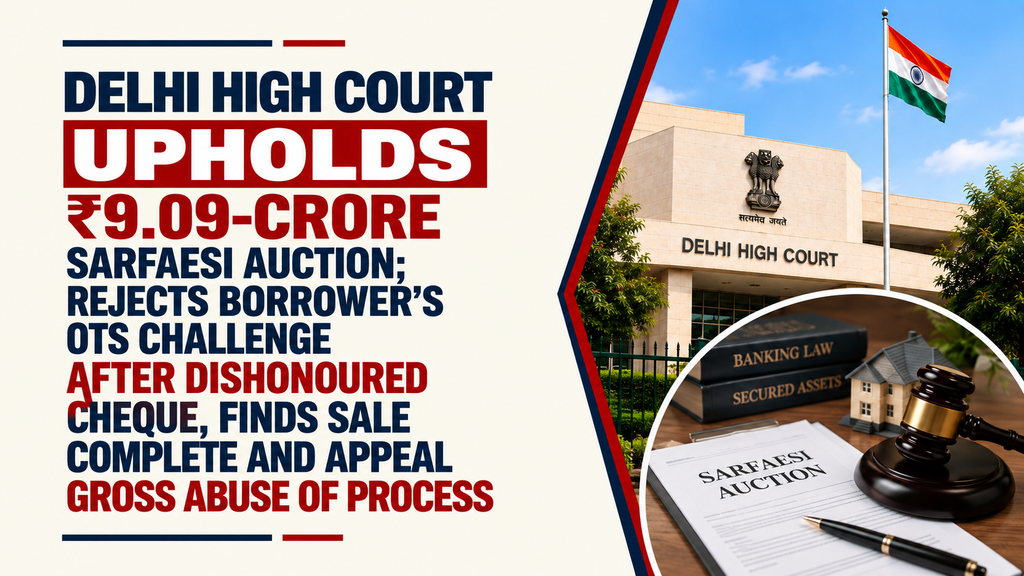
Delhi High Court Upholds ₹9.09-Crore SARFAESI Auction; Rejects Borrower’s OTS Challenge After Dishonoured Cheque, Finds Sale Complete and Appeal Gross Abuse of Process

Delhi High Court Rejects Borrower’s ₹15-Crore OTS Plea; Says Dishonoured Cheque, Failed Settlement and Completed Auction Defeat Challenge to Secured Asset Sale
Facts
MS Patil Constructions and Infrastructure Ltd. had availed two loan facilities of ₹15 crore and ₹10 crore from IFCI Venture Capital Funds Ltd. against mortgage of properties at Padegaon and Divanshi, Aurangabad. The accounts were classified as NPA on 31 July 2019, and a demand notice under Section 13(2) SARFAESI sought ₹14,28,27,343.
The borrower challenged SARFAESI measures before the DRT, Aurangabad. During that period, it made several OTS proposals, including ₹8 crore and later ₹11.03 crore, with 10% of the latter deposited.
In 2025, IFCI Venture simultaneously initiated Section 7 IBC proceedings and issued a fresh auction notice. The borrower then filed a writ petition before the Delhi High Court. On 12 August 2025, the Single Judge recorded an in-principle arrangement for a ₹15-crore OTS, subject to approval, and noted a cheque of ₹9.92 crore plus balance payment of ₹4.08 crore. The auction was kept in abeyance.
The ₹15-crore OTS was formally approved on 22 September 2025, but the ₹9.92-crore cheque was dishonoured for insufficient funds. IFCI Venture thereafter initiated contempt proceedings.
Meanwhile, the DRT permitted the sale to proceed but directed that the Sale Certificate not be registered without its permission. One secured asset at Padegaon was then sold for ₹9.09 crore to M/s United Traders, and a Sale Certificate was issued on 6 April 2026.
The borrower later made another ₹15-crore OTS proposal, but IFCI Venture rejected it. The Single Judge dismissed the writ, finding that the borrower had misled the Court by tendering a cheque that was not good for payment, while accepting an unconditional apology in contempt.
The present LPA challenged that dismissal.
Issues
The principal questions were:
- whether the writ petition could be dismissed because the borrower tendered a cheque that was dishonoured;
- whether the ₹15-crore OTS remained subsisting despite cheque dishonour and subsequent events;
- whether the ₹9.09-crore auction sale had attained finality when the entire sale price had been paid and Sale Certificate issued, though registration was still pending;
- whether the borrower’s right of redemption survived;
- whether E. Muthurathinasabathy applied to preserve the borrower’s rights;
- whether the auction purchaser’s rights could be displaced by a later OTS proposal; and
- whether the pending Section 17 SARFAESI proceedings before the DRT affected the present appeal.
Appellant’s Arguments
The borrower argued that the Single Judge wrongly dismissed the writ solely on cheque dishonour without adjudicating its substantive SARFAESI objections, including alleged violations of Rules 8 and 9, undervaluation, non-adjustment of prior payments and subsistence of OTS.
It contended that the cheque was meant to be presented only after approval of the OTS and that IFCI Venture delayed approval by five weeks and then presented the cheque almost immediately, without notice.
The borrower further argued that the Sale Certificate had not been registered and therefore the sale remained incomplete, preserving the right of redemption. It relied heavily on E. Muthurathinasabathy v. Sri International and Mathew Varghese.
It also contended that IFCI Venture was seeking excessive recovery by retaining prior payments, auction proceeds and rights over the remaining secured asset.
IFCI Venture’s Arguments
IFCI Venture argued that the auction purchaser had paid the entire consideration within the period under Rule 9(4), the sale had been confirmed and the Sale Certificate issued.
It submitted that any challenge to the auction had to be adjudicated by the DRT under Section 17 SARFAESI.
It also stressed that the borrower’s OTS proposals had failed repeatedly and that the ₹15-crore cheque had been dishonoured. In its submission, rights of the successful auction purchaser could not be displaced to accommodate a later OTS.
Auction Purchaser’s Arguments
The auction purchaser argued that it had deposited the full ₹9.09-crore consideration within the statutory period and that Rule 9 created vested rights in its favour.
It distinguished E. Muthurathinasabathy on the basis that, in that case, only 25% of the price had initially been paid and the balance was delayed by about 15 months because of judicial restraint. Here, the full price had been deposited within time.
Analysis of the Law
1. Full Payment and Sale Certificate Completed the Sale
The Division Bench held that the critical distinction from E. Muthurathinasabathy was that the auction purchaser here had deposited the entire sale consideration within the statutory period under Rule 9(4), after which the Sale Certificate was issued.
The mere fact that registration of the Sale Certificate was still pending did not by itself render the sale incomplete.
2. DRT’s Order Did Not Restrain the Sale
The DRT had expressly permitted the secured creditor to proceed with the auction and only directed that registration of the Sale Certificate await its permission.
The High Court held that this did not invalidate or prevent completion of the sale. It merely kept the sale subject to the final outcome of the pending securitisation application.
3. E. Muthurathinasabathy Was Distinguishable
The Court held that the appellant could not rely upon that judgment because there, the statutory sale process had not been completed within the prescribed framework.
Here, the full consideration was deposited in time and the Sale Certificate had already been issued.
Thus, the borrower could not use that precedent to reopen the completed auction.
4. Failed OTS Could Not Override Completed Auction
The Court held that although IFCI Venture had issued the Letter of Approval for the ₹15-crore OTS, the cheque issued pursuant to it was dishonoured and the agreed amount was not paid.
The borrower itself thereafter made a fresh OTS proposal, which was rejected on 30 June 2026. Therefore, there was no subsisting settlement governing the parties when the auction sale was completed.
5. Auction Purchaser’s Rights Could Not Be Unsettled
The Court held that the borrower could not undo a sale where the purchaser had already paid the entire consideration and received a Sale Certificate merely to revive a later OTS proposal.
The Court also found the borrower’s renewed willingness to pay under the OTS to be an afterthought, noting that no Demand Draft for the claimed balance was actually tendered before the Court.
6. Dishonoured Cheque Justified Dismissal
The Division Bench agreed with the Single Judge that the borrower had misled the Court by tendering a cheque that was dishonoured when presented.
It described the conduct as “clearly contumacious in nature”, while affirming the Single Judge’s leniency in accepting the unconditional apology.
7. Appeal Was a Gross Abuse of Process
The Court ultimately held that the appeal constituted a “gross abuse of the process of law” and that no legal infirmity had been shown in the impugned order.
Precedent Analysis
E. Muthurathinasabathy v. Sri International, (2026) 6 SCC 749
Relied on by the borrower for preservation of redemption rights and for the proposition that statutory sale irregularities can prevent finality.
The Delhi High Court distinguished it because there the auction purchaser had initially paid only 25%, while the balance was deposited much later. In the present case, the full sale price was deposited within Rule 9(4).
Mathew Varghese v. M. Amritha Kumar, (2014) 5 SCC 610
Relied upon by the borrower on the mortgagor’s right of redemption and Article 300A protection of property.
However, the Court did not accept that principle as sufficient to undo the completed sale in the facts before it.
Celir LLP v. Bafna Motors (Mumbai) Pvt. Ltd., (2024) 2 SCC 1
Relied upon by the respondents and auction purchaser for finality of a SARFAESI sale where the auction purchaser complies with the statutory payment timeline and the sale is confirmed.
The Court found the present facts closer to Bafna than to E. Muthurathinasabathy.
Court’s Reasoning
The Court treated the case as turning on three decisive factors:
- the borrower’s cheque under the OTS was dishonoured;
- the later OTS proposal was rejected; and
- the auction purchaser paid the full ₹9.09 crore in time and received a Sale Certificate.
Once those facts were established, the borrower could not rely on the mere pendency of registration to say the sale was incomplete.
At the same time, the Court carefully preserved the borrower’s pending DRT remedies. It expressly clarified that its findings would not prejudice S.A. No.80/2021 or any other proceeding between the parties.
Conclusion
The Delhi High Court dismissed the appeal and upheld the Single Judge’s order.
It held that:
- the ₹9.09-crore auction sale had been completed;
- pending registration of the Sale Certificate did not make the sale incomplete;
- the failed ₹15-crore OTS could not defeat the auction purchaser’s rights;
- the borrower’s conduct in tendering a dishonoured cheque was contumacious;
- the appeal was a gross abuse of process; and
- the pending DRT proceedings would continue independently on their own merits.
Case Details
Case: MS Patil Constructions and Infrastructure Limited v. IFCI Venture Capital Funds Ltd. & Anr.
Court: High Court of Delhi at New Delhi
Case Number: LPA 604/2026 with connected applications
Bench: Chief Justice Devendra Kumar Upadhyaya and Justice Tejas Karia
Judgment by: Justice Tejas Karia
Reserved on: 12 August 2026
Date: 3 September 2026
Underlying SARFAESI Proceeding: S.A. No.80/2021 before DRT Aurangabad
Auctioned Asset: Padegaon, Aurangabad, Maharashtra
Auction Price: ₹9.09 crore
Result: Appeal dismissed; completed SARFAESI auction left undisturbed; no costs; pending DRT proceedings preserved for independent adjudication