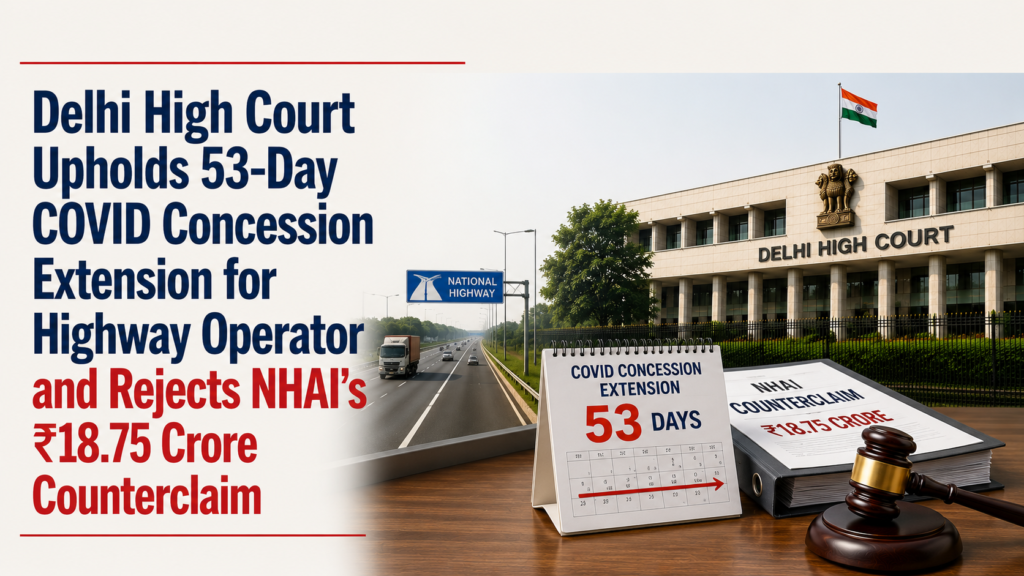
Delhi High Court Upholds 53-Day COVID Concession Extension for Highway Operator and Rejects NHAI’s ₹18.75 Crore Counterclaim

COVID Reduced Toll Collections Even After Reopening; Delhi High Court Refuses to Set Aside 53-Day BOT Concession Extension
Facts
The dispute arose out of a Concession Agreement dated 9 December 2005 between the National Highways Authority of India (NHAI) and Atlanta Infra Assets Limited for the four-laning, operation and maintenance of the Nagpur–Kondhali section of NH-6 in Maharashtra on a Build, Operate and Transfer (BOT) basis. The concession period commenced on 5 June 2006 and was scheduled to expire on 5 June 2026.
Following the COVID-19 pandemic, the concessionaire sought an extension of 53 days, comprising 25 days of complete suspension of toll collection and 28 additional days during which toll collections remained substantially below normal levels due to travel restrictions. NHAI granted only the first 25 days, refusing the balance extension.
Separately, the concessionaire also claimed that the inauguration of the Samruddhi Expressway had diverted traffic and sought further extension of the concession period. During arbitration, five claims were raised by the concessionaire, while NHAI filed two counterclaims, including a claim of ₹18.75 crore arising from de-scoping of service road works.
The Arbitral Tribunal allowed only the COVID-related claim for a 53-day extension, rejected the remaining claims, and dismissed both counterclaims of NHAI. Aggrieved, NHAI filed a petition under Section 34 of the Arbitration and Conciliation Act, 1996, seeking partial setting aside of the award.
Issues
- Whether the Arbitral Tribunal wrongly granted an additional 28-day concession extension beyond the 25-day toll suspension period due to COVID-19.
- Whether the Tribunal wrongly rejected NHAI’s counterclaim seeking ₹18.75 crore on account of de-scoping of service road works.
- Whether the arbitral award suffered from patent illegality or perversity warranting interference under Section 34 of the Arbitration and Conciliation Act, 1996.
Petitioner’s Arguments
NHAI argued that the Tribunal exceeded its jurisdiction by granting an additional 28-day extension based upon the policy circular dated 26 May 2020.
According to NHAI:
- the policy applied only to concession agreements based upon the Model Concession Agreement (MCA);
- the present agreement was materially different and therefore outside the policy’s scope;
- Clause 29.6(c) permitted extension only during complete suspension of toll collection and not for periods of reduced traffic after toll plazas reopened;
- the Tribunal effectively rewrote the contractual terms by importing benefits not available under the concession agreement.
Regarding the de-scoping counterclaim, NHAI contended that the earlier settlement merely resolved completion of pending works and did not extinguish its right to recover amounts already paid for de-scoped portions of the project. It argued that the Tribunal wrongly treated the settlement as a complete bar to future monetary claims.
Respondent’s Arguments
Atlanta Infra Assets Limited submitted that COVID-19 continued to severely affect toll collections even after toll plazas reopened because travel restrictions remained in force.
The concessionaire argued that:
- the policy circular was intended to provide relief against COVID-related revenue losses;
- NHAI itself had relied upon the same policy while granting the initial 25-day extension;
- reduced toll collections below 90% of average daily collections also constituted the very mischief addressed by the policy;
- the Tribunal correctly adopted a purposive interpretation harmonising the policy with the concession agreement.
On the de-scoping issue, the concessionaire contended that:
- the parties had already executed a comprehensive settlement during the earlier arbitration;
- it completed the remaining service road works without additional payment;
- NHAI thereafter issued a completion certificate;
- having fully acted upon the settlement without reserving future claims, NHAI could not subsequently reopen the dispute through another arbitration.
Analysis of the Law
The High Court reiterated that proceedings under Section 34 are not appellate proceedings and do not permit re-appreciation of evidence or substitution of the Court’s own interpretation merely because another view is possible.
The Court relied upon the Supreme Court’s decision in Consolidated Construction Consortium Ltd. v. Software Technology Parks of India, emphasising that arbitral awards can be set aside only on the limited statutory grounds, including patent illegality or conflict with the fundamental policy of Indian law.
Regarding COVID relief, the Court found that the Tribunal had not rewritten the concession agreement. Instead, it had interpreted Clause 29.6(c) harmoniously with NHAI’s own beneficial policy issued during the pandemic, recognising that the underlying objective of both was to compensate concessionaires affected by the Force Majeure event.
On the de-scoping dispute, the Court held that settlements are intended to finally resolve disputes. Once parties voluntarily settle an issue without reserving future claims and subsequently perform their obligations under the settlement, they cannot reopen the same cause of action through later proceedings.
Precedent Analysis
Consolidated Construction Consortium Ltd. v. Software Technology Parks of India
The High Court relied upon this decision to reiterate that Section 34 confers only a limited supervisory jurisdiction. Courts cannot re-appreciate evidence or interfere merely because another interpretation appears preferable. Interference is justified only where the award suffers from patent illegality or perversity.
Court’s Reasoning
The Court found no perversity in the Tribunal’s rejection of NHAI’s de-scoping counterclaim.
The Tribunal had correctly noted that:
- the issue of de-scoping had already been settled in the earlier arbitration;
- the concessionaire completed the remaining three kilometres of service roads pursuant to that settlement;
- NHAI issued a completion certificate after accepting the completed works;
- no reservation of future monetary claims had been made while entering into the settlement.
Accordingly, permitting NHAI to reopen the issue would defeat the finality of settlements.
On the COVID extension, the Court held that the Tribunal merely aligned the beneficial COVID policy with the contractual Force Majeure clause. The Tribunal’s interpretation recognised the commercial reality that although toll plazas had reopened, traffic remained drastically reduced because government restrictions discouraged travel.
The Court also noted that NHAI fairly conceded during arguments that applying its own policy formula would have yielded approximately 27 days, making the Tribunal’s grant of 28 days neither arbitrary nor perverse.
Since both findings represented plausible interpretations of the evidence and contract, no ground for interference under Section 34 existed.
Conclusion
The Delhi High Court dismissed NHAI’s petition under Section 34 of the Arbitration and Conciliation Act.
The Court upheld the arbitral award granting the concessionaire a 53-day extension of the concession period on account of the impact of COVID-19 and affirmed the rejection of NHAI’s ₹18.75 crore counterclaim relating to de-scoped works. It held that the award disclosed neither patent illegality nor perversity warranting judicial interference.
Case Details
Case: National Highways Authority of India v. Atlanta Infra Assets Limited
Court: Delhi High Court
Case Number: O.M.P. (COMM) 161/2026
Judge: Justice Tushar Rao Gedela
Date of Decision: 23 July 2026
Result: Petition dismissed. The Delhi High Court upheld the arbitral award granting the concessionaire a 53-day extension of the concession period due to the impact of COVID-19 and rejected NHAI’s challenge to the dismissal of its ₹18.75 crore de-scoping counterclaim, finding no patent illegality or perversity under Section 34 of the Arbitration and Conciliation Act, 1996.