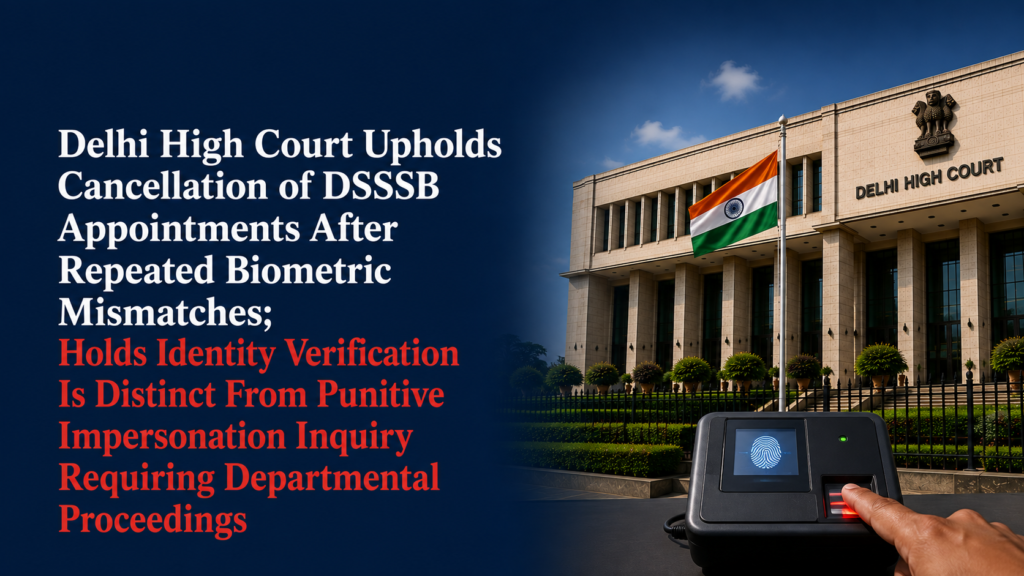
Delhi High Court Upholds Cancellation of DSSSB Appointments After Repeated Biometric Mismatches; Holds Identity Verification Is Distinct From Punitive Impersonation Inquiry Requiring Departmental Proceedings

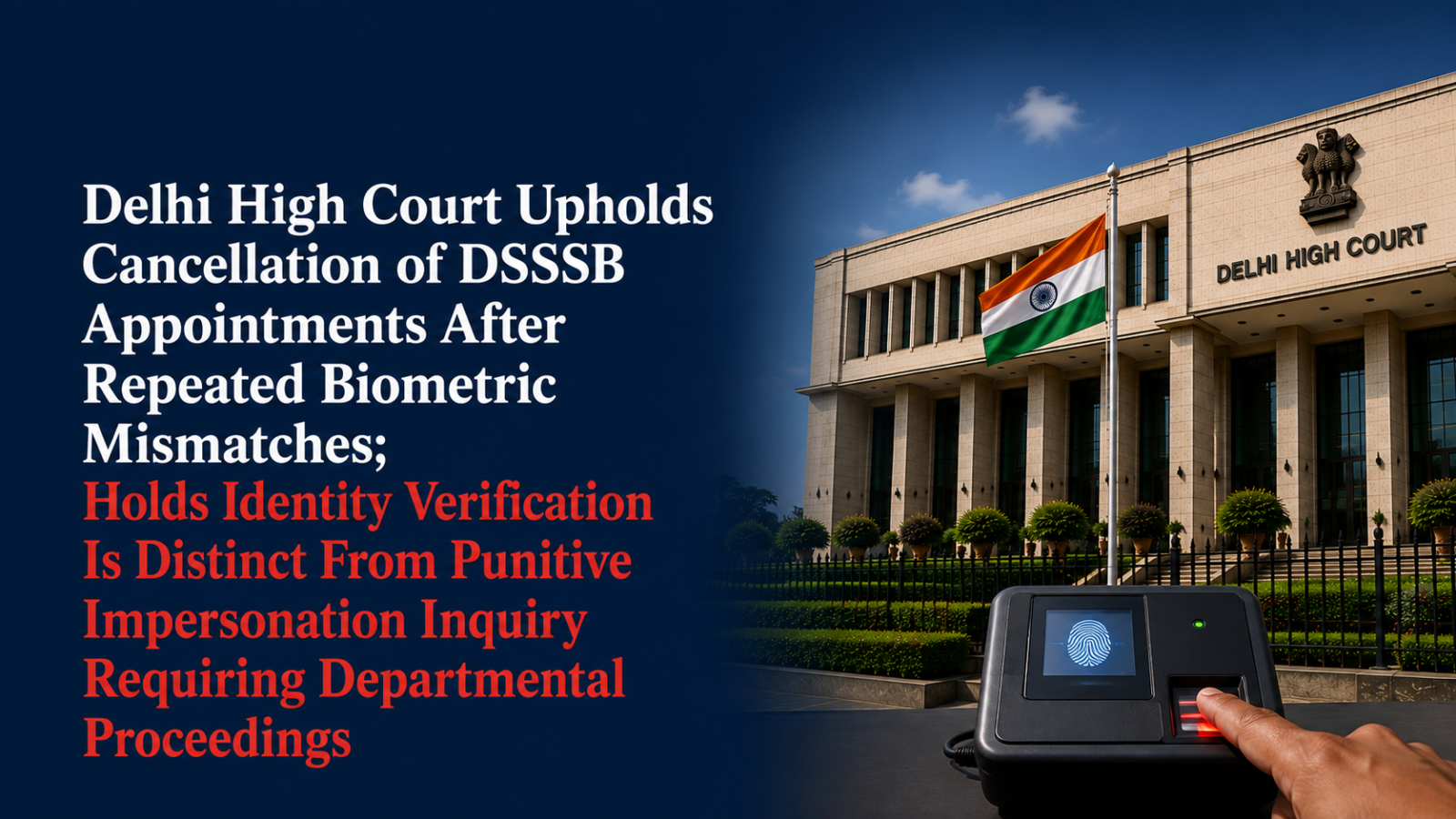
Delhi High Court Upholds Cancellation of Government Jobs Over Recruitment Identity Doubts; Clarifies No Finding of Criminal Impersonation or Disciplinary Guilt Is Made
Facts
The Delhi High Court decided a batch of ten writ petitions filed primarily by the Director General of Prisons and the Government of NCT of Delhi against orders of the Central Administrative Tribunal concerning employees recruited through the Delhi Subordinate Services Selection Board (DSSSB). The common judgment was pronounced on 14 August 2026.
The respondents had been selected for posts including Grade-IV (DASS), Stenographer Grade-III, Warder, Assistant Superintendent and Matron. After being declared successful, their dossiers were forwarded to the concerned departments, formalities including document verification and medical examination were completed, and they entered service on probation or provisional appointment.
Subsequently, complaints were received alleging impersonation in DSSSB recruitment examinations. The authorities therefore compared the biometric particulars, fingerprints, photographs and other identifying material of employees already in service with the records preserved during recruitment.
Where discrepancies were found, employees were called upon to explain them and were in several cases given repeated opportunities for verification. Their services were thereafter brought to an end under Rule 5(1) of the CCS (Temporary Service) Rules, 1965.
In the seven Prison Department cases, verification was conducted on three occasions, including at Tihar Prison Headquarters and the DSSSB office. The CAT subsequently quashed the termination orders and granted consequential benefits, principally treating the action as punitive and stigmatic because it rested upon allegations of impersonation.
Similar relief was granted by the Tribunal in the connected matters involving Mandeep, Sheetal and the DASS recruits.
The GNCTD and Prison authorities challenged those orders before the High Court.
Issues
The principal issues were:
- Whether the orders issued under Rule 5(1) were termination simpliciter based on suitability and genuineness of appointment, or punitive orders founded upon misconduct.
- Whether a regular departmental inquiry was mandatory before the authorities could act upon biometric, photographic or fingerprint mismatches.
- Whether the relevant inquiry concerned whether the employee committed impersonation, or the anterior question whether the employee was in fact the candidate whose candidature resulted in selection.
- Whether repeated biometric mismatches, coupled with other identification material and opportunities to explain, were capable of sustaining cancellation of the appointments.
- Whether the CAT had erred by treating every action arising from an impersonation allegation as punitive.
- What legal consequence should follow if the appointment itself was found to lack the foundational identity required for a valid recruitment.
Petitioners’ Arguments
The GNCTD and Prison authorities argued that the CAT had incorrectly treated the impugned actions as punitive merely because biometric mismatch and alleged impersonation formed part of the background.
They contended that the respondents were temporary or probationary employees governed by Rule 5(1), and that no finding of guilt for impersonation had been recorded.
No charge-sheet was issued, no misconduct was adjudicated, and no disciplinary penalty was imposed. Rather, the verification material was used to decide whether the respondents were suitable and whether they were the actual candidates selected through the recruitment process.
The petitioners relied on the distinction between “motive” and “foundation”, particularly under Radhey Shyam Gupta v. U.P. State Agro Industries Corporation Ltd. and Pavanendra Narayan Verma v. Sanjay Gandhi PGI. They argued that adverse material may motivate discontinuance without transforming it into punishment, provided the employer does not adjudicate guilt.
They further submitted that the alleged irregularity related to the recruitment process itself and therefore went to the validity of the appointment, not misconduct committed after entering service.
In Sheetal’s case, the authorities also relied upon a communication dated 7 July 2023 allegedly stating that another person had appeared in her examination, along with fingerprint and photographic mismatches.
Respondents’ Arguments
The employees argued that the orders were punitive in substance because the authorities had proceeded on allegations that they had used impersonators or unfair means in the recruitment examination.
They submitted that once an authority effectively concludes that an employee procured appointment through impersonation, such a finding carries serious stigma and civil consequences and therefore cannot be reached without a proper inquiry.
The respondents also emphasised that their identities had already been checked at several stages of recruitment using:
- admit cards;
- photographs;
- identity documents;
- signatures;
- thumb impressions;
- videography; and
- CCTV footage.
They argued that later biometric results were inconsistent and should not have been treated as conclusive without examining the contemporaneous recruitment records as a whole.
They further relied upon Union of India v. Sanjeev Kumar, where this Court had interfered with terminations founded upon allegations of impersonation and untested forensic material.
Analysis of the Law
Identity of the Selected Candidate Is Foundational to Appointment
The High Court identified a crucial distinction which, in its view, the Tribunal had failed to appreciate.
An appointment made pursuant to a competitive recruitment process attaches to the specific candidature of the person who actually participated and was selected.
Identity is therefore not a collateral matter; it forms part of the very foundation of the appointment.
If later material raises a serious and substantiated doubt about whether the person holding the post is the same person who participated in the recruitment process, the employer is entitled to examine the validity of the appointment itself.
That inquiry is conceptually different from asking whether the employee deliberately committed impersonation and is guilty of misconduct.
Appointment Validity and Disciplinary Culpability Are Distinct
The Court drew the distinction in clear terms:
- An inquiry into whether the person appointed is the candidate selected concerns the foundation of the appointment.
- An inquiry into whether that person deliberately impersonated another or arranged an impersonation concerns culpability and misconduct.
The first does not necessarily require a disciplinary inquiry; the second ordinarily would if punishment were to follow.
Thus, the use of words such as “impersonation,” “unfair means” or “mala fide intention” in notices does not automatically convert the exercise into disciplinary proceedings.
The Court must examine the substance of what the authority actually decided.
Provisional Appointments Remained Open to Verification
The offers and appointment orders expressly described many of the posts as temporary and the appointments as provisional and subject to verification.
The Court held that these conditions were not meaningless.
Entry into service did not immunise the appointment from subsequent scrutiny concerning whether the person who joined was truly the candidate selected.
The fact that employees had already served for some years also could not retrospectively establish the identity of the person who had taken the examination.
Departmental Inquiry Not Always Mandatory
The Court rejected the CAT’s proposition that a regular departmental inquiry was an indispensable condition before services could be brought to an end in these cases.
Such an inquiry would be necessary if the authority intended to find the employee guilty of impersonation and impose disciplinary punishment.
But where the authority is deciding whether the essential condition underlying the appointment—identity with the selected candidate—has been established, a disciplinary proceeding is not automatically required.
The Court therefore held that absence of a departmental inquiry could not by itself invalidate the action.
Biometric Material Must Be Considered Cumulatively
The High Court did not hold that every biometric mismatch automatically proves invalid appointment.
It expressly cautioned that an isolated mismatch may require further examination.
Relevant factors include:
- number of verification exercises;
- reliability of the biometric material;
- fingerprints and thumb impressions;
- photographs;
- signatures;
- CCTV or videography;
- explanations offered by the employee; and
- opportunities given for re-verification.
However, repeated mismatches after multiple verification opportunities stand on a materially different footing from a single inconclusive result.
Prison Department Cases
In the seven Prison Department matters, the authorities had conducted verification three times.
The employees were issued show-cause notices, furnished replies and were given further chances to establish their identity.
The biometric discrepancies nevertheless persisted.
The High Court held that the CAT erred in treating this entire exercise as if the authorities had conducted a disciplinary adjudication and found the employees guilty of impersonation.
The actual concern was whether the respondents had satisfactorily established that they were the candidates selected through DSSSB.
Therefore, the CAT’s common judgment dated 30 April 2024 was legally unsustainable insofar as it treated a disciplinary inquiry as indispensable.
Mandeep’s Case
Mandeep had been appointed as Warder (Male).
The DSSSB SOP contemplated initial verification through photographs and signatures, followed where required by biometric verification.
According to the authorities, he underwent biometric verification on five occasions and repeatedly failed to obtain a matching result.
The CAT had nevertheless applied its earlier reasoning and treated the action as punitive.
The High Court held that repeated failures were directly relevant to the foundational issue of identity and therefore set aside the CAT’s order dated 27 May 2025.
Sheetal’s Case
Sheetal’s case involved additional material.
She had undergone biometric and photographic verification more than once, failed to attend one scheduled exercise despite reminders, and was later given a final opportunity.
The report relied upon by the authorities recorded a 0.0% fingerprint match and 36.03% image match.
The authorities also relied upon a disputed communication dated 7 July 2023 allegedly indicating that another person had appeared in the written examination.
The High Court held that it was unnecessary in these writ proceedings to determine whether that material proved a criminal offence.
Its significance was that it formed part of the material the competent authority could consider while determining whether Sheetal’s candidature was genuine.
DASS Recruitment Cases
In the connected DASS matters, verification reports recorded mismatches including, for example, a 49.88% fingerprint match with 91.01% image match for Komal Dabas and 0.0% fingerprint match with 92.71% image match for Sandeep Kumar.
A further verification was conducted, and the authorities maintained that the fingerprint mismatches continued.
The High Court held that extension of probation did not itself validate candidature or bar later verification where the appointment remained provisional.
The CAT had principally relied on its earlier reasoning instead of independently assessing the cumulative effect of the identification material and opportunities afforded to the respondents.
Its order dated 25 February 2025 was therefore also liable to be set aside.
Correct Legal Characterisation: Cancellation, Not Punitive Termination
This is the most significant part of the judgment.
The High Court clarified that it was not affirming a disciplinary termination and was not finding any respondent guilty of impersonation.
Instead, it held that the appropriate legal characterisation was cancellation of appointment because the foundational requirement—that the person holding the appointment was the candidate who had been selected—had not been satisfactorily established.
The distinction was substantive:
Cancellation of appointment rests upon failure to establish foundational eligibility/identity.
Punitive termination rests upon a finding that the employee committed misconduct.
The Court accordingly moulded the relief so that the impugned actions would operate as cancellations rather than disciplinary punishments.
No Disqualification From Future Government Recruitment
Because the Court made no finding of criminal or disciplinary guilt, it expressly protected the respondents from being permanently prejudiced in future recruitment.
The cancellation of their appointments shall not operate as a disqualification for future Government recruitment or employment.
They remain free to participate in future recruitment processes subject to satisfying the applicable eligibility requirements.
Criminal or Disciplinary Proceedings Still Permissible Separately
The High Court also clarified that the judgment does not prevent the competent authorities from independently initiating:
- disciplinary proceedings;
- criminal proceedings; or
- other lawful action,
if warranted by material concerning impersonation or use of unfair means.
Any such proceeding must, however, be independently initiated and decided in accordance with law.
The present judgment does not constitute a finding on the merits of those allegations.
Precedent Analysis
Radhey Shyam Gupta v. U.P. State Agro Industries Corporation Ltd.
The Supreme Court precedent supplied the motive-foundation distinction.
Adverse information may constitute the motive for discontinuing a probationer without making the action punitive, provided the authority does not adjudicate the truth of misconduct and base punishment upon such adjudication.
Pavanendra Narayan Verma v. Sanjay Gandhi P.G.I. of Medical Sciences
This decision emphasises that courts must examine the substance and real basis of the order, rather than its form or label, when deciding whether a termination is punitive.
Government of NCT of Delhi v. Dalbir Singh
The Delhi High Court had held that a preliminary exercise undertaken to determine whether a probationer should be retained does not by itself transform subsequent discontinuance into a punitive termination.
Govt. of NCT of Delhi v. Virender
This precedent similarly held that circumstances causing an authority to doubt suitability do not automatically make the resulting discontinuance punitive.
Union of India v. Sanjeev Kumar
The respondents relied heavily on this judgment.
The High Court distinguished it because Sanjeev Kumar involved termination expressly founded upon allegations of unfair means and impersonation where forensic material was being used as proof of completed misconduct without proper departmental testing.
In the present batch, the Court viewed the central issue as whether the person holding the appointment was the person selected, rather than whether a completed disciplinary offence of impersonation had been proved.
Court’s Reasoning
The High Court found that the CAT approached the controversy from the wrong legal starting point.
The Tribunal assumed that because the notices referred to impersonation and unfair means, the authorities had necessarily imposed a punishment for misconduct.
The High Court held that the first question should instead have been whether the respondents had satisfactorily established the identity foundational to their appointments.
The authorities were entitled to undertake post-appointment verification, especially where the appointments were temporary or provisional and expressly subject to verification.
Repeated mismatches, opportunities to respond and cumulative identification material could legitimately cause the competent authority to conclude that the foundational identity had not been established.
That conclusion did not require the High Court itself to declare anyone an impersonator.
Accordingly, the proper result was cancellation of the appointments, while preserving the respondents’ rights against any stigma or future disqualification arising from an unproved allegation of misconduct.
Conclusion
The Delhi High Court answered the issues in favour of the GNCTD and Prison authorities.
It held that the CAT had erred by treating the actions as necessarily punitive without first examining whether the respondents had established that they were the candidates who actually participated in the recruitment process and were selected.
The Court accordingly:
- set aside the CAT orders dated 30 April 2024, 27 May 2025, 4 March 2025 and 25 February 2025;
- declared that the respondents’ appointments stand cancelled;
- vacated the interim orders which had continued them in service;
- denied consequential benefits flowing solely from the CAT orders; and
- allowed all the writ petitions.
At the same time, the cancellation was expressly held not to constitute a finding of impersonation or disciplinary guilt, and it will not disqualify the respondents from participating in future Government recruitment.
Case Details
Case: Director General of Prisons & Ors. v. Rinku Kumar & Ors., with connected matters
Court: Delhi High Court
Case Numbers: W.P.(C) 12736/2024, 13317/2024, 13672/2024, 13875/2024, 14183/2024, 15747/2024, 15752/2024, 16837/2025, 9441/2025 and 9758/2025
Judges: Justice Anil Kshetrapal and Justice Shail Jain
Date: 14 August 2026
Result: All writ petitions allowed; CAT orders set aside; respondents’ appointments cancelled for failure to establish foundational identity, without any finding of criminal or disciplinary guilt.