


1. Court’s decision
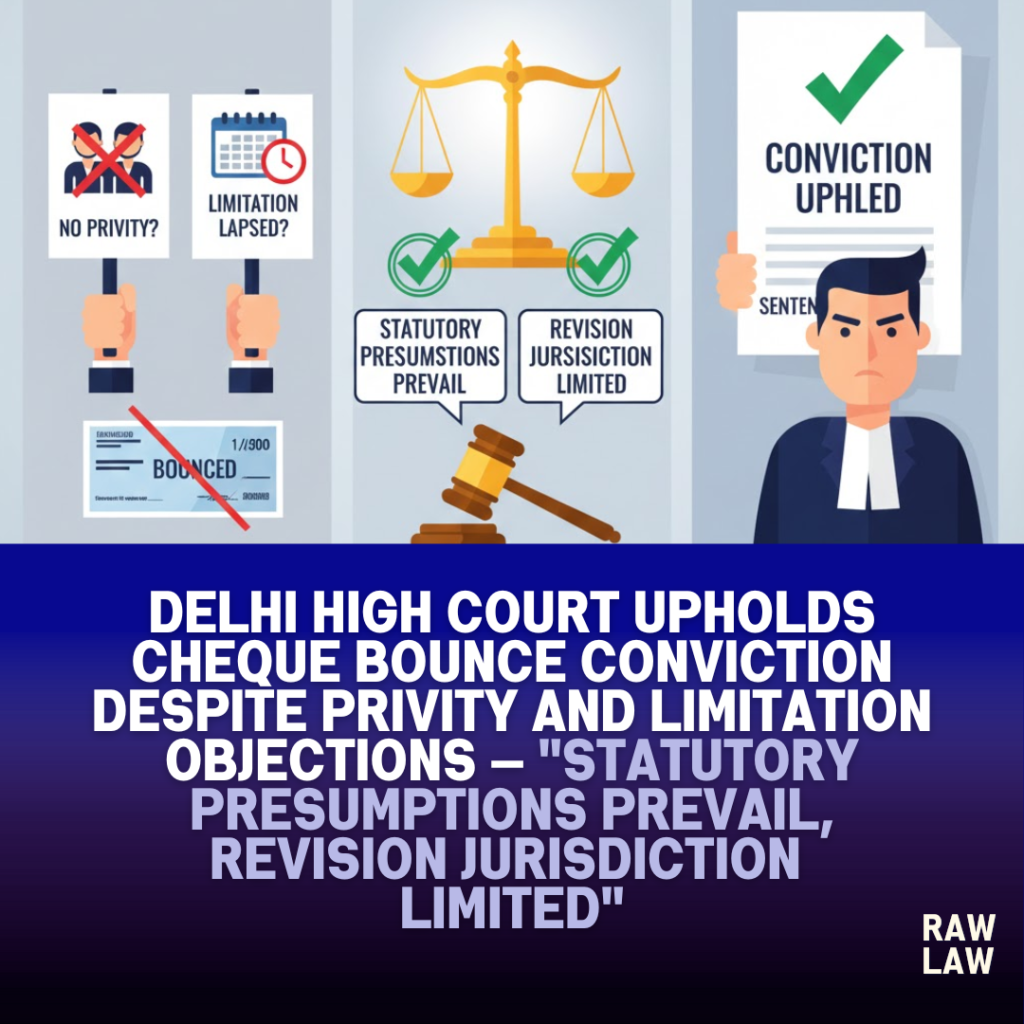
The Delhi High Court dismissed a criminal revision petition and upheld concurrent findings of conviction under Section 138 of the Negotiable Instruments Act, 1881. The Court ruled that once execution of the cheque and receipt of statutory notice are admitted, presumptions under Sections 118(a) and 139 of the Act operate with full force, and vague defences of lack of privity, limitation, or stolen cheque—unsupported by evidence—cannot dislodge criminal liability. The High Court reaffirmed that revisional jurisdiction is narrow and does not permit re-appreciation of evidence.
2. Facts
The dispute arose from a memorandum of understanding executed in 2009 between the respondent firm and the petitioner’s brother for joint construction and profit sharing of an immovable property in Delhi. After construction, the property was sold without the respondent’s consent and its share of profits was allegedly withheld. To discharge liability, the petitioner issued a cheque for ₹8 lakh in 2017, which was dishonoured with the remark “account closed”. Despite service of a statutory demand notice, payment was not made, leading to a complaint under Section 138 of the Negotiable Instruments Act. The Trial Court convicted the petitioner and imposed fine with default imprisonment. The Appellate Court affirmed the conviction, prompting the present revision.
3. Issues
The principal issues were whether the petitioner could escape liability by claiming absence of privity of contract, whether the alleged underlying transaction was time-barred, whether the complainant failed to establish its proprietary status, and whether the High Court should interfere with concurrent findings of fact in revisional jurisdiction.
4. Petitioner’s arguments
The petitioner argued that the memorandum of understanding was executed only between the respondent and his brother, and therefore no legally enforceable debt existed against him personally. It was contended that the underlying transaction was of 2009 vintage and thus time-barred when the cheque was issued in 2017. The petitioner also alleged that the cheque was stolen, that there was no documentary proof of investment or construction by the respondent, and that the complainant failed to prove its status as sole proprietor, rendering the complaint not maintainable.
5. Respondent’s arguments
The respondent contended that issuance and signature on the cheque were admitted and that statutory presumptions therefore squarely applied. It was argued that the petitioner issued the cheque towards discharge of liability arising from the joint venture, even if undertaken through his brother. The respondent emphasised that limitation under Section 138 is computed from the date of cheque dishonour and statutory notice, not from the date of the underlying transaction, and that the petitioner had failed to rebut presumptions by any cogent evidence.
6. Analysis of the law
The Court analysed the scheme of Sections 118(a) and 139 of the Negotiable Instruments Act, reiterating that these provisions create a mandatory presumption that a cheque was issued in discharge of a legally enforceable debt once execution is admitted. The burden then shifts to the accused to rebut the presumption on a balance of probabilities, either by leading evidence or by exposing serious infirmities in the complainant’s case. Mere assertions under Section 313 of the Code of Criminal Procedure do not suffice.
7. Precedent analysis
The Court relied on authoritative Supreme Court decisions, including Rangappa v. Sri Mohan and Rajesh Jain v. Ajay Singh, which hold that admission of signature on a cheque triggers statutory presumptions and that failure to rebut them results in conviction. The Court also endorsed settled law that limitation in cheque dishonour cases is reckoned from the date of dishonour and issuance of notice, not from the date of the underlying transaction.
8. Court’s reasoning
Applying these principles, the Court found that the petitioner admitted issuance and signature of the cheque as well as receipt of the statutory notice. No defence evidence was led to support the plea of stolen cheque or lack of liability. The contention of absence of privity was rejected, as the cheque was voluntarily issued by the petitioner towards the respondent’s claim. The plea of limitation was held misconceived since the relevant dates are those of dishonour and notice. The Court further held that revisional jurisdiction cannot be used as a third appellate forum to reassess evidence already considered by two courts.
9. Conclusion
The High Court concluded that no illegality, perversity, or jurisdictional error existed in the concurrent judgments of the Trial Court and the Appellate Court. The conviction and sentence under Section 138 of the Negotiable Instruments Act were upheld, and the criminal revision petition was dismissed.
10. Implications
The judgment reinforces the robustness of statutory presumptions in cheque dishonour cases and underscores that defences such as lack of privity or limitation must be substantiated by credible evidence. It also reiterates the restrained scope of revisional jurisdiction, signalling that accused persons cannot seek a rehearing on facts after failing before two courts.
Case Law References
- Rangappa v. Sri Mohan – Held that admission of signature on a cheque raises presumption of legally enforceable debt.
- Rajesh Jain v. Ajay Singh – Clarified burden of rebuttal under Sections 118(a) and 139 of the Negotiable Instruments Act.
- Milind Shripad Chandurkar v. Kalim M. Khan – Cited on evidentiary requirements in cheque dishonour proceedings.
- Ashwani Kumar v. Raj Kumar – Referred on limitation arguments, distinguished in context of Section 138.
FAQs
Q1. Can absence of privity defeat a cheque bounce case?
No. If the accused issues a cheque towards a liability, statutory presumptions apply regardless of whether the underlying transaction involved a third party.
Q2. How is limitation calculated in Section 138 cases?
Limitation is computed from the date of cheque dishonour and issuance of statutory notice, not from the date of the original transaction.
Q3. Can the High Court re-appreciate evidence in criminal revision?
No. Revisional jurisdiction is limited to examining legality or perversity and does not permit re-evaluation of facts.