


Court’s decision
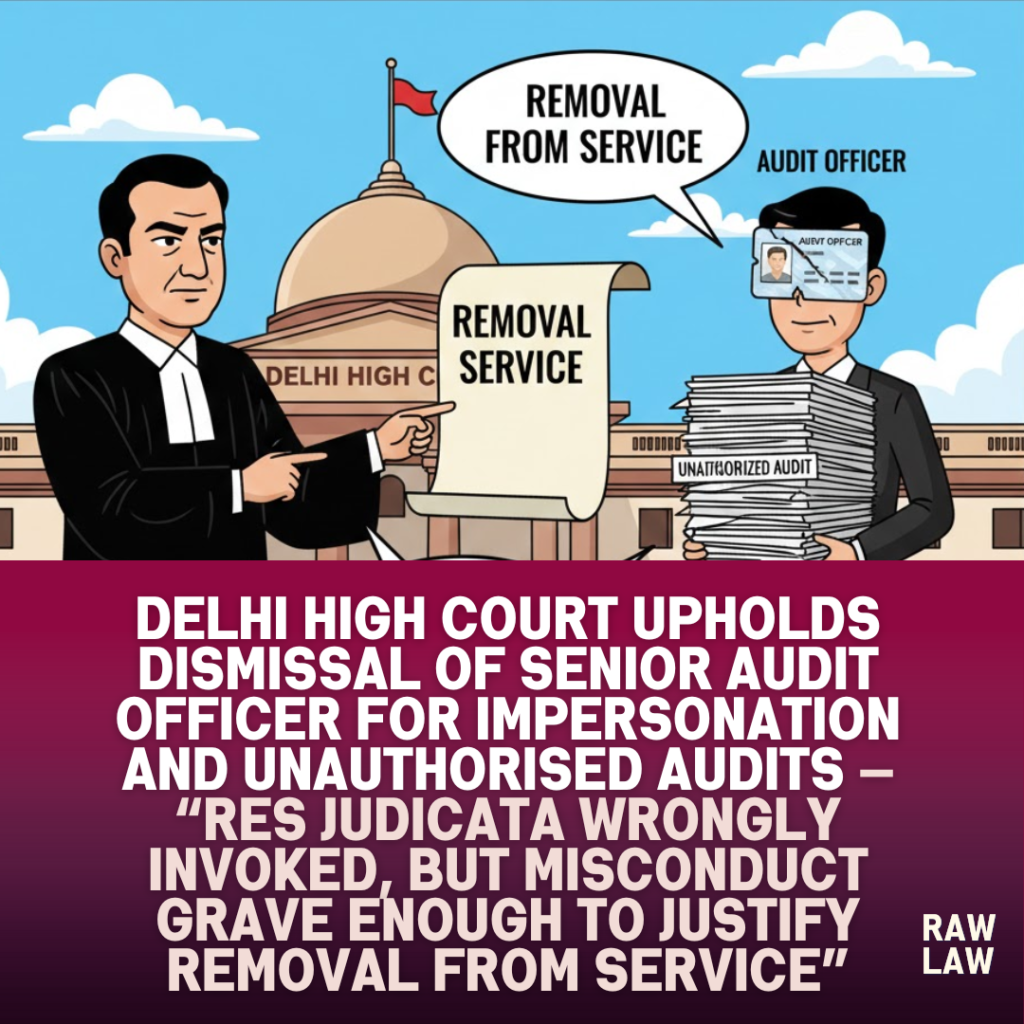
The Delhi High Court dismissed a writ petition challenging the dismissal of a senior audit officer from the office of the Comptroller and Auditor General of India, holding that although the Central Administrative Tribunal had erred in strictly applying the doctrine of res judicata, the disciplinary action and penalty of dismissal were legally sound and proportionate. The Court ruled that impersonation of a superior officer and unauthorised exercise of statutory audit functions strike at the core of integrity in public service and warrant the severest penalty, notwithstanding long years of service.
Court’s decision
A Division Bench declined to interfere with concurrent findings of guilt recorded in departmental proceedings and affirmed by the Tribunal. It held that judicial review under Article 226 is confined to examining procedural fairness and legality, not reappreciation of evidence. The Court found that the inquiry was conducted fairly, the delay in issuance of the charge-sheet was satisfactorily explained, and the punishment imposed was not shockingly disproportionate. Consequently, the writ petition was dismissed.
Facts
The petitioner joined the office of the Accountant General in 1969 as an Upper Division Clerk and was later promoted to Senior Auditor. While posted in the Audit Management Group of the office of the Director General of Audit, Central Revenues, allegations surfaced that between 1996 and 1999 he had unauthorisedly conducted Central Excise audits of industrial units in the Okhla Industrial Area. It was alleged that he issued audit memos and completion certificates without authority and impersonated an Assistant Audit Officer by misusing the official seal. A complaint from an industry association triggered a fact-finding inquiry and forensic examination of documents.
Issues
The principal issues before the Court were whether the disciplinary proceedings were vitiated by delay, procedural infirmities, or lack of evidence, and whether the punishment of dismissal was disproportionate. A further issue arose as to whether the petitioner’s second application before the Tribunal was barred by res judicata, given that an earlier Tribunal order had remitted the matter only on the limited issue of proportionality of punishment.
Petitioner’s arguments
The petitioner argued that the Tribunal wrongly invoked res judicata, as the earlier remand order had expressly kept all other grounds open. He contended that the charge-sheet was issued after an unexplained delay of several years, causing serious prejudice. It was submitted that the inquiry was biased and selective, that no motive or personal gain was established, and that the forensic opinion was unreliable. Emphasising his long and otherwise unblemished service, the petitioner argued that dismissal from service was grossly disproportionate and warranted judicial interference.
Respondents’ arguments
The respondents contended that the misconduct was grave, involving impersonation, misuse of official seal, and unauthorised discharge of statutory functions by an employee of a constitutional authority. They submitted that the delay in issuing the charge-sheet was explained by the need to collect records, obtain expert forensic opinion, and conduct a thorough investigation. It was argued that the inquiry followed due process, multiple witnesses identified the petitioner, and the appellate authority had reconsidered proportionality after remand and given reasons for affirming dismissal.
Analysis of the law
The Court reiterated settled principles governing judicial review of disciplinary proceedings. It held that courts do not sit as appellate authorities to reassess evidence or substitute their own views on punishment. Interference is warranted only where there is violation of natural justice, statutory rules, or findings based on no evidence. On delay, the Court held that mere passage of time does not vitiate proceedings unless prejudice is shown. On proportionality, it emphasised that in cases involving integrity and impersonation, long service cannot operate as a mitigating factor.
Precedent analysis
Relying on authoritative Supreme Court jurisprudence on the scope of judicial review in disciplinary matters, the Court reaffirmed that punishment can be interfered with only if it shocks the conscience of the court. It also reiterated that equality cannot be claimed in illegality and that failure to proceed against others does not exonerate a delinquent employee. The Court distinguished precedents on delay and proportionality, holding them inapplicable to cases involving serious breach of trust.
Court’s reasoning
The Court agreed with the petitioner to the limited extent that the Tribunal had technically erred in applying res judicata, since the earlier remand order had left other grounds open. However, it held that this error did not affect the ultimate outcome. On merits, the Court found sufficient evidence to sustain the charges, including forensic opinion and witness testimony. It held that impersonation of a superior officer and unauthorised audits undermine institutional credibility and justify dismissal. The appellate authority had duly reconsidered proportionality, and the punishment imposed was neither arbitrary nor excessive.
Conclusion
The High Court dismissed the writ petition, holding that the disciplinary proceedings were lawful, the findings of guilt were supported by evidence, and the penalty of dismissal was proportionate to the gravity of misconduct. It clarified that while res judicata was not strictly applicable, the petitioner was not entitled to any relief on merits. No costs were awarded.
Implications
This judgment reinforces strict standards of integrity expected from public servants, particularly those serving in constitutional institutions like the Comptroller and Auditor General’s office. It underscores judicial reluctance to interfere with disciplinary penalties in cases involving impersonation and misuse of authority. The ruling also clarifies that technical errors such as misapplication of res judicata will not result in relief where misconduct is otherwise conclusively established.
Case law references
- Scope of judicial review in disciplinary proceedings: Courts cannot reappreciate evidence or substitute punishment unless findings are perverse or punishment shocks conscience. Applied to uphold dismissal.
- Delay in disciplinary action: Delay alone does not vitiate proceedings absent prejudice. Applied to reject challenge to charge-sheet.
- Proportionality and integrity: In cases of impersonation and misuse of authority, dismissal is justified despite long service. Applied to affirm penalty.
FAQs
1. Can long years of service reduce punishment in disciplinary cases?
Not where misconduct involves loss of integrity, impersonation, or misuse of authority. Courts treat such charges as grave.
2. Does delay in issuing a charge-sheet invalidate disciplinary proceedings?
Only if the delay is unexplained and causes real prejudice to the defence. Mere passage of time is insufficient.
3. Can courts re-examine evidence in departmental inquiries?
No. Judicial review is limited to legality, procedural fairness, and existence of some evidence.