

Headnote
Arbitration and Conciliation Act, 1996 – Sections 31(7), 36 – Code of Civil Procedure, 1908 – Order XXI Rule 1 – Execution of arbitral award – Appropriation of payments – Interest-first rule – Powers of executing court – Municipal liability.
Held, in execution of an arbitral award, part-payments made by the judgment debtor must, in the absence of a contrary direction in the award, be appropriated first towards accrued interest and thereafter towards principal, in accordance with settled law. Payments made in instalments over a prolonged period, without full and unconditional satisfaction of the decree and in the presence of interim stays, do not result in cessation of interest. Judgments concerning cessation of interest upon full deposit under Order XXI Rule 1 CPC are distinguishable where deposits are partial or conditional. An executing court cannot reduce or modify the rate of post-award interest fixed by the arbitrator, as it cannot go behind the award except to correct clerical or arithmetical errors. While upholding the decree-holder’s computation, the Court, considering the public nature and financial constraints of a municipal body, exercised discretion to freeze the decretal amount and permit payment in instalments. The execution petition was disposed of accordingly.
Court’s decision
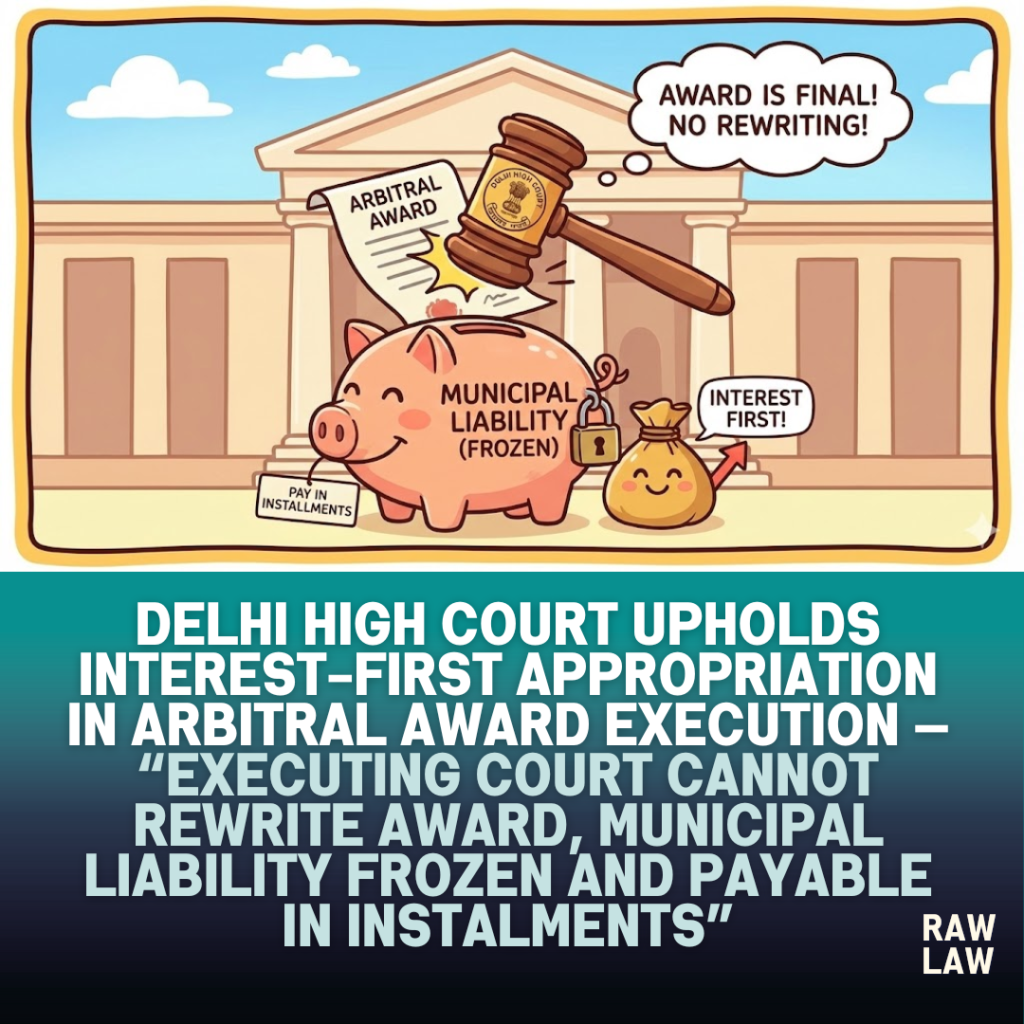
The Delhi High Court upheld the calculation furnished by the decree holder in a long-pending execution arising out of an arbitral award and rejected the rival computation of the Municipal Corporation of Delhi. The Court held that amounts paid over time had to be adjusted first towards interest and not principal, and that interest had not ceased to run. While affirming that a sum of ₹8.71 crore remained payable, the Court froze the decretal liability as on the date of judgment and directed payment in 25 equal monthly instalments, considering the municipal body’s financial position.
Facts
The execution proceedings arose from an arbitral award dated December 16, 1997, corrected on December 18, 1997, by which the decree holder was awarded approximately ₹1.70 crore as principal along with interest. Challenges under Sections 34 and 37 of the Arbitration and Conciliation Act were dismissed, and even the Special Leave Petition filed before the Supreme Court of India ultimately failed, save for an interim stay limited to certain claims.
A long-standing controversy persisted during execution regarding the manner of appropriation of payments made by the judgment debtor over several years. The municipal body had paid over ₹12.68 crore in three instalments between 2002 and 2017. The decree holder contended that these payments must be appropriated first towards interest, while the municipal body argued that they should extinguish the principal first, resulting in alleged overpayment.
Issues
The principal issues before the Court were whether part-payments made during execution should be appropriated first towards interest or principal, whether interest ceased to accrue upon such deposits, and whether the executing court had the power to reduce or alter the rate of post-award interest fixed in the arbitral award.
Decree holder’s arguments
The decree holder relied on settled Supreme Court jurisprudence to argue that in the absence of a specific direction to the contrary, part-payments must be appropriated first towards interest and costs, and only thereafter towards principal. It was submitted that the municipal body had never deposited the entire decretal amount unconditionally, and that several payments were made during periods when execution was stayed or partially stayed. Consequently, interest continued to accrue. The decree holder also contended that the executing court lacked jurisdiction to modify the award or reduce the rate of interest.
Judgment debtor’s arguments
The Municipal Corporation of Delhi contended that interest should cease upon deposit of amounts in court and that payments ought to be adjusted towards principal first. Relying on decisions dealing with Order XXI Rule 1 CPC, it was argued that once deposits were made, the decree holder was no longer entitled to interest under the award. The municipal body further urged the Court to reduce the rate of interest, citing changed economic conditions and its strained financial position.
Analysis of the law
The Court analysed the law governing appropriation of payments in execution proceedings and reiterated that the general rule, consistently upheld by the Supreme Court, mandates adjustment of payments first towards interest and costs unless the decree or award provides otherwise. The Court distinguished judgments dealing with cessation of interest upon full and unconditional deposit, noting that those principles do not apply where payments are partial, staggered, or subject to stays.
The Court further emphasised the limited jurisdiction of an executing court, holding that it cannot go behind the decree or award or modify the rate of interest fixed by the arbitrator, except to correct clerical or arithmetical errors.
Precedent analysis
The Court relied on Bharat Heavy Electricals Ltd. v. R.S. Avtar Singh & Co. to reaffirm the interest-first rule of appropriation. Authorities cited by the municipal body, including decisions on cessation of interest upon deposit, were distinguished as fact-specific and inapplicable where the award had not been fully satisfied. The Court also relied on recent Supreme Court jurisprudence clarifying that executing courts cannot rewrite arbitral awards.
Court’s reasoning
Applying these principles, the Court rejected the municipal body’s computation, holding that it incorrectly adjusted payments towards principal first and wrongly assumed cessation of interest. The decree holder’s detailed calculations were found to be consistent with law and precedent. However, recognising that the judgment debtor was a public municipal authority performing essential civic functions and facing financial constraints, the Court exercised equitable discretion to freeze the decretal amount and permit payment in instalments.
Conclusion
The Delhi High Court upheld the decree holder’s calculations and held that ₹8.71 crore remained payable under the award. The amount was frozen as on the date of judgment and directed to be paid by the Municipal Corporation of Delhi in 25 equal monthly instalments. The execution petition was disposed of with liberty to revive in case of default.
Implications
The ruling is significant for arbitration enforcement in India. It reinforces the principle that interest continues to accrue until full satisfaction of the award and that part-payments are ordinarily appropriated towards interest first. The judgment also reiterates the strict limits on the powers of executing courts, while demonstrating judicial sensitivity in structuring relief where public bodies are involved.
Case-law references
- Bharat Heavy Electricals Ltd. v. R.S. Avtar Singh & Co. – Laid down the interest-first rule of appropriation.
- Gurpreet Singh v. Union of India – Scope of cessation of interest upon deposit under Order XXI Rule 1 CPC.
- McDermott International Inc. v. Burn Standard Co. Ltd. – Limits on court’s power to modify arbitral awards.
- Gayatri Balasamy v. ISG Novasoft Technologies Ltd. – Executing court cannot go behind the award.
FAQs
1. How are part-payments appropriated in execution of arbitral awards?
Unless the award directs otherwise, payments are adjusted first towards accrued interest and costs, then towards principal.
2. Does interest stop running once money is deposited in court?
Only where the entire decretal amount is unconditionally deposited with proper notice. Partial or conditional deposits do not stop interest.
3. Can an executing court reduce the rate of interest awarded by an arbitrator?
No. An executing court cannot modify or rewrite the award except to correct clerical or arithmetical errors.


