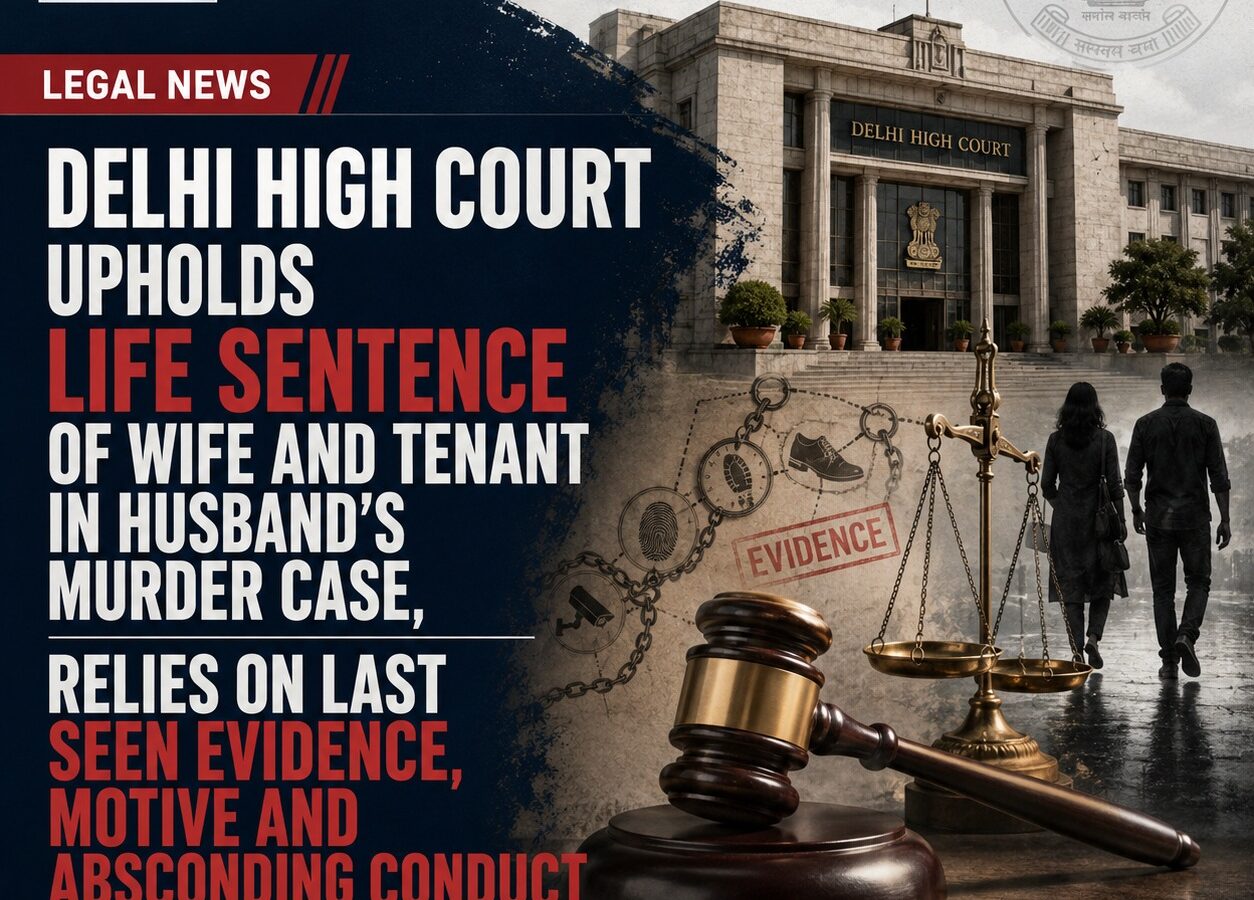
Delhi High Court Upholds Life Sentence Of Wife And Tenant In Husband’s Murder Case, Relies On Last Seen Evidence, Motive And Absconding Conduct

Court’s Decision
The Delhi High Court dismissed the criminal appeals filed by Ajay Singh and Meera and affirmed their conviction under Section 302 read with Section 34 of the Indian Penal Code.
The Court upheld the judgment of conviction dated 13 April 2004 and the order on sentence dated 15 April 2004 passed by the Trial Court, whereby both appellants were sentenced to life imprisonment with a fine of Rs. 5,000 each. In default of payment of fine, they were directed to undergo simple imprisonment for two months each.
The High Court directed both appellants to surrender before the Jail Superintendent within two weeks to undergo the remaining sentence. If they fail to surrender, the State was directed to take appropriate steps to ensure that they are taken into custody.
Facts
The case arose from FIR No. 574/2002 registered at Police Station Badarpur under Sections 302/34 and 120B IPC.
On 17 October 2002, at about 8:30 PM, information was received that a person was lying dead in a house at 40 Foota Road, Mollarband Extension, G Block, Delhi. Police reached House No. G-83/4 and found the dead body of Inder Kumar Singh/Inder Singh lying on a cot in a room on the ground floor. A rope was tied around his neck, and one end of the rope was tied to the leg of the cot.
The deceased was the husband of appellant Meera. Appellant Ajay Singh had earlier been staying in the same house as a tenant. The prosecution alleged that Ajay and Meera were in an illicit relationship. It was further alleged that on Holi in 2002, the deceased’s brother, Manna Singh, had seen Ajay and Meera in an objectionable condition, which led to a quarrel.
According to the prosecution, on 17 October 2002, Ajay, Meera and Meera’s children were seen leaving the house at around 4:00 PM. The appellants were arrested together on 2 November 2002.
The Trial Court convicted both appellants under Section 302/34 IPC and sentenced them to life imprisonment. Their sentences were later suspended by the High Court in 2007 during the pendency of the appeals.
Issues
- Whether the prosecution had proved a complete chain of circumstantial evidence against the appellants.
- Whether the “last seen” evidence was reliable and sufficient when read with other circumstances.
- Whether the non-examination of Meera’s children, who were allegedly present in the house, created a fatal defect in the prosecution case.
- Whether Meera’s plea of alibi was credible.
- Whether the alleged illicit relationship between Ajay and Meera established motive.
- Whether the appellants’ post-incident conduct of absconding was relevant.
- Whether the Trial Court’s conviction under Section 302/34 IPC required interference.
Appellant Ajay Singh’s Arguments
Ajay Singh argued that the investigation was unfair and defective. His main submission was that Meera’s children were allegedly present in the house at the time of occurrence, yet their statements were not recorded and they were not examined as witnesses.
It was argued that the prosecution deliberately withheld the best available evidence and that an adverse inference should be drawn against it.
Ajay also argued that once the Trial Court did not convict the appellants for criminal conspiracy under Section 120B IPC, it could not still hold them guilty with the aid of Section 34 IPC, because common intention also required a shared mental element.
He further challenged the medical timeline. As per the post-mortem, the time since death was approximately 44 hours before the post-mortem conducted on 19 October 2002 between 11 AM and 12 PM. According to him, this placed the time of death around 3 PM on 17 October 2002, which allegedly did not match the prosecution evidence.
Ajay also contended that the prosecution witnesses had made material improvements and contradictions. He submitted that PW-2 had not disclosed the allegation of illicit relationship in his earlier statement under Section 161 CrPC, PW-3 had turned hostile, and PW-4 and PW-5 gave inconsistent versions regarding the movement of the appellants.
It was further argued that “last seen” is a weak piece of evidence and that no witness had seen Ajay inside the room where the deceased was found dead.
Appellant Meera’s Arguments
Meera argued that she was not present at the place of occurrence. According to her, she had been staying at her parental home from 16 October 2002 to 20 October 2002 along with her children.
She relied on the testimony of DW-2 Rajender Singh, her brother, who stated that Meera and her children were at his house during the relevant period.
Meera also alleged that the deceased may have been murdered by his own relatives or at their instance because of a property dispute. She stated that the house stood in her name because the deceased apprehended that his father and brothers may grab the property.
She further submitted that the prosecution had failed to explain who first discovered the body, how entry into the house was gained, and why the guard and the unidentified person who allegedly conveyed information about the death were not examined.
According to her, the chain of circumstances was incomplete and the possibility of involvement of other persons could not be ruled out.
State’s Arguments
The State argued that the prosecution had established a complete chain of circumstances pointing towards the guilt of the appellants.
It was submitted that Ajay and Meera were in an illicit relationship, which created a strong motive for the murder. The Holi incident, where PW-2 allegedly saw them in a compromising position, was relied upon as an important circumstance.
The State further argued that the medical evidence proved homicidal death by asphyxia due to ligature constriction of the neck, and the estimated time of death matched the last seen evidence.
The State relied on PW-3, PW-4 and PW-5, who were neighbours and had seen Ajay and Meera leaving the house around 4:00 PM to 4:15 PM on 17 October 2002.
The State also relied on the conduct of the appellants after the incident, particularly the fact that both were absconding and were arrested together on 2 November 2002.
Analysis
The High Court noted at the outset that the Investigating Officer had failed to record the statements of Meera’s children despite knowing that they were present in the house. The Court described this as a serious lapse and observed that the investigation on this aspect appeared to be botched.
However, the Court held that this lapse did not destroy the prosecution case. The Court noted that Meera herself could have examined her children in defence, especially when her brother DW-2 had stated that the children were staying with him during the trial. Since the defence also did not produce them, the non-examination of the children was not sufficient to discredit the prosecution case in its entirety.
The Court then examined the case as one based on circumstantial evidence and applied the principles laid down in Sharad Birdhichand Sarda v. State of Maharashtra. The Court reiterated that in a case based on circumstantial evidence, the circumstances must be fully established, must point only towards the guilt of the accused, must exclude every other hypothesis, and must form a complete chain.
Last Seen Evidence
The High Court found the last seen evidence to be a crucial circumstance.
PW-3 stated that he saw Ajay coming out of Meera’s room and going somewhere, and after about 15 to 30 minutes, Meera also came out with her children.
PW-4 stated that on 17 October 2002 at about 4 PM, he saw Ajay going into the street, followed by Meera and her children. In cross-examination, he stated that there was a distance of about ten steps between Ajay and Meera.
PW-5 stated that at about 4 PM to 4:15 PM, he saw Ajay coming out of Meera’s house, followed by Meera and her children after about 5 to 10 minutes.
The Court held that this evidence matched the medical opinion, which placed the time of death around 3 PM to 4 PM on 17 October 2002.
The Court also held that Ajay’s defence that he had vacated the premises earlier did not help him. On the contrary, if he was no longer a tenant, his presence at or near the house at the relevant time required explanation.
The Court found PW-3, PW-4 and PW-5 to be independent neighbours. No suggestion of previous enmity or ill-will was put to them. Therefore, their evidence could not be discarded.
At the same time, the Court noted that last seen evidence alone should not be the sole basis of conviction and referred to Nizam v. State of Rajasthan. However, in the present case, last seen evidence was supported by motive, medical evidence and post-incident conduct.
Plea Of Alibi
The Court rejected Meera’s plea of alibi.
Meera claimed that she was at her parental home from 16 October 2002 to 20 October 2002. The Court held that this was not supported by reliable independent evidence. The only defence witness supporting her was her brother, who was a related witness and did not inspire confidence.
The Court also noted that even if Meera’s claim from 16 October to 20 October was accepted, she gave no explanation for her whereabouts from 20 October 2002 till her arrest on 2 November 2002.
The Court found it improbable that after the murder of her husband, she would not return to her house. Her conduct created serious doubt about the genuineness of her defence.
The Court relied on Shaikh Sattar v. State of Maharashtra to reiterate that the burden of proving alibi lies on the accused and must be established with certainty. However, the Court also clarified that failure of alibi does not automatically prove the prosecution case; the prosecution must still prove its case independently.
Motive
The High Court held that motive was an important link in the chain of circumstances.
The prosecution alleged that Meera and Ajay were in an illicit relationship. PW-2 Manna Singh, brother of the deceased, stated that on Holi in 2002 he had seen Ajay and Meera in an objectionable condition. This led to a quarrel and the police had to be called.
The defence argued that PW-2 had not mentioned this incident in his first statement under Section 161 CrPC. However, the High Court accepted the Trial Court’s reasoning that the omission had to be seen in the context of family honour and the emotional condition of the family after the unnatural death of the deceased.
The Court held that the Holi incident was not imaginary because even the appellants did not dispute that there had been a quarrel and that the police had been called.
The Court also noted that PW-9, PW-10 and PW-11 corroborated the allegation that the relationship between Meera and Ajay was a cause of dispute.
The Court held that while motive alone cannot sustain a conviction, it strengthens the prosecution case when supported by other circumstances. The Court referred to Gautam Satnami v. State of Chhattisgarh, where the Supreme Court held that motive is a supporting factor and cannot replace a complete chain of evidence.
Conduct After The Incident
The Court considered the appellants’ conduct after the incident as another incriminating circumstance.
Both appellants were absconding after the occurrence and were arrested together on 2 November 2002. The Court held that absconding by itself may not prove guilt, but when read with other evidence, it becomes relevant.
Their continued association after the incident and failure to provide a satisfactory explanation supported the prosecution case.
Non-Examination Of Children And Other Witnesses
The Court accepted that Meera’s children could have been material witnesses and that their non-examination reflected a lapse by the Investigating Officer.
However, relying on Rajesh Yadav v. State of U.P., the Court held that mere non-examination of a witness does not automatically vitiate the prosecution case. The Court must see the quality of the evidence already on record.
The Court also rejected the argument regarding non-examination of the guard and the unidentified person who informed PW-9. The Court held that they had merely passed information about the murder and were not witnesses to the occurrence. Therefore, their non-examination was of no consequence.
Defence Of Property Dispute
The Court rejected Meera’s defence that the deceased may have been murdered by his father or brothers to grab the property.
The Court reasoned that the house already stood in Meera’s name. Therefore, by killing the deceased, his father and brothers would not have gained the property. This made Meera’s defence unacceptable.
Defence Of Ajay Singh
Ajay claimed that on Holi, Manna Singh came to Meera’s house under the influence of liquor and misbehaved with her, due to which Ajay called the police.
The Court found this defence to be an afterthought. Importantly, Meera herself did not take the stand that Manna Singh had misbehaved with her. Therefore, Ajay’s version was not accepted.
Precedents Relied Upon
The Court referred to the following judgments:
- Sharad Birdhichand Sarda v. State of Maharashtra — for the five golden principles governing circumstantial evidence.
- Nizam v. State of Rajasthan — for the principle that last seen evidence is an important link but should not be the sole basis of conviction unless supported by other circumstances.
- Shaikh Sattar v. State of Maharashtra — for the burden of proving a plea of alibi.
- Rajesh Yadav v. State of U.P. — for the principle that mere non-examination of a witness does not automatically vitiate the prosecution case.
- Gautam Satnami v. State of Chhattisgarh — for the principle that motive is a supporting factor and cannot replace a complete chain of evidence.
Reasoning
The High Court held that the prosecution had successfully proved the following circumstances:
- The death of the deceased was homicidal.
- Ajay and Meera were seen leaving the house around the relevant time.
- The medical evidence matched the prosecution timeline.
- The illicit relationship between Ajay and Meera provided motive.
- Meera’s plea of alibi was not proved.
- Ajay’s defence was not reliable.
- Both appellants absconded and were arrested together after about 15 days.
- The property dispute defence was not believable.
- The prosecution witnesses were independent and credible.
- The lapses in investigation did not create reasonable doubt because the remaining evidence formed a complete chain.
Conclusion
The Delhi High Court held that the prosecution had established a complete and unbroken chain of circumstances pointing towards the guilt of both appellants.
The Court found that the last seen evidence, medical corroboration, motive and conduct of the appellants collectively formed a coherent narrative. The contradictions and omissions pointed out by the defence were held to be minor and not sufficient to affect the core of the prosecution case.
Accordingly, the appeals were dismissed. The conviction and sentence under Section 302/34 IPC were affirmed.
Both appellants were directed to surrender within two weeks to undergo the remaining sentence.
Implications
This judgment reinforces that in a murder case based on circumstantial evidence, conviction can be sustained where the chain of circumstances is complete and points only towards the guilt of the accused.
The judgment also clarifies that:
- Last seen evidence is not enough by itself, but can become decisive when supported by motive, medical evidence and conduct.
- Non-examination of a material witness does not automatically destroy the prosecution case.
- A defective investigation does not always result in acquittal if the other evidence is credible.
- A plea of alibi must be proved by the accused with reliable and cogent evidence.
- Absconding is not conclusive proof of guilt, but it is a relevant circumstance when read with other evidence.
- Motive cannot replace proof, but it can strengthen an otherwise complete chain of circumstances.
The judgment is significant because it shows how courts evaluate circumstantial evidence in cases where there is no direct eyewitness to the murder.