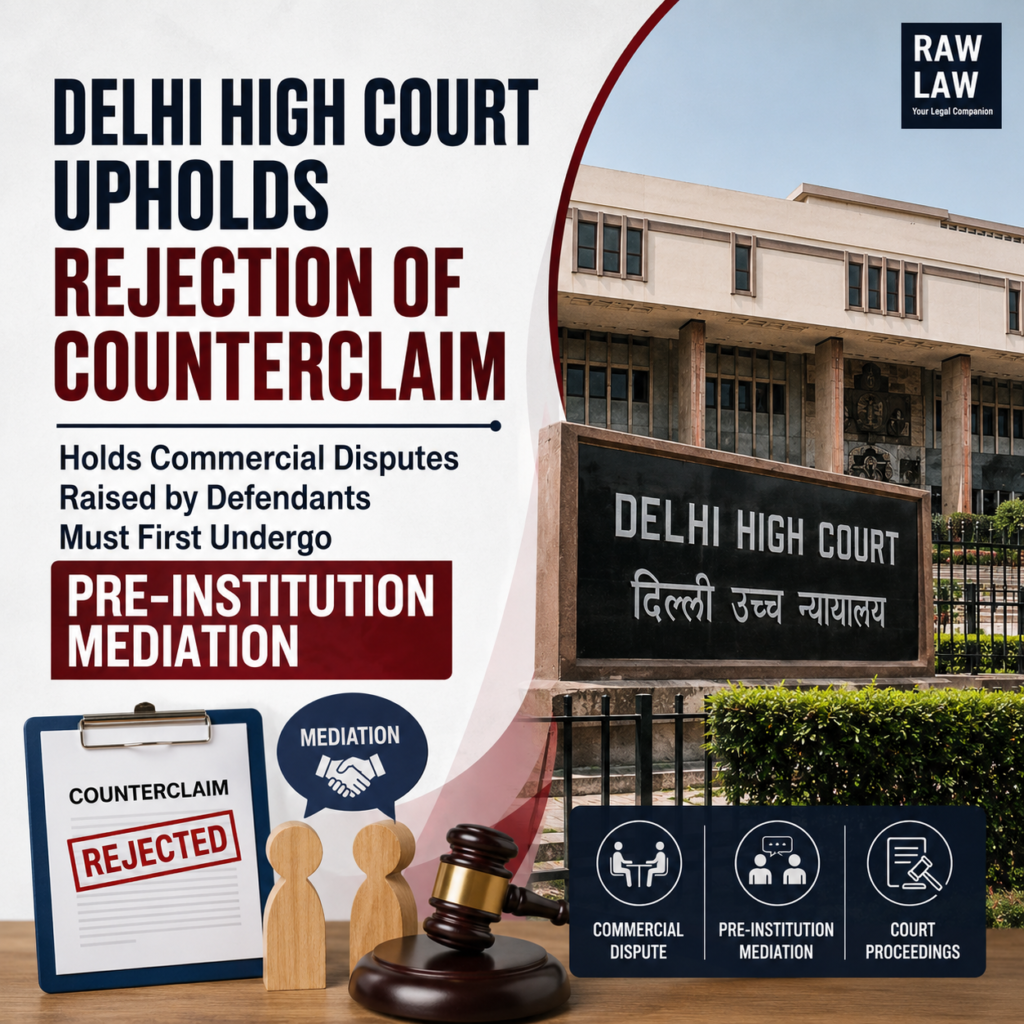
Delhi High Court Upholds Rejection of Counterclaim, Holds Commercial Disputes Raised by Defendants Must First Undergo Pre-Institution Mediation

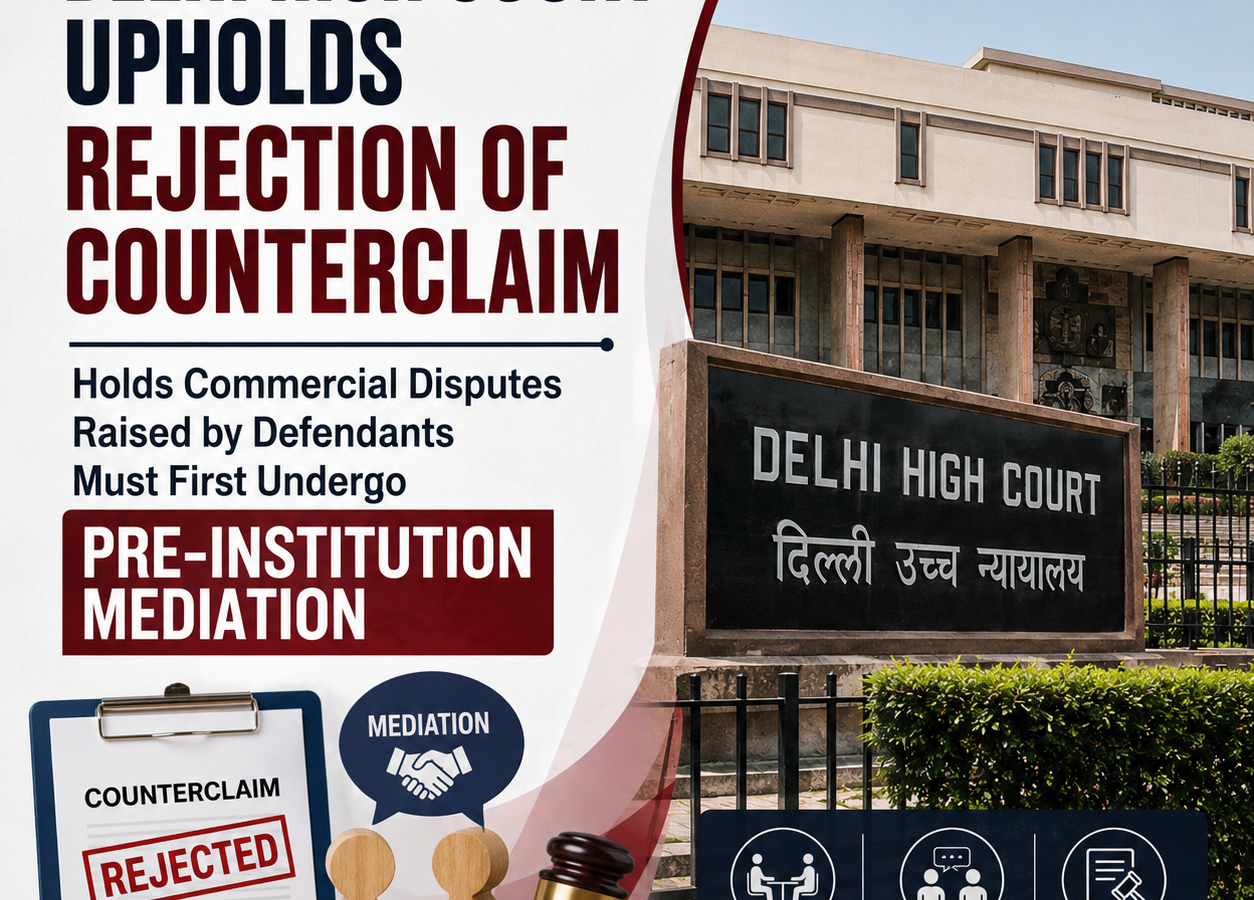
Delhi High Court Holds Counterclaims in Commercial Suits Must Undergo Pre-Institution Mediation Unless the Same Dispute Was Already Meaningfully Mediated
Facts
Havells India Limited and the other respondents instituted a commercial suit against Vijay, the appellant. The original suit was filed without undergoing pre-institution mediation under Section 12A of the Commercial Courts Act, 2015 because urgent interim relief was sought.
By an order dated 27 May 2024, the Commercial Court appointed a Local Commissioner. Inspections were subsequently conducted on 1 June and 17 June 2024.
The appellant thereafter filed a counterclaim based on the inspections and the commercial relationship between the parties. He alleged that the actions undertaken by the respondents during the inspections were contrary to and beyond the scope of the Court’s order dated 27 May 2024.
Before instituting the counterclaim, the appellant did not independently initiate pre-institution mediation under Section 12A.
The respondents filed an application under Order VII Rule 11 CPC seeking rejection of the counterclaim for failure to comply with Section 12A. On 25 January 2025, the Commercial Court allowed the application and rejected the counterclaim, holding that independent compliance with pre-institution mediation was mandatory.
The appellant challenged that order before the Delhi High Court.
Issues
- Whether a counterclaim filed by a defendant in a pending commercial suit is subject to Section 12A of the Commercial Courts Act.
- Whether every counterclaim must invariably undergo a separate pre-institution mediation process.
- Whether earlier mediation between the parties can satisfy Section 12A for a subsequently filed counterclaim.
- Whether independent mediation is necessary where the counterclaim was never disclosed or considered in any earlier mediation.
- Whether the counterclaim in the present case was rightly rejected under Order VII Rule 11 CPC.
Petitioner’s Arguments
The appellant argued that the expression “suit” in Section 12A does not include a counterclaim. Therefore, a defendant filing a counterclaim in a pending suit was not independently required to undergo pre-institution mediation.
It was submitted that although the Commercial Courts Act introduced several amendments to the CPC, the legislature did not amend Order VIII Rules 6A, 6B or 6C governing counterclaims. This indicated that counterclaims were not intended to be subjected to an additional mediation requirement.
The appellant contended that a counterclaim remains part of the same proceeding unless the plaintiff applies under Order VIII Rule 6C for its exclusion. Since no such application had been filed, the counterclaim could not be treated as an entirely independent action.
It was further argued that counterclaims are intended to prevent multiplicity of proceedings and enable comprehensive adjudication of all disputes between the same parties.
The appellant also highlighted the practical difficulty arising from the timelines prescribed in commercial suits. A written statement must ordinarily be filed within 30 days, with an absolute outer limit of 120 days. In contrast, mediation under Section 12A may continue for three months and may be extended by another two months. Requiring mediation before every counterclaim could therefore impair the defendant’s right to raise a counterclaim.
The appellant submitted that the decision in Aditya Birla Fashion and Retail Limited v. Saroj Tandon, which treated independent mediation as invariably necessary, did not correctly appreciate the statutory character of a counterclaim.
Respondent’s Arguments
The respondents submitted that a counterclaim is in the nature of a cross-suit and possesses the essential features of an independent proceeding. It must therefore comply with Section 12A unless urgent interim relief is sought.
They argued that the original suit had itself been filed without mediation because it sought urgent interim protection. Consequently, the counterclaim represented the first opportunity for the parties to attempt settlement of the claims raised by the appellant.
The respondents maintained that although a second mediation may not be required where the same disputes had already been subjected to mediation, the present case was different because no pre-institution mediation had taken place at all.
Reliance was placed on Aditya Birla Fashion, in which the Delhi High Court had held that a counterclaim filed without urgent interim relief must comply with Section 12A.
The respondents also submitted that the issue raised in the appeal had become largely academic because an issue relating to the counterclaim had already been framed in the original proceedings. Nevertheless, they supported the rejection of the counterclaim on the admitted ground of non-compliance.
Analysis of the Law
Section 12A of the Commercial Courts Act makes pre-institution mediation mandatory in commercial disputes that do not contemplate urgent interim relief.
The High Court clarified that the mandatory character of Section 12A was no longer open to debate after the Supreme Court’s ruling in Patil Automation Pvt. Ltd. v. Rakheja Engineers Pvt. Ltd.
The narrower question was how that requirement applies to a counterclaim.
The Court rejected both extreme positions:
- that every counterclaim must invariably undergo a fresh mediation irrespective of earlier proceedings; and
- that counterclaims are completely outside the scope of Section 12A.
A counterclaim is treated under the CPC as a cross-suit and has several incidents of an independent suit. It is therefore, in principle, subject to Section 12A.
However, the requirement must be applied purposively. The object of Section 12A is not merely to compel formal participation in mediation. It is to give the parties a genuine opportunity to settle the identified disputes before adversarial litigation begins.
The relevant inquiry is therefore whether the claims later raised through the counterclaim:
- formed part of an earlier mediation;
- were disclosed during that mediation; and
- were capable of being meaningfully addressed and settled.
Where no fresh mediation may be required
A second round of mediation may not be necessary where:
- pre-institution mediation was already conducted;
- the defendant disclosed the proposed counterclaims during it;
- the parties had a meaningful opportunity to settle those claims; and
- the process concluded in a non-settlement report.
In such circumstances, requiring another mediation would cause duplication and delay commercial adjudication.
Where independent mediation remains necessary
Independent compliance would ordinarily be required where:
- no mediation took place before the suit;
- the counterclaim was never disclosed during the earlier mediation;
- the claim was not part of the disputes referred to mediation; or
- the parties never had a meaningful opportunity to attempt settlement of that claim.
A prior mediation relating only to the plaintiff’s claim does not automatically satisfy Section 12A for every later claim by the defendant.
Effect of settlement
Where mediation culminates in a settlement, a subsequent counterclaim would ordinarily not arise unless certain claims had been expressly reserved.
Counterclaim filing timelines
The Court rejected the argument that mediation would necessarily defeat the time available to file a counterclaim.
Order VIII Rule 6A permits a counterclaim based on a cause of action accruing before the defendant delivers the defence or before the time for delivering the defence expires. It does not require every counterclaim to be physically filed along with the written statement.
Further, Section 12A provides that the period spent in mediation is excluded while computing limitation.
Precedent Analysis
Patil Automation Pvt. Ltd. v. Rakheja Engineers Pvt. Ltd.
The Supreme Court held that Section 12A is mandatory in commercial disputes that do not contemplate urgent interim relief.
The Delhi High Court clarified that the present case did not concern whether Section 12A was mandatory, but when that requirement could be treated as fulfilled for a counterclaim.
Sanjana Agarwal v. Namoshivai Apparels Private Limited
In this case, the Delhi High Court held that a second mediation was not necessary where the plaintiff had already invoked pre-institution mediation and the counterclaim arose from the same transactions and disputes.
The Court observed that repeatedly sending parties to mediation over the same dispute would undermine the Commercial Courts Act’s objective of speedy adjudication.
The present Division Bench approved this reasoning where the counterclaim had already been part of or meaningfully capable of consideration during the earlier mediation.
Anil Kumar Pitti v. Comsol Energy Private Limited
The Court in that case held that mediation initiated by one party concerning its own claim did not satisfy Section 12A for a separate claim subsequently raised by the opposite party.
The appellant’s claim had never been referred to mediation. Therefore, insisting upon mediation did not amount to duplication.
The present Court relied on this decision to support the principle that the decisive consideration is whether the particular claim was actually subjected to the mediation process.
Aditya Birla Fashion and Retail Limited v. Saroj Tandon
The Commercial Court had relied primarily on this decision for the proposition that every counterclaim independently requires compliance with Section 12A.
The Division Bench did not accept such an absolute formulation. It held that the necessity of fresh mediation depends upon whether the counterclaim had already formed part of a meaningful mediation process.
However, the Division Bench agreed that where no earlier mediation occurred, the counterclaim must comply with Section 12A.
Satyender v. Saroj
The appellant relied upon this decision for the principle that counterclaims facilitate comprehensive adjudication and avoid multiplicity of proceedings.
The High Court accepted the general character of counterclaims but held that this did not exempt them from the statutory mandate of Section 12A.
Jag Mohan Chawla v. Dera Radha Swami Satsang
This decision recognised a counterclaim as a cross-suit capable of being adjudicated along with the principal suit.
The High Court relied upon the same legal character to conclude that a counterclaim is, in principle, amenable to Section 12A.
Ambalal Sarabhai Enterprises Ltd. v. K.S. Infraspace LLP
The Supreme Court emphasised that the Commercial Courts Act must be interpreted to secure fair, efficient and expeditious resolution of commercial disputes.
The High Court applied this purposive approach by avoiding both unnecessary repeated mediations and blanket exemption of counterclaims from Section 12A.
Court’s Reasoning
The Court held that a counterclaim cannot be excluded from the expression “suit” for the purposes of Section 12A merely because it is filed within an existing proceeding.
Its character as a cross-suit makes it subject to the statutory mediation requirement.
At the same time, requiring a fresh mediation where the same claim had already been disclosed and meaningfully considered would serve no useful purpose and would delay the suit.
The determining factor is therefore not merely whether some mediation previously occurred, but whether the particular dispute raised in the counterclaim was part of that process.
In the present case, the original commercial suit was filed without mediation because urgent interim relief was sought. Thus:
- no pre-institution mediation was conducted;
- the appellant’s proposed claims were never disclosed in mediation;
- the parties never had an opportunity to explore settlement of those claims; and
- the statutory object of Section 12A remained wholly unfulfilled.
The appellant’s counterclaim did not itself seek or contemplate urgent interim relief. It therefore could not claim the benefit of the exception used by the plaintiffs while filing the original suit.
Accordingly, independent compliance with Section 12A was required before the counterclaim could be instituted.
The Commercial Court was therefore correct in rejecting the counterclaim, although the High Court partly differed from the broader reasoning that every counterclaim invariably requires a separate mediation.
Conclusion
The Delhi High Court held that counterclaims in commercial suits are, in principle, subject to the mandatory requirement of pre-institution mediation under Section 12A of the Commercial Courts Act.
A fresh mediation is not necessary where the particular claims raised in the counterclaim were already disclosed and meaningfully subjected to an earlier mediation process.
However, where no mediation took place or the counterclaim was never part of the earlier mediation, independent compliance with Section 12A is ordinarily mandatory.
Since no pre-institution mediation had taken place in the present case, the appellant’s counterclaim was rightly rejected.
The appeal was dismissed.
Case: Vijay v. Havells India Limited and Others
Court: Delhi High Court
Case Number: FAO (COMM) No. 46 of 2025
Judge: Justice Anil Kshetrapal and Justice Amit Mahajan
Date: 1 July 2026
Result: Appeal dismissed; rejection of the counterclaim for non-compliance with Section 12A of the Commercial Courts Act upheld.