Delhi High Court Upholds Technical Officer’s Dismissal for Refusing Temporary Tuticorin Posting; Finds Wilful Unauthorised Absence Proved and Departmental Inquiry Fairly Conducted Throughout

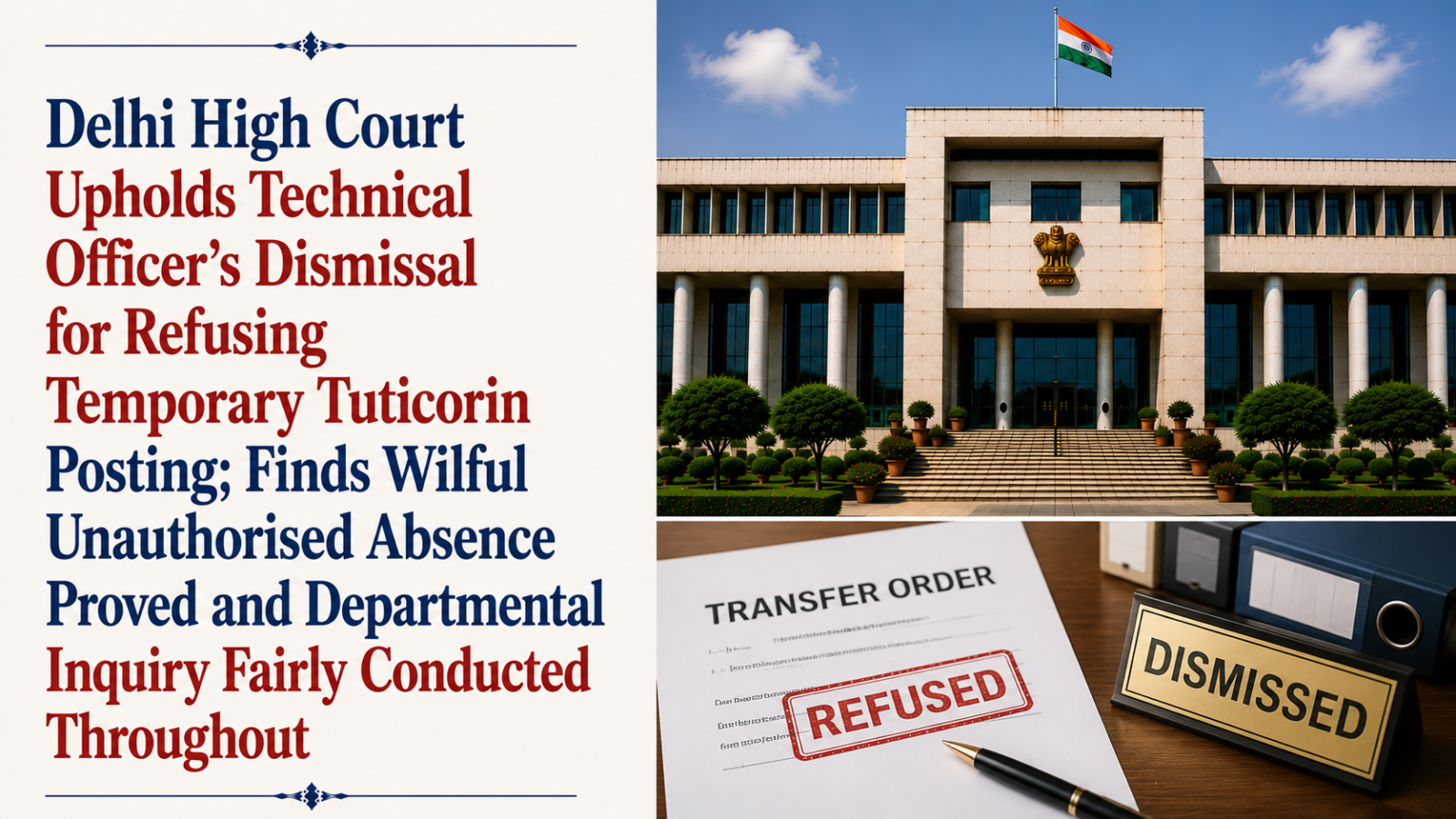
Delhi High Court Dismisses Technical Officer’s Service Appeal; Finds Transfer Valid, Charges Proved, Inquiry Fair and Penalty of Dismissal Not Disproportionate
Facts
Parveen Kumar was serving as a Technical Officer with the Export Inspection Agency (EIA), Delhi. By an order dated 11 April 2014, he was relieved from Delhi and directed to temporarily join EIA Chennai’s Sub-Office at Tuticorin because of administrative exigencies.
The appellant did not join at Tuticorin.
The authorities repeatedly directed him to report for duty through communications dated 6 May, 13 May, 23 May, 27 May and 30 May 2014.
Instead, on 16 May 2014, the appellant sought voluntary retirement and also submitted a leave application and representations. His leave application was rejected on 23 May 2014, while his request for voluntary retirement was rejected on 27 May 2014.
He was again directed to join Tuticorin by 5 June 2014. When he failed to do so, a charge-sheet dated 5 June 2014 was issued containing two charges:
- wilful disobedience of the temporary posting order and continued failure to report despite repeated directions; and
- unauthorised absence and failure to properly specify the nature and particulars of the leave sought.
Following a departmental inquiry, the Inquiry Officer found both charges proved.
The disciplinary authority accepted the findings and, on 5 April 2016, dismissed the appellant from service. His statutory appeal was rejected on 21 February 2017.
The appellant challenged both orders in W.P.(C) 4788/2017. A Single Judge dismissed his petition on 10 March 2026.
He thereafter filed the present intra-court appeal.
Issues
The principal issues before the Division Bench were:
- Whether the disciplinary proceedings and dismissal order suffered from any jurisdictional or procedural illegality.
- Whether describing the statutory body as the “Export Inspection Council of India” instead of “Export Inspection Council” invalidated the proceedings.
- Whether the temporary posting order to Tuticorin was mala fide or retaliatory.
- Whether the appellant had been denied natural justice because he was not granted a separate personal hearing at the pre-inquiry stage.
- Whether his absence could legally be treated as wilful and unauthorised while his leave request was pending.
- Whether dismissal from service was disproportionate to the misconduct established against him.
- What was the permissible scope of judicial review over findings recorded in departmental proceedings.
Appellant’s Arguments
The appellant, appearing in person, raised several objections to the disciplinary proceedings.
He argued that the proceedings were fundamentally defective because they had been conducted under the name “Export Inspection Council of India”, whereas Section 3 of the Export (Quality Control and Inspection) Act, 1963 creates a statutory body called the “Export Inspection Council”.
He also reiterated that his temporary posting to Tuticorin was motivated by mala fides and retaliation.
The appellant challenged the appointment of the Inquiry Officer and alleged procedural irregularities during the disciplinary proceedings.
He further argued that he had been denied an opportunity for a personal hearing at the pre-inquiry stage as contemplated under Rule 11(4) of the CCS (CCA) Rules.
On the merits of the misconduct, he submitted that since his leave application remained under consideration, his absence could not properly be characterised as unauthorised or wilful.
He relied upon Krushnakant B. Parmar v. Union of India, (2012) 3 SCC 178, to argue that mere absence does not constitute misconduct unless the employer proves that the absence was wilful.
He also invoked the doctrine of proportionality, relying particularly on Raghubir Singh v. General Manager, Haryana Roadways, Hissar, (2014) 10 SCC 301, to challenge the extreme penalty of dismissal.
Respondent’s Arguments
The Export Inspection Council and other respondents defended the disciplinary proceedings and the dismissal.
They maintained that the temporary posting was issued because of genuine administrative exigencies arising from the nature of EIC/EIA’s nationwide export-inspection functions.
The validity of the posting order had already been challenged by the appellant in earlier proceedings and upheld by both the Single Judge and Division Bench.
The respondents contended that the appellant repeatedly failed to comply with the posting order despite several directions and despite rejection of his leave and voluntary-retirement requests.
They further relied upon the departmental record to show that the appellant was afforded a full opportunity to participate in the inquiry, cross-examine witnesses, lead defence evidence and respond to the Inquiry Officer’s report.
Analysis of the Law
The Division Bench emphasised the limited scope of judicial review in disciplinary proceedings.
A High Court exercising jurisdiction under Article 226 does not sit as an appellate authority over the Inquiry Officer or disciplinary authority.
It cannot ordinarily re-appreciate evidence or substitute its own factual conclusions merely because another view may be possible.
Interference with factual findings is warranted where the findings are shown to be perverse, unsupported by evidence, or reached through a process suffering from material illegality or violation of natural justice.
The Court also stressed the requirement of prejudice when procedural violations are alleged.
A procedural irregularity by itself does not necessarily invalidate an entire departmental proceeding. The charged employee must demonstrate that the irregularity resulted in denial of a reasonable opportunity or caused actual prejudice.
Precedent Analysis
Krushnakant B. Parmar v. Union of India
The appellant relied on Krushnakant B. Parmar v. Union of India, (2012) 3 SCC 178 for the proposition that unauthorised absence becomes misconduct only where the absence is shown to be wilful.
The High Court accepted the legal principle but held that it did not assist the appellant.
Here, the Inquiry Officer had considered the evidence and specifically found the charge of unauthorised absence proved. The disciplinary authority independently concurred with that finding and supplied reasons.
Therefore, this was not a case of mere absence without proof of wilfulness.
Raghubir Singh v. General Manager, Haryana Roadways
The appellant relied heavily on Raghubir Singh v. General Manager, Haryana Roadways, Hissar, (2014) 10 SCC 301 to invoke the doctrine of proportionality.
The High Court distinguished the precedent.
In Raghubir Singh, the employee’s absence resulted from genuine constraints, including his judicial custody.
Here, by contrast, the material demonstrated that the appellant’s absence was not attributable to any genuine inability to report for duty. Rather, it appeared to be his deliberate choice not to comply with the Tuticorin posting order.
Accordingly, the doctrine of proportionality could not be invoked to invalidate the dismissal.
Bhupinderpal Singh Gill v. State of Punjab
The Court placed reliance on the Supreme Court’s recent decision in Bhupinderpal Singh Gill v. State of Punjab, 2025 SCC OnLine SC 113.
That decision reiterated that judicial review of disciplinary proceedings primarily examines whether the proceedings were conducted fairly and whether any procedural defect caused prejudice to the charged employee.
Judicial review is “not intended to be an appeal in disguise.”
Applying that principle, the Division Bench found no procedural defect causing prejudice to the appellant.
Other Authorities
The appellant also cited Union of India v. H.C. Goel, State of Assam v. Ranga Mohd., Meghmala v. G. Narasimha Reddy, Mohinder Singh Gill v. Chief Election Commissioner, State of Punjab v. V.K. Khanna, Arjun Chaubey v. Union of India, Mohd. Yunus Khan v. State of U.P., Roshan Lal Tandon v. Union of India and State of A.P. v. Nalla Raja Reddy.
The Court held that none of these authorities assisted the appellant in the factual circumstances of the case.
Court’s Reasoning
The Court first rejected the technical objection concerning the name of the statutory authority.
Referring to the Export Inspection Council as the “Export Inspection Council of India” instead of “Export Inspection Council” was merely a minor deviation in nomenclature. It did not invalidate actions otherwise taken by the competent statutory authority.
The allegation of mala fides in the temporary posting could not be reopened.
The appellant had previously challenged the 11 April 2014 posting order in W.P.(C) 3873/2014. That petition was dismissed, with the Court holding that the temporary posting was valid and issued to meet administrative exigencies.
The Division Bench subsequently affirmed that decision and specifically recognised temporary posting as a valid mode of transfer.
The appellant’s separate challenge to the appointment of the Inquiry Officer had likewise already failed in earlier proceedings.
No Violation of Natural Justice
The Court found that the appellant had received extensive opportunities during the disciplinary proceedings.
He submitted written statements of defence, participated in the regular inquiry, cross-examined the respondents’ witnesses, examined himself as a defence witness, responded to the Presenting Officer’s written brief and submitted representations against the Inquiry Report.
Accordingly, even assuming that he desired a separate oral hearing at the preliminary stage, he failed to demonstrate any prejudice resulting from its absence.
Wilful Refusal to Join Posting
The Court found the factual record particularly significant.
The appellant had been repeatedly directed to report at Tuticorin. His leave application and voluntary retirement request were rejected, yet he continued not to report for duty.
The Court accepted the finding that his continued absence was not caused by circumstances beyond his control but was a conscious choice not to comply with the valid posting order.
Given the nature of EIC/EIA’s functions, officers may frequently be required to serve temporarily at different centres across the country in response to export-related administrative requirements.
In that institutional context, repeated refusal to obey a valid temporary posting order constituted serious misconduct.
The Court therefore found no basis either to reopen the factual findings or to hold that dismissal was disproportionate.
Conclusion
The Delhi High Court held that the appellant had failed to establish any illegality, perversity or violation of natural justice in the departmental proceedings culminating in his dismissal.
The temporary posting to Tuticorin had already been judicially upheld and could not be challenged again on grounds of mala fides.
The charges of wilful disobedience and unauthorised absence had been established through a properly conducted disciplinary inquiry.
The appellant had fully participated in that inquiry and failed to demonstrate any procedural defect that caused prejudice.
The Court also rejected his proportionality challenge, distinguishing cases involving employees who were unable to attend duty because of genuine constraints from the appellant’s deliberate refusal to comply with a valid posting order.
Finding no ground to interfere with the Single Judge’s judgment, the Division Bench dismissed the appeal and all pending applications, without costs.
Case Details
Case: Parveen Kumar v. Export Inspection Council & Ors.
Court: High Court of Delhi at New Delhi
Case Number: LPA 637/2026 with CM APPL. 54081-83/2026; CNR No. DLHC010376022026
Judge: Chief Justice Devendra Kumar Upadhyaya and Justice Tejas Karia; judgment authored by Chief Justice Devendra Kumar Upadhyaya
Date: 18 August 2026; reserved on 14 August 2026
Result: Appeal dismissed; dismissal from service upheld. The Court found the temporary posting valid, unauthorised absence and wilful disobedience proved, disciplinary proceedings fair, and no ground for interference under Article 226.