


Court’s decision
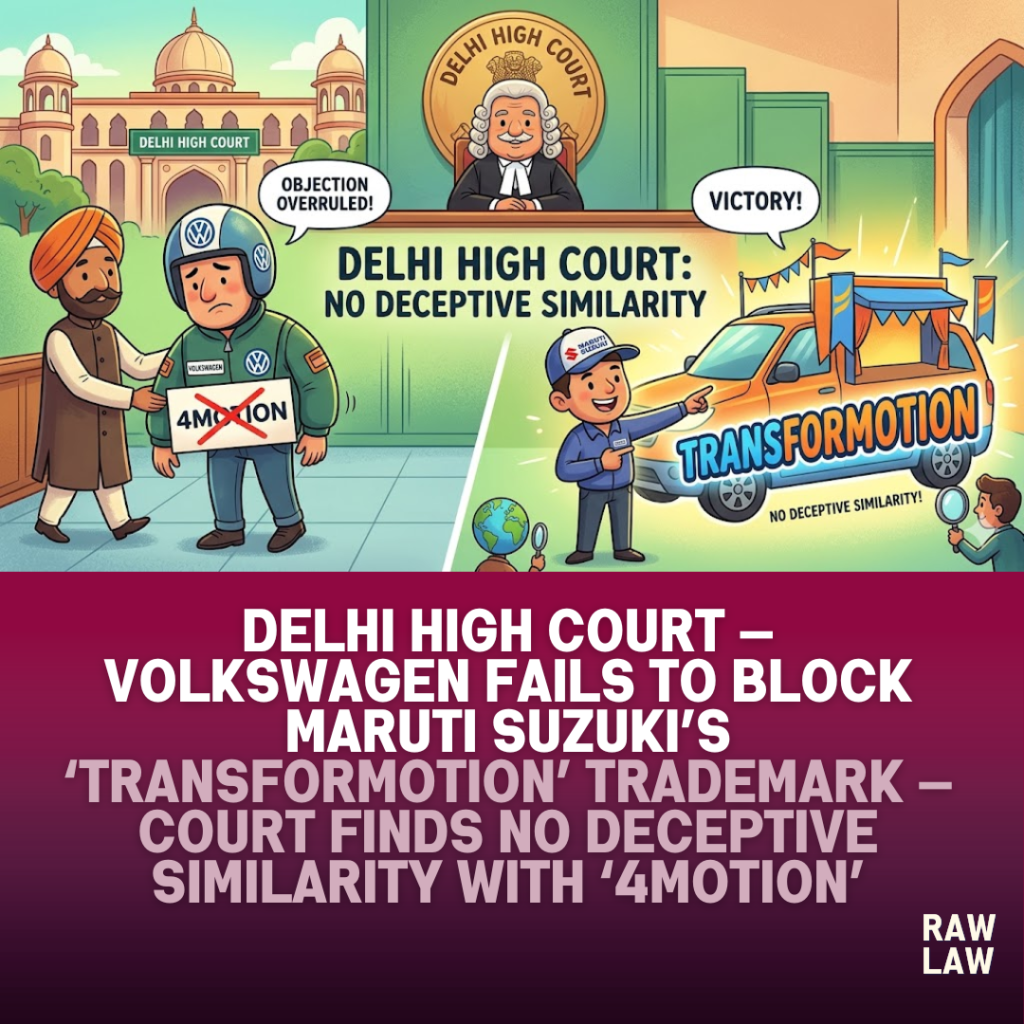
The Delhi High Court examined an appeal filed under the Trade Marks Act challenging an order of the Registrar of Trade Marks that had dismissed Volkswagen’s opposition to the registration of the mark “TRANSFORMOTION.”
After analysing the competing trademarks, the Court held that the Registrar had correctly concluded that the marks were not deceptively similar.
The Court emphasised that trademarks must be assessed as a whole, and dissecting the impugned mark to compare isolated elements is legally impermissible.
Since the rival marks created distinct overall impressions and there was no likelihood of confusion among consumers, the Court dismissed the appeal and upheld the trademark registration granted to Maruti Suzuki.
Facts
Volkswagen AG owns the registered trademark “4MOTION,” which refers to its intelligent all-wheel-drive technology used in certain vehicles.
The trademark was registered in several classes, including Class 12, which covers vehicles and related goods.
In 2015, Maruti Suzuki India Limited applied for registration of the mark “TRANSFORMOTION” in Class 12 for vehicles and related products.
The application was advertised in the Trade Marks Journal in 2017.
Upon learning of the advertisement, Volkswagen filed a notice of opposition, claiming that the mark “TRANSFORMOTION” was deceptively similar to its earlier trademark “4MOTION.”
However, the Registrar of Trade Marks dismissed the opposition and allowed registration of the impugned mark.
Aggrieved by this decision, Volkswagen approached the Delhi High Court.
Issues
The Court considered the following legal questions:
- Whether the trademark “TRANSFORMOTION” is deceptively similar to the trademark “4MOTION.”
- Whether the presence of the common word “MOTION” creates a likelihood of confusion.
- Whether Volkswagen’s prior registration entitled it to prevent registration of the impugned mark.
Petitioner’s arguments
Volkswagen argued that Maruti Suzuki had copied the essential part of its trademark “4MOTION.”
According to the appellant, the impugned mark incorporated the entirety of its mark and merely added the prefix “TRANS.”
Volkswagen contended that its mark “4MOTION” is pronounced as “FORMOTION,” and therefore the dominant portion of both marks—“FORMOTION”—is identical.
It was further argued that the marks were phonetically, visually, and conceptually similar, and that the adoption of the impugned mark would lead to confusion among consumers.
Volkswagen also emphasised that it was the prior registered proprietor of the mark and therefore entitled to prevent registration of deceptively similar marks.
Respondent’s arguments
Maruti Suzuki argued that the two marks must be evaluated in their entirety rather than by isolating individual components.
According to the respondent, the word “MOTION” is commonly used in the automobile industry and cannot be monopolised by a single company.
The respondent further argued that the prefixes of the marks—“4” and “TRANSFOR”—are completely distinct and create a different commercial impression.
Maruti Suzuki also contended that its mark was used as part of an advertising campaign to indicate technological transformation in its vehicles.
Therefore, the impugned mark had a different conceptual meaning and commercial purpose.
Analysis of the law
The Court examined established principles of trademark comparison.
It reiterated that trademarks must be assessed based on their overall impression rather than dissecting them into individual components.
The Court also noted that where a component of a trademark is common or descriptive in a particular industry, greater importance must be given to the distinctive portions of the competing marks.
In the automobile industry, the word “MOTION” is commonly used and therefore cannot be treated as the decisive element in comparing the rival marks.
Consequently, the comparison must focus on the distinctive parts of the marks.
Precedent analysis
The Court relied on several judicial precedents governing trademark comparison.
In F. Hoffmann-La Roche & Co. Ltd. v. Geoffrey Manners & Co. Pvt. Ltd., the Supreme Court held that trademarks must be considered as a whole rather than dissected.
The Court also referred to J.R. Kapoor v. Micronix India, where the Supreme Court held that when a common word forms part of competing trademarks, the focus must shift to the distinctive elements of the marks.
These precedents guided the Court’s analysis of the rival trademarks.
Court’s reasoning
The Court found that the rival marks were fundamentally different.
First, the marks were visually distinct, since Volkswagen’s mark begins with the numeral “4,” whereas the impugned mark begins with the word “TRANS.”
Second, the marks were phonetically different, as the presence of the prefix “TRANS” significantly alters the pronunciation of the impugned mark.
Third, the Court held that the word “MOTION” is descriptive and commonly used in the automobile industry.
Therefore, it could not be treated as the dominant or distinctive element of the trademarks.
The Court also noted that the impugned mark was used as part of an advertising campaign indicating transformation in vehicle technology, whereas Volkswagen used “4MOTION” to describe its four-wheel-drive system.
These conceptual differences further reduced the likelihood of confusion.
Conclusion
The Delhi High Court concluded that the trademark “TRANSFORMOTION” is not deceptively similar to “4MOTION.”
Since the overall structure, pronunciation, and conceptual meaning of the marks are different, consumers are unlikely to confuse the two.
Accordingly, the Court dismissed the appeal and upheld the registration of Maruti Suzuki’s trademark.
Implications
This judgment reinforces key principles in trademark law, particularly the rule that trademarks must be compared as a whole rather than by dissecting them into components.
The decision also highlights the limited protection available for descriptive or commonly used words within an industry.
For businesses operating in technology-driven sectors such as the automobile industry, the ruling clarifies that shared descriptive elements will not automatically create trademark infringement or deceptive similarity.
Case Law References
- F. Hoffmann-La Roche & Co. Ltd. v. Geoffrey Manners & Co. Pvt. Ltd. (1969)
Held that trademarks must be compared as a whole and not dissected into individual parts. - J.R. Kapoor v. Micronix India (1994)
Held that where a common element is used in competing trademarks, emphasis should be placed on the distinctive parts of the marks. - Corn Products Refining Co. v. Shangrila Food Products Ltd. (1960)
Established that the overall impression created by a trademark is the decisive factor in determining deceptive similarity.
FAQs
1. What is deceptive similarity in trademark law?
Deceptive similarity occurs when two trademarks are so similar that consumers may mistakenly believe the goods originate from the same source.
2. Can companies monopolise common words used in an industry?
Generally no. Words that are descriptive or commonly used in a particular industry cannot usually be monopolised as exclusive trademarks.
3. How do courts compare trademarks in disputes?
Courts compare trademarks based on their overall impression, considering visual, phonetic, and conceptual similarity.