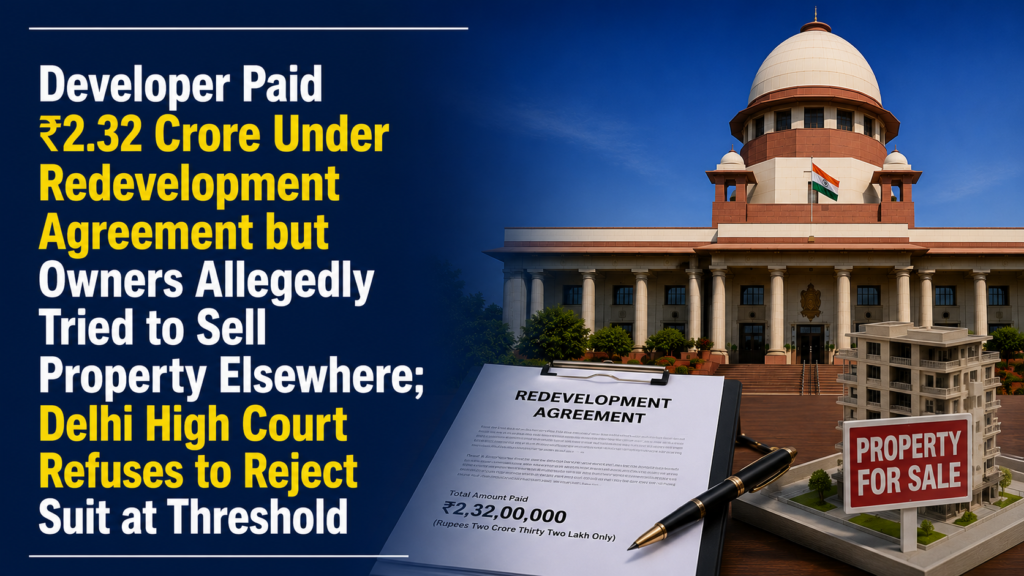
Developer Paid ₹2.32 Crore Under Redevelopment Agreement but Owners Allegedly Tried to Sell Property Elsewhere; Delhi High Court Refuses to Reject Suit at Threshold

Owners Claimed Redevelopment Suit Was Filed Nearly 10 Years Late; Delhi High Court Says Limitation Requires Trial and Declines to Reject Plaint
Facts
The appeal arose from an order refusing to reject a plaint under Order VII Rule 11 CPC.
The respondent, M/s S. Shalu Constructions, entered into a Collaboration Agreement dated 1 February 2013 with the appellants, the joint owners of a property at New Friends Colony, New Delhi, for redevelopment.
Under the agreement:
- the developer agreed to redevelop the property;
- the owners were to receive ₹7.50 crore and specified portions of the redeveloped building;
- the developer allegedly paid ₹2 crore in cash on execution of the agreement, followed by ₹20 lakh and ₹12 lakh to facilitate settlement of pending litigation.
The plaint alleged that the owners were required to:
- conclude pending partition proceedings;
- obtain mutation;
- convert the property from leasehold to freehold;
- thereafter hand over possession.
According to the developer, although building plans were sanctioned in 2013, the owners failed to complete these obligations. The partition proceedings concluded only in 2022, after which the owners allegedly attempted to sell the property to third parties instead of honouring the agreement.
The developer issued a public notice and legal notice before filing a suit in 2023 seeking:
- specific performance;
- permanent injunction;
- alternatively, recovery of money with interest.
The owners sought rejection of the plaint, contending that:
- the suit was barred by limitation under Article 54 of the Limitation Act; and
- it was not maintainable for want of pre-institution mediation under Section 12A of the Commercial Courts Act.
The Single Judge rejected those objections, leading to the present appeal.
Issues
The Division Bench considered:
- Whether the plaint was ex facie barred by limitation so as to justify rejection under Order VII Rule 11(d) CPC.
- Whether limitation could be determined solely from the pleadings without recording evidence.
- Whether the Collaboration Agreement fixed a definite date for performance.
- Whether the owners’ obligations were conditions precedent before possession became due.
- Whether the dispute qualified as a “commercial dispute” under the Commercial Courts Act.
- Whether failure to undertake pre-institution mediation rendered the suit non-maintainable.
Appellants’ Arguments
The owners argued that:
- the Collaboration Agreement was executed on 1 February 2013;
- substantial payments and sanctioned plans existed by 2013;
- one receipt specifically contemplated possession by 5 February 2014.
Therefore, according to them:
- limitation commenced, at the latest, on 5 February 2014;
- the suit filed in December 2023 was hopelessly barred under Article 54.
They further contended that the developer could not indefinitely postpone limitation merely because partition proceedings continued.
The appellants also argued that:
- the dispute was a commercial dispute;
- Section 12A of the Commercial Courts Act made pre-institution mediation mandatory;
- the suit was therefore liable to be rejected on that ground as well.
Respondent’s Arguments
The developer submitted that possession was never intended to be delivered immediately.
Instead, the agreement required the owners first to:
- conclude pending litigation;
- obtain mutation;
- convert the property into freehold.
According to the plaint:
- those obligations were completed only in 2022;
- thereafter a legal notice demanding performance was issued in November 2023;
- the owners failed to comply.
The developer therefore argued that:
- the cause of action arose only after refusal following completion of those prerequisite obligations;
- limitation required evidence and could not be decided at the threshold.
It also disputed that the agreement constituted a commercial dispute attracting Section 12A.
Analysis of the Law
Limitation Under Article 54
The Court reiterated that Article 54 prescribes two alternative starting points:
- where a date for performance is fixed; or
- where no date is fixed, from the date when refusal becomes known.
The Court found that the plaint did not simply allege a promise to hand over possession by a calendar date.
Instead, it specifically pleaded that possession would follow only after:
- completion of pending litigation;
- mutation;
- conversion to freehold.
Whether these contractual obligations operated as conditions precedent required interpretation of the agreement and surrounding circumstances.
Such issues could not be decided merely by reading one receipt in isolation.
Reciprocal Obligations Require Trial
The Court observed that the plaint consistently alleged that:
- redevelopment depended upon completion of reciprocal obligations by the owners;
- the partition proceedings concluded only in 2022.
Assuming those averments to be true—as the Court must while considering Order VII Rule 11—the developer’s right to sue could not be said to have arisen before completion of those proceedings.
Whether that version ultimately proves correct is a matter for trial.
Accordingly, limitation could not be conclusively determined at the preliminary stage.
Scope of Order VII Rule 11
The Division Bench reaffirmed settled law governing rejection of plaints.
While deciding an application under Order VII Rule 11:
- only the plaint and accompanying documents are examined;
- all plaint averments are assumed to be true;
- disputed questions cannot be adjudicated.
Where limitation depends upon:
- reciprocal obligations;
- conduct of parties;
- refusal to perform;
- extension of time;
- readiness and willingness;
the issue becomes a mixed question of law and fact requiring evidence.
Consequently, rejection of the plaint would be impermissible.
Commercial Courts Act
The Court rejected the argument based upon Section 12A.
It held that the present Collaboration Agreement was not merely a construction contract.
Instead:
- the developer was to receive proprietary rights in portions of the redeveloped building along with an undivided share in the land.
Such proprietary rights distinguished the agreement from an ordinary construction contract.
Accordingly, the dispute did not fall within the definition of a commercial dispute under Section 2(1)(c) of the Commercial Courts Act.
Since the Act itself was held inapplicable, the requirement of pre-institution mediation under Section 12A also did not arise.
Precedent Analysis
Ahmadsahab Abdul Mulla (2) v. Bibijan
The Supreme Court explained that where no definite date for performance exists, limitation begins only when the plaintiff receives notice of refusal.
The Division Bench relied on this principle while holding that the agreement required interpretation before deciding limitation.
Panchanan Dhara v. Monmatha Nath Maity
The Supreme Court held that where contractual performance depends upon reciprocal obligations or statutory formalities, limitation may commence only after those obligations are fulfilled or performance is refused.
The Court applied this principle because the developer pleaded that possession depended upon completion of partition, mutation and freehold conversion.
Popat and Kotecha Property v. SBI Staff Association
The Supreme Court held that Order VII Rule 11(d) applies only where the plaint itself unmistakably shows the suit is barred by law.
Since the plaint disclosed facts requiring adjudication, rejection was impermissible.
Urvashiben v. Krishnakant Trivedi
The Supreme Court reiterated that limitation cannot be decided at the Order VII Rule 11 stage where the date of refusal requires evidence.
The Division Bench found that principle directly applicable.
Balasaria Construction v. Hanuman Seva Trust
The Supreme Court held that limitation involving mixed questions of law and fact cannot justify rejection of a plaint.
The Court relied upon this decision to dismiss the appeal.
Asif Ali Khan v. Manoj Kumar
The Delhi High Court previously held that an agreement creating proprietary rights in redeveloped property is not merely a construction contract.
Following that judgment, the Division Bench concluded that the present dispute was outside the Commercial Courts Act.
Court’s Reasoning
The Division Bench held that the plaint did not admit only one possible conclusion.
Accepting the plaint as correct—as required under Order VII Rule 11—the Court found:
- the owners themselves allegedly undertook to complete litigation, mutation and conversion before handing over possession;
- the partition proceedings concluded only in 2022;
- refusal to perform allegedly occurred only after legal notice in 2023.
Accordingly:
- limitation required evidence;
- interpretation of the agreement required trial;
- the plaint could not be rejected merely because the agreement was executed in 2013.
The Court further held that:
- the redevelopment agreement created proprietary rights;
- it was not merely a construction contract;
- therefore Section 12A pre-institution mediation was inapplicable.
Finding no error in the Single Judge’s reasoning, the appeal was dismissed.
Conclusion
The Delhi High Court dismissed the appeal.
It upheld the Single Judge’s refusal to reject the plaint under Order VII Rule 11 CPC.
The Court held that:
- limitation depended upon disputed contractual obligations and required trial;
- the plaint was not ex facie barred under Article 54;
- the Collaboration Agreement was not a pure construction contract;
- the Commercial Courts Act and its pre-institution mediation requirement did not apply.
The suit for specific performance was therefore permitted to proceed to trial.
Key Takeaways
- A plaint can be rejected under Order VII Rule 11 only where limitation is apparent from the plaint itself.
- Where reciprocal contractual obligations require interpretation, limitation ordinarily becomes a mixed question of law and fact.
- Courts must assume the plaint to be correct while deciding Order VII Rule 11 applications.
- Performance linked to completion of statutory or contractual preconditions may postpone commencement of limitation.
- Every redevelopment agreement is not automatically a commercial dispute under the Commercial Courts Act.
- Collaboration agreements granting proprietary rights to developers differ from ordinary construction contracts.
- Section 12A pre-institution mediation applies only where the dispute falls within the Commercial Courts Act.
Case Details
Case: Ashok Kaura & Ors. v. S. Shalu Constructions
Court: Delhi High Court (Division Bench)
Case Number: FAO(OS) 56/2026
Judges: Justice Vivek Chaudhary and Justice Renu Bhatnagar
Reserved On: 5 May 2026
Date of Decision: 24 July 2026
Result: Appeal dismissed. Order refusing to reject the plaint under Order VII Rule 11 CPC upheld. Suit held not ex facie barred by limitation, and Section 12A of the Commercial Courts Act held inapplicable.