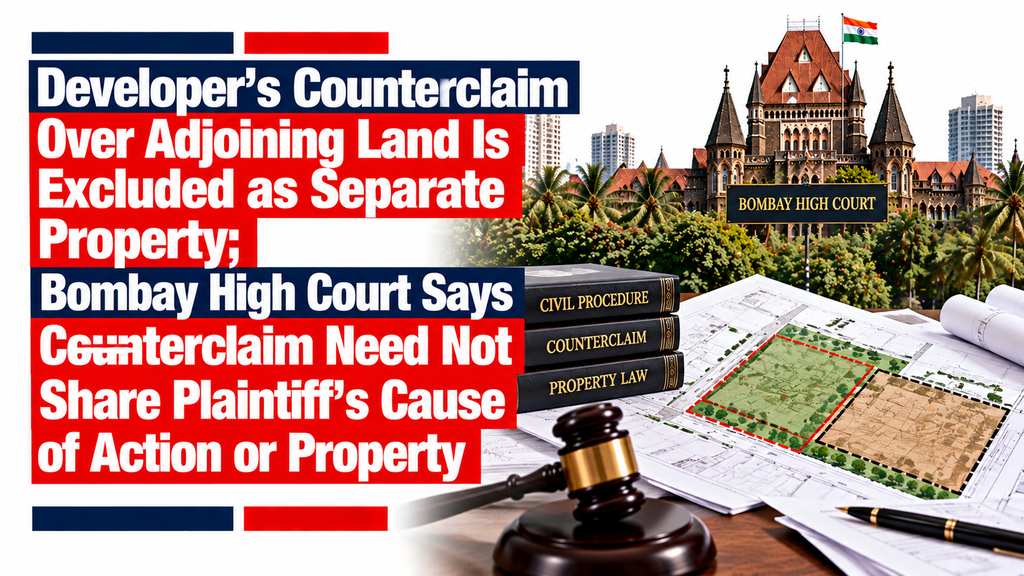
Developer’s Counterclaim Over Adjoining Land Is Excluded as Separate Property; Bombay High Court Says Counterclaim Need Not Share Plaintiff’s Cause of Action or Property

Can a Counterclaim Concern Different Property From the Original Suit? Bombay High Court Says Yes and Sets Aside Trial Court’s Exclusion Order
Facts
The dispute arose between Shradhha Realtors, the plaintiff before the trial court, and M/s Ganesh Land Developers & Construction Pvt. Ltd. and other defendants concerning adjoining parcels of land at Palghar. The plaintiff claimed ownership of Survey Nos. 87/A/1 and 88/A/1 under a registered Sale Deed dated 10 August 2011. Ganesh Land Developers asserted rights over Survey Nos. 93/A/2/K/2, 86/1/E/1 and 121/3. GANESH LAND
Shradhha Realtors alleged that it had obtained planning permission for construction of a ground-plus-seven-floor building and that the defendants attempted to encroach upon its land and obstruct development. It therefore filed RCS No. 35 of 2026, seeking a perpetual injunction restraining the defendants from entering upon or interfering with the suit properties. GANESH LAND
The defendants disputed the plaintiff’s version. They alleged that the plaintiff had obtained permission to construct over land which did not exist at the site as described and was attempting, on the strength of that permission, to encroach upon the defendants’ properties. They filed a written statement together with a counterclaim seeking declaration of their ownership and an injunction against the plaintiff from encroaching upon their properties. GANESH LAND
The trial court had itself earlier observed that the dispute related to the boundaries of the suit properties and counterclaim properties and directed both parties to maintain status quo. GANESH LAND
Shradhha Realtors thereafter sought rejection/exclusion of the counterclaim. On 4 July 2026, the Civil Judge, Palghar invoked Order VIII Rule 6-C CPC and excluded it, principally holding that the suit properties and counterclaim properties were different, did not overlap and had no nexus with each other. GANESH LAND
Ganesh Land Developers challenged that order before the Bombay High Court.
Issues
The principal issue was whether a defendant’s counterclaim can be excluded merely because it concerns property different from the property forming the subject matter of the plaintiff’s suit.
The Court also considered:
- Whether a counterclaim must arise from the same cause of action as the plaintiff’s suit.
- Whether the counterclaim must have a nexus with the plaintiff’s claim.
- What limitations Order VIII Rule 6-A CPC places upon counterclaims.
- How judicial discretion under Order VIII Rule 6-C CPC should be exercised.
- Whether the plaintiff, being dominus litis, can effectively insist that a counterclaim be tried separately.
- Whether joint adjudication was preferable in the present boundary and encroachment dispute.
Applicant’s Arguments
Ganesh Land Developers argued that the Civil Judge had fundamentally misunderstood the scope of a counterclaim under Order VIII Rule 6-A CPC.
The plaintiff’s own pleadings showed that the defendants’ properties were situated on the northern side of the plaintiff’s properties, and the alleged interference forming the foundation of the suit itself was attributed to the defendants as holders of those adjoining lands. GANESH LAND
More importantly, the applicant argued that there is no legal requirement that the subject matter of a suit and counterclaim must be identical.
The validity of a counterclaim depends upon the accrual of a cause of action in favour of the defendant against the plaintiff within the period prescribed under Order VIII Rule 6-A—not upon identity of properties.
Reliance was placed principally upon the Supreme Court judgment in Jag Mohan Chawla v. Dera Radha Swami Satsang, (1996) 4 SCC 699. GANESH LAND
Respondent’s Arguments
Shradhha Realtors supported the trial court’s order.
It argued that the properties involved in the suit and counterclaim were completely distinct. Therefore, according to the plaintiff, there was no sufficient nexus to justify their adjudication in the same proceedings.
The plaintiff further argued that no prejudice would be caused to Ganesh Land Developers because the defendants remained free to institute an independent suit for declaration, ownership and possession regarding their properties. GANESH LAND
It was also argued that a defendant does not possess an absolute right to have every counterclaim tried with the plaintiff’s suit. Order VIII Rule 6-C expressly gives the court discretion to exclude a counterclaim where it should appropriately be adjudicated independently.
Reliance was placed upon Satyender v. Saroj, (2022) 17 SCC 154, and the Bombay High Court’s decision in Abhishek Boke v. Dr. Ashwinikumar Arvind Deshmukh, 2017 (1) Mh.L.J. 342. GANESH LAND
Analysis of the Law
Counterclaim Can Have an Independent Cause of Action
The High Court examined Order VIII Rule 6-A CPC.
The provision permits a defendant to raise “any right or claim in respect of a cause of action accruing to the defendant against the plaintiff”, subject principally to the prescribed temporal and pecuniary limitations.
The Court held that the restriction concerns when the defendant’s cause of action arose, rather than whether the counterclaim concerns the same subject matter as the plaintiff’s suit. GANESH LAND
There is also no restriction in Rule 6-A concerning the nature or type of right that may be asserted.
The counterclaim does not have to flow from the plaintiff’s claim. Its statutory function is broader: it operates as a cross-suit, enabling competing claims between the parties to be determined in the same proceedings. GANESH LAND
Different Property Is Not a Bar
The Court relied heavily upon Jag Mohan Chawla v. Dera Radha Swami Satsang.
The Supreme Court had held that a counterclaim may arise from an independent cause of action and:
- need not relate to the plaintiff’s original cause of action;
- need not have a nexus with the plaintiff’s cause of action; and
- may even concern a different property.
The legislative purpose behind Rules 6-A to 6-G is to avoid multiplicity of proceedings by enabling the original suit and the cross-suit to be decided together. GANESH LAND
The Bombay High Court therefore expressly observed:
“Though the identity of the property may be different that does not warrant dismissal of the counter-claim.” GANESH LAND
Satyender v. Saroj Distinguished
The plaintiff relied upon the Supreme Court’s three-Judge Bench decision in Satyender v. Saroj to argue that a counterclaim involving property outside the original suit could be excluded.
The High Court rejected this interpretation.
It explained that Satyender did not overrule or depart from Jag Mohan Chawla. In fact, Satyender expressly reaffirmed that a counterclaim may arise from a separate or independent cause of action. GANESH LAND
The difficulty in Satyender was different: the counterclaim there was not genuinely directed against the plaintiffs in relation to the properties concerned.
Thus, Satyender could not be read as establishing a general proposition that a counterclaim must concern the same property as the original suit.
The High Court held that a counterclaim “can be made by the defendant, even on a separate or independent cause of action.” GANESH LAND
Order VIII Rule 6-C — Exclusion Is Discretionary
The Court next considered the scope of Order VIII Rule 6-C CPC.
The provision permits a plaintiff, before settlement of issues concerning the counterclaim, to request that the counterclaim be excluded and independently tried.
However, exclusion is not automatic merely because the plaintiff asks for it.
The discretion belongs to the court and must be exercised judicially, taking into account all relevant circumstances. It cannot be exercised arbitrarily or merely according to the plaintiff’s preference. GANESH LAND
Plaintiff Is Dominus Litis — But Not Absolutely
The Court considered Abhishek Boke, where emphasis had been placed upon the plaintiff’s status as dominus litis and the need to give appropriate weight to the plaintiff’s request for exclusion.
Justice N.J. Jamadar clarified that this principle does not give the plaintiff carte blanche.
If the plaintiff’s preference were automatically decisive, the judicial discretion expressly conferred upon the court by Rule 6-C would effectively become subordinate to the plaintiff’s wishes.
The plaintiff’s application must therefore receive consideration—but it need not necessarily be accepted. GANESH LAND
Rules 6-A and 6-C Must Be Read Together
The High Court held that Order VIII Rules 6-A and 6-C must be harmoniously construed.
Rule 6-A facilitates adjudication of a defendant’s independent claim in the same proceeding, while Rule 6-C allows exclusion in appropriate circumstances.
Giving overriding primacy to Rule 6-C or to the plaintiff’s wishes would undermine the very legislative objective behind counterclaims: avoiding multiplicity and resolving disputes between the same parties within one proceeding. GANESH LAND
When Can a Counterclaim Be Excluded?
Importantly, the High Court did not hold that counterclaims can never be separated.
The Court identified several considerations that may legitimately justify exclusion:
- the nature of the counterclaim;
- the stage and progress of the original suit;
- complexity likely to arise from trying both together;
- whether joint trial would substantially prolong the proceedings; and
- other circumstances affecting convenient and effective adjudication.
However, the plaintiff’s mere assertion that it wants a separate trial cannot be decisive. GANESH LAND
Application to the Present Property Dispute
The trial court’s fundamental error was that it treated the alleged difference between the suit properties and counterclaim properties as sufficient reason for exclusion.
The High Court held that this was the wrong legal test because identity of property is not required for maintaining a counterclaim. GANESH LAND
There was also a factual error.
The plaintiff’s own pleadings showed that the counterclaim properties—particularly Survey Nos. 121/3 and 93/A/2/K/3—were situated along the northern boundary of the plaintiff’s properties.
The plaintiff itself alleged that the defendants, as owners of those adjoining properties, were interfering with and attempting to encroach upon the plaintiff’s land. GANESH LAND
Therefore, the two disputes were not factually disconnected.
They arose from competing claims concerning contiguous/adjoining properties, boundaries, possession and alleged encroachment.
Why Joint Trial Was Necessary
The High Court held that determination of the suit and counterclaim in the same proceedings was “indispensable for a complete and effectual adjudication” of the disputes.
Separating them would create:
- multiplicity of proceedings;
- prolonged litigation; and
- a risk of conflicting judicial orders.
The trial court had therefore failed to exercise its discretion under Order VIII Rule 6-C judicially. GANESH LAND
Precedent Analysis
Jag Mohan Chawla v. Dera Radha Swami Satsang, (1996) 4 SCC 699 — The principal authority. A counterclaim may be founded upon an independent cause of action and need not concern the same property or arise from the plaintiff’s cause of action. Its purpose is to avoid multiple proceedings. GANESH LAND
Satyender v. Saroj, (2022) 17 SCC 154 — Distinguished. The Supreme Court did not depart from Jag Mohan Chawla. The counterclaim there failed because it was not properly a claim against the plaintiffs; the judgment does not establish that every counterclaim must concern the same property. GANESH LAND
Abhishek Boke v. Dr. Ashwinikumar Arvind Deshmukh, 2017 (1) Mh.L.J. 342 — The plaintiff’s request for exclusion deserves weight, but the High Court clarified that the principle of dominus litis does not confer an absolute veto over a counterclaim. GANESH LAND
Reserve Bank of India v. Peerless General Finance & Investment Co. Ltd., AIR 1987 SC 1023 — Applied for the principle that statutory provisions must be construed contextually and harmoniously as part of the statute as a whole. GANESH LAND
Court’s Reasoning
The High Court identified two fundamental errors in the trial court’s approach.
First, the trial court committed an error of law by assuming that the suit property and counterclaim property must be identical or substantially overlap. Order VIII Rule 6-A imposes no such requirement.
Second, even the factual finding that there was no nexus was incorrect. The plaintiff’s own pleadings showed that the defendants’ properties were adjoining the plaintiff’s land and that the dispute itself arose from allegations of boundary interference and encroachment.
The question was therefore not simply whether the survey numbers were different. The real question was whether the competing claims could be effectively adjudicated together.
Since both sides were asserting rights over adjoining lands and accusing each other of interference and encroachment, separate proceedings would unnecessarily duplicate evidence and potentially produce inconsistent findings.
The trial court had consequently exercised its discretion under Order VIII Rule 6-C on an incorrect legal and factual foundation.
Conclusion
The Bombay High Court allowed the Civil Revision Application.
It quashed and set aside the Civil Judge’s order dated 4 July 2026, which had excluded the counterclaim, and restored the counterclaim to the trial court.
The trial court was directed to decide the original suit and counterclaim in accordance with law as expeditiously as possible. The High Court clarified that its observations concerned only the legality of excluding the counterclaim and did not express any opinion on the merits of the competing property claims. GANESH LAND
The central proposition emerging from the judgment is clear: a counterclaim need not concern the same property or arise from the same cause of action as the plaintiff’s suit. Where joint adjudication would resolve interconnected disputes and prevent multiplicity, exclusion merely because the properties bear different descriptions or survey numbers is legally unsustainable.
Case Details
Case: M/s Ganesh Land Developers & Construction Private Limited v. Shradhha Realtors & Ors.
Court: Bombay High Court, Civil Appellate Jurisdiction
Case No.: Civil Revision Application No. 409 of 2026 GANESH LAND
CNR No.: HCBM010358432026
Neutral Citation: 2026:BHC-AS:39681
Judge: Justice N. J. Jamadar
Reserved On: 7 September 2026
Pronounced On: 29 September 2026 GANESH LAND
Impugned Order: Order dated 4 July 2026 passed by the Civil Judge, Palghar in RCS No. 35 of 2026, excluding the counterclaim under Order VIII Rule 6-C CPC. GANESH LAND
Result: Civil Revision Application allowed; impugned order quashed; counterclaim restored; trial court directed to decide the suit and counterclaim expeditiously. No costs.