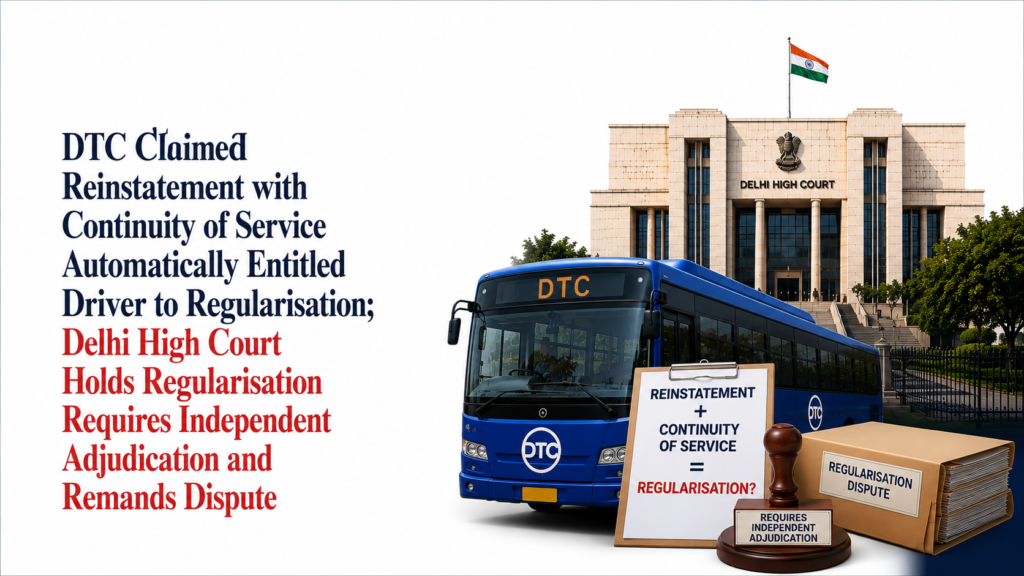
Driver Reinstated with Continuity of Service Sought Retrospective Regularisation; Delhi High Court Holds Such Relief Requires Independent Examination and Remands Matter
Facts
Shamsher Singh was appointed as a Retainer Crew Driver with the Delhi Transport Corporation (DTC) on a daily-wage basis in March 1982. His services were terminated in July 1983 following his alleged involvement in a fatal accident. He challenged the termination before the Industrial Tribunal, which, in 1999, directed his reinstatement with continuity of service and 50% back wages. DTC’s challenge to that award failed, and he was reinstated in 2002 as a daily-rated Retainer Crew Driver.
Subsequently, the workman sought regularisation as a Driver from the date of his initial appointment, claiming that employees junior to him had already been regularised during the period he remained out of service. The Industrial Tribunal accepted his claim and directed DTC to regularise his services retrospectively from 2 March 1982 with all consequential benefits. DTC challenged that award before the Delhi High Court.
Issues
- Whether reinstatement with continuity of service automatically entitled the workman to retrospective regularisation.
- Whether the Industrial Tribunal correctly interpreted the legal effect of continuity of service.
- Whether the Tribunal properly examined the applicable service rules governing Retainer Crew Drivers before granting regularisation.
- Whether the workman’s plea of discrimination vis-à-vis junior employees had been properly adjudicated.
Petitioner’s Arguments
DTC contended that the earlier Industrial Tribunal award merely granted reinstatement with continuity of service and 50% back wages and did not confer any right to regularisation. It argued that reinstatement restored the workman only to the position he occupied before termination, namely that of a daily-rated Retainer Crew Driver. Under the applicable service conditions, regularisation depended upon factors such as merit, seniority, conduct, performance and availability of vacancies and could not be claimed automatically.
It was further argued that the Tribunal wrongly equated continuity of service with permanent status and ignored the distinction between reinstatement, absorption and regularisation. According to DTC, the award was contrary to settled principles of service jurisprudence and liable to be set aside.
Respondent’s Arguments
The workman argued that once reinstatement with continuity of service had attained finality, he had to be treated as having remained in uninterrupted service. Denying regularisation from the date on which he would otherwise have become eligible would render the earlier award meaningless and unfairly place him below employees who were junior to him.
He also contended that continuity of service necessarily carried consequential benefits, including seniority, increments, promotional avenues and retirement benefits. Since similarly situated employees had allegedly been regularised during the period of his illegal termination, he claimed parity with them.
Analysis of the Law
The High Court explained the legal distinction between reinstatement, continuity of service, and regularisation. Reinstatement merely restores the employer-employee relationship after an illegal termination, while continuity of service removes the artificial break in service for purposes recognised by law, such as qualifying service or retirement-related benefits. Neither concept, by itself, creates an automatic right to regularisation.
The Court further held that regularisation is an independent concept governed by statutory provisions, service rules and constitutional principles relating to public employment. A claim for regularisation must therefore be independently examined on the basis of the applicable service policy, comparative treatment of similarly situated employees and relevant evidence, rather than being inferred solely from an earlier order granting continuity of service.
Precedent Analysis
- Deepali Gundu Surwase v. Kranti Junior Adhyapak Mahavidyalaya – Relied upon to explain the concepts of reinstatement and continuity of service and clarify that the consequences depend upon the relief granted and applicable service rules.
- Allahabad Bank v. Prem Singh – Cited to hold that reinstatement does not automatically confer permanent status or regular appointment.
- Regional Manager, SBI v. Mahatma Mishra – Relied upon to reiterate that continuation in service alone does not create a legal right to regularisation.
- Secretary, State of Karnataka v. Uma Devi – Referred to for the principle that regularisation cannot become an alternative mode of public recruitment and must comply with constitutional requirements.
- State of Rajasthan v. Dayalal – Cited to hold that neither long service nor reinstatement with continuity automatically entitles an employee to regularisation.
Court’s Reasoning
The High Court held that the Industrial Tribunal fundamentally erred in treating the earlier award granting reinstatement with continuity of service as creating a vested right to retrospective regularisation. The previous award dealt only with the legality of termination and did not decide or imply any entitlement to regularisation. Therefore, the workman’s claim for regularisation constituted an independent dispute requiring separate adjudication under the applicable service conditions.
The Court further observed that the Tribunal failed to appreciate the legal distinction between absorption and regularisation and did not examine whether the governing service policy actually entitled the workman to retrospective regularisation. It also noted that neither party had produced sufficient documentary evidence regarding comparative seniority, applicable policies or the alleged regularisation of junior employees. Despite these evidentiary deficiencies, the Tribunal granted retrospective regularisation without analysing the governing rules or recording adequate reasons. Such an approach, according to the Court, rendered the award legally unsustainable.
Since the workman’s plea of discrimination vis-à-vis junior employees had never been properly examined, the Court held that the matter required fresh consideration by the Industrial Tribunal based on the applicable service framework and relevant evidence, without expressing any opinion on the ultimate merits of the claim.
Conclusion
The Delhi High Court allowed DTC’s writ petition, set aside the Industrial Tribunal’s award granting retrospective regularisation, and remanded the dispute for fresh adjudication. It held that reinstatement with continuity of service does not automatically entitle a workman to regularisation and that such a claim must be independently determined with reference to the applicable service rules, evidence and governing policy.
Case Details
- Case: D.T.C. v. Shamsher Singh
- Court: Delhi High Court
- Case Number: W.P.(C) 530/2006
- Judge: Justice Shail Jain
- Date: 28 July 2026
- Result: Writ petition allowed; Industrial Tribunal’s award set aside and matter remanded for fresh adjudication.