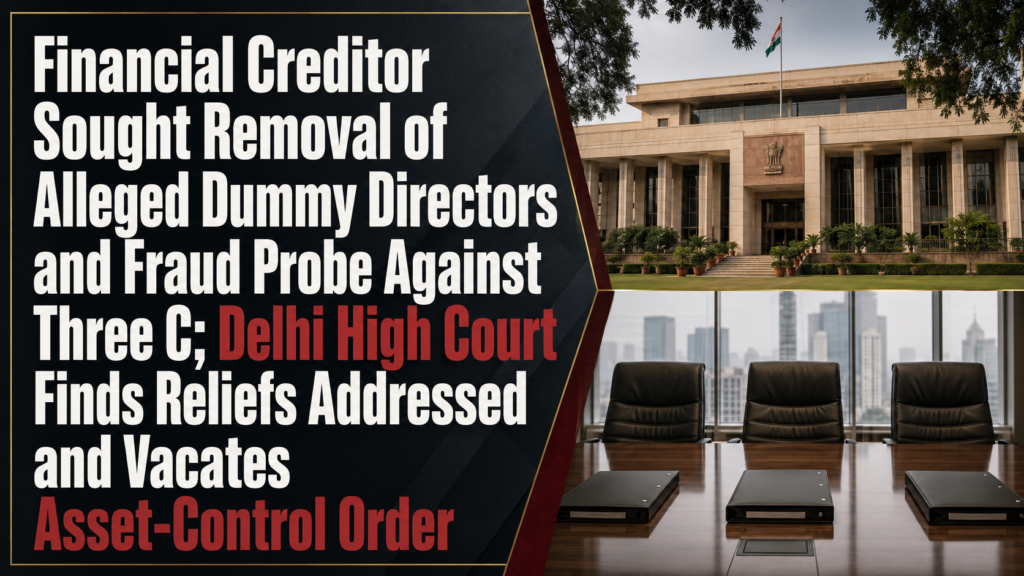
Three C’s Director Records Were Corrected and Insolvency Proceedings Revived; Delhi High Court Disposes Financial Creditor’s Writ
Facts
Nishit Badola was a financial creditor and claimant of Three C Shelters Private Limited, a company incorporated on 31 December 2010.
Corporate insolvency proceedings were initiated against Three C after Straight Edge Contracts Private Limited filed an application under Section 9 of the Insolvency and Bankruptcy Code, 2016.
The National Company Law Tribunal admitted the insolvency petition in 2020, commenced the Corporate Insolvency Resolution Process and appointed an Interim Resolution Professional.
Subsequent proceedings raised allegations that:
- Three C and Straight Edge had collusively initiated insolvency proceedings;
- Individuals projected as directors were merely office or pantry employees;
- Money collected from homebuyers had been diverted to related entities; and
- Assets had allegedly been created from the diverted funds.
The National Company Law Appellate Tribunal recalled the insolvency admission orders on 28 August 2023. However, the Supreme Court stayed that decision on 19 November 2024 and directed that Three C’s Corporate Insolvency Resolution Process should continue.
Dispute Over Company Records
The petitioner alleged that the Ministry of Corporate Affairs’ online master data incorrectly reflected:
- Rajiv Baisoya as a director; and
- Girish Chander Joshi as an additional director despite the expiry of his tenure.
The petitioner sought:
- Removal of Rajiv Baisoya’s name from Three C’s records;
- Removal of expired additional directors, including Girish Chander Joshi;
- An investigation into the alleged fraud; and
- Appropriate consequential relief.
Interim Order Dated 22 October 2024
During the writ proceedings, the Delhi High Court passed an interim order directing the Ministry of Corporate Affairs to show Three C’s status as “under Corporate Insolvency Resolution Process.”
The Court also permitted the Interim Resolution Professional to take specified measures for protecting assets allegedly connected with Three C, including:
- Increasing security at identified properties;
- Taking steps against alleged trespassers;
- Protecting identified assets;
- Seeking mutation of allegedly laundered assets in Three C’s name;
- Publicising claims concerning diverted assets;
- Identifying further properties allegedly created from diverted funds; and
- Conducting meetings of financial creditors.
The identified properties included:
- Hotel Plot Number A-3a at Nehru Place, New Delhi; and
- Units in the Ace Palm Floors Project at Sector 89, Gurugram.
Recall Applications
Bright Buildtech Private Limited, Lavender Infra Projects Private Limited and other companies claiming ownership, mortgage or security interests over the affected properties sought recall of the interim order.
They argued that they had neither been made parties nor heard before directions affecting their properties were passed.
A Division Bench directed that no steps be taken under the interim order and subsequently permitted the affected parties to seek its recall before the Single Judge.
Subsequent Developments
During the proceedings:
- The Ministry of Corporate Affairs removed the names of Rajiv Baisoya and Girish Chander Joshi from Three C’s director records.
- Three C’s status was shown as being under Corporate Insolvency Resolution Process.
- The Supreme Court revived the insolvency proceedings.
- The Enforcement Directorate issued provisional attachment orders.
- Proceedings concerning restitution and investigation continued before the Supreme Court, the Special Court under the Prevention of Money Laundering Act, the National Company Law Tribunal and other authorities.
- A Coordinate Bench of the Delhi High Court had already directed an investigation into Three C’s affairs through the Serious Fraud Investigation Office.
The petitioner consequently filed an application seeking disposal of the writ petition because its principal concerns had been addressed by subsequent developments.
Issues
- Whether the petitioner’s requests for correction of Three C’s director records continued to survive.
- Whether a separate writ direction for investigation remained necessary.
- Whether the High Court should exercise jurisdiction under Article 226 despite remedies under the Insolvency and Bankruptcy Code, the Prevention of Money Laundering Act and the Companies Act.
- Whether the interim order dated 22 October 2024 could affect properties claimed by third parties who had not been heard.
- Whether the Interim Resolution Professional could take control of, mutate or otherwise proceed against properties whose ownership by Three C had not been judicially determined.
- Whether the interim order could continue after the main writ petition was disposed of without adjudicating the parties’ substantive rights.
- Whether the High Court should determine if the Nehru Place and Ace Palm properties were created from siphoned Three C funds.
Petitioner’s Arguments
The petitioner argued that:
- Three C had committed a large-scale fraud affecting numerous homebuyers and financial creditors.
- Funds collected for the Greenopolis housing project had allegedly been diverted to related entities.
- The entities claiming the properties were proxies or related entities of the Three C Group.
- The High Court possessed broad powers under Article 226 to provide effective relief in cases involving systemic fraud and public interest.
- The interim order protected homebuyers and financial creditors from dissipation of assets.
- Recalling the order would enable the alleged beneficiaries of diverted funds to sell or encumber the properties.
- Reports prepared by the Interim Resolution Professional identified assets allegedly created from siphoned funds.
- Subsequent orders of the Supreme Court, Enforcement Directorate and Special Court supported restitution of attached assets for the benefit of Three C’s creditors.
- Procedural objections should not defeat substantive justice for affected homebuyers.
However, because of the subsequent Supreme Court and Special Court proceedings, the petitioner ultimately sought disposal of the writ petition on the ground that its principal reliefs and concerns had been effectively addressed.
Respondents’ Arguments
Bright Buildtech Private Limited
Bright Buildtech argued that:
- The interim order travelled far beyond the original prayers concerning company records and investigation.
- It was not a party when the order was passed.
- The order affected units in the Ace Palm Project and third-party homebuyers.
- The Interim Resolution Professional’s status report was only an opinion and not a judicial determination.
- No competent forum had held that its assets were acquired from Three C’s diverted funds.
- It was not part of the Three C Group.
- The resolution professional lacked adjudicatory powers to decide ownership.
Lavender Infra Projects Private Limited
Lavender argued that:
- It owned the Nehru Place property through a registered Conveyance Deed dated 19 September 2011.
- The Haryana Real Estate Regulatory Authority and Haryana Real Estate Appellate Tribunal had recognised its ownership.
- The property dispute was already pending before other competent forums.
- The Interim Resolution Professional could take possession only of assets owned by the corporate debtor.
- Three C’s ownership of the Nehru Place property had never been established.
- The interim order was passed without notice and violated natural justice.
Mortgage and Security Claimants
Delhi Brass and Metal Works Private Limited and other applicants argued that:
- They held prior mortgage and security interests over the Nehru Place property.
- Their rights arose before Three C’s insolvency proceedings.
- The property was acquired in 2011, while the alleged transfer of diverted funds occurred later.
- The National Company Law Tribunal was already seized of the dispute.
- The High Court could not permit liquidation or control of third-party property solely on the basis of an unadjudicated report.
- The affected parties had been condemned without being heard.
Ministry of Corporate Affairs
The Ministry explained that:
- The Insolvency and Bankruptcy Board of India was authorised to request changes in a company’s insolvency status.
- The earlier status change was made pursuant to such a request.
- The names of Rajiv Baisoya and Girish Chander Joshi had subsequently been removed.
- The relevant company forms had been supplied to the Interim Resolution Professional.
Analysis of the Law
Availability of Alternative Statutory Remedies
The Court held that the allegations concerning fraud, diversion of funds, corporate assets and money laundering could be investigated and adjudicated under:
- The Insolvency and Bankruptcy Code, 2016;
- The Prevention of Money Laundering Act, 2002; and
- The Companies Act, 2013.
The National Company Law Tribunal was already seized of the insolvency proceedings after the Supreme Court revived the Corporate Insolvency Resolution Process.
The Enforcement Directorate had issued provisional attachment orders, and a separate investigation into Three C’s affairs had already been directed through the Serious Fraud Investigation Office.
The Court therefore found no reason to conduct parallel adjudication under Article 226.
Natural Justice
The applicants seeking recall were not parties when the order dated 22 October 2024 was passed.
Nevertheless, that order directly affected properties over which they claimed:
- Ownership;
- Possession;
- Mortgage rights; or
- Other security interests.
The Court held that passing such directions without notice or an opportunity of hearing violated the principles of natural justice.
Interim Relief Cannot Survive Without Main Relief
An interim order exists only to support final relief that may ultimately be granted in the principal proceeding.
Once the main writ petition is disposed of without deciding the parties’ substantive rights, the Court cannot keep the interim protection alive merely to enable a party to approach another forum.
The Court therefore rejected the request to continue the interim order for an additional period.
Precedent Analysis
Radha Krishan Industries v. State of Himachal Pradesh, (2021) 6 Supreme Court Cases 771
The Supreme Court held that the existence of an alternative remedy does not remove the High Court’s jurisdiction under Article 226. However, the High Court ordinarily declines to exercise that jurisdiction when an effective statutory remedy exists.
Recognised exceptions include:
- Enforcement of fundamental rights;
- Violation of natural justice;
- Complete absence of jurisdiction; and
- Challenge to the validity of legislation.
The Delhi High Court relied on this decision to exercise restraint because specialised statutory forums were already available.
Ambika Traders v. Commissioner, 2025 Delhi High Court 6181, Division Bench
The Delhi High Court reiterated that writ jurisdiction is discretionary and should ordinarily not be exercised where an adequate and effective statutory remedy exists.
This principle supported the decision to leave the insolvency, fraud and property disputes to the competent forums.
Mangal Rajendra Kamthe v. Tahsildar, Purandhar, 2026 Indian Supreme Court Cases 185
The Supreme Court held that where a High Court declines to entertain a writ petition because of an alternative remedy, it cannot continue interim relief as the only surviving relief.
The Delhi High Court applied this principle while refusing to extend its order dated 22 October 2024.
State of Orissa v. Madan Gopal Rungta
The Constitution Bench held that interim relief under Article 226 can be granted only in aid of final relief that the High Court may grant.
Where the Court declines to determine substantive rights and leaves the parties to another forum, it cannot issue or continue temporary injunctions as a standalone final outcome.
Swiss Ribbons Private Limited v. Union of India, (2019) 4 Supreme Court Cases 17
The recall applicants relied upon this judgment to argue that an Interim Resolution Professional performs administrative and facilitative functions and does not possess adjudicatory authority to finally determine ownership.
The High Court did not decide the rival ownership claims on their merits.
Embassy Property Developments Private Limited v. State of Karnataka, (2020) 13 Supreme Court Cases 308
The applicants relied on this decision to argue that insolvency authorities and resolution professionals must operate within their statutory jurisdiction and cannot treat disputed third-party property as a corporate debtor’s asset without legal determination.
Again, the High Court left this controversy open for adjudication by the competent forum.
Broad Writ-Power Decisions
The petitioner relied upon Nur Islam v. State of Assam, Shiv Shankar Dal Mills v. State of Haryana, Andi Mukta Sadguru Trust v. V.R. Rudani and Roshan Deen v. Preeti Lal to argue that writ courts can mould relief to prevent injustice.
The Court accepted that these principles were binding but held that judicial restraint remained the norm where equally efficacious specialised remedies existed.
Court’s Reasoning
The Ministry’s compliance affidavit showed that the names of Rajiv Baisoya and Girish Chander Joshi had been removed from Three C’s records.
The direction requiring the company’s online status to be shown as “under Corporate Insolvency Resolution Process” had also been implemented.
Therefore, the first two prayers stood satisfied.
The petitioner itself stated that the investigation and restitution concerns had been addressed through subsequent proceedings. Accordingly, the third prayer had become infructuous.
The Court additionally found that:
- The insolvency proceedings were continuing before the National Company Law Tribunal;
- Money-laundering proceedings were continuing before the Enforcement Directorate and Special Court;
- A Serious Fraud Investigation Office inquiry had already been directed; and
- Several issues were pending before the Supreme Court and other competent authorities.
The High Court therefore declined to adjudicate disputed allegations of ownership, fund diversion or fraud under Article 226.
The earlier interim order directly affected third-party properties without hearing their claimed owners and secured creditors. It therefore violated natural justice.
Since the main writ was being disposed of without any decision on substantive ownership rights, the interim order could not continue independently.
The Court expressly clarified that:
- It had not decided whether the properties were acquired from diverted Three C funds.
- It had not adjudicated the merits of the petitioner’s, resolution professional’s or homebuyers’ allegations.
- The parties remained free to initiate appropriate legal proceedings.
- No order passed by any other competent court or tribunal was modified or vacated.
Conclusion
The Delhi High Court held that:
- The requests to remove the disputed directors’ names had already been satisfied.
- Three C’s status as undergoing Corporate Insolvency Resolution Process had been restored.
- The request for investigation had become infructuous and was also covered by alternative statutory remedies.
- The affected property claimants were not heard before the interim asset directions were issued.
- The interim order dated 22 October 2024 violated natural justice and could not survive disposal of the main writ.
- Ownership, fraud, money-laundering and fund-diversion disputes must be decided by the competent statutory forums.
The Court disposed of the writ petition without deciding the merits and vacated the interim order dated 22 October 2024.
The parties were granted liberty to initiate appropriate proceedings in accordance with law. All pending applications, including applications relating to recall, auction stay and impleadment, were disposed of as infructuous.
Case Details
Case: Nishit Badola v. Union of India Through Ministry of Corporate Affairs and Another
Neutral Citation: 2026:DHC:5770
Court: High Court of Delhi at New Delhi
Case Number: Writ Petition (Civil) Number 174 of 2024 with connected Civil Miscellaneous Applications
Key Applications: Civil Miscellaneous Application Numbers 22897 of 2024; 18080, 18081, 19004, 19005, 50797 and 59752 of 2025; and 7585, 7700, 7759, 7760 and 7792 of 2026
Judge: Justice Jasmeet Singh
Reserved On: 4 May 2026
Pronounced On: 20 July 2026
Result: Writ petition disposed of without adjudicating the merits; interim order dated 22 October 2024 vacated; parties granted liberty to approach competent forums; connected applications disposed of