Two Motorcycles Collided Under Moti Bagh Flyover and One Rider Died; Delhi High Court Says “High Speed” Alone Does Not Prove Rash Driving and Upholds Acquittal

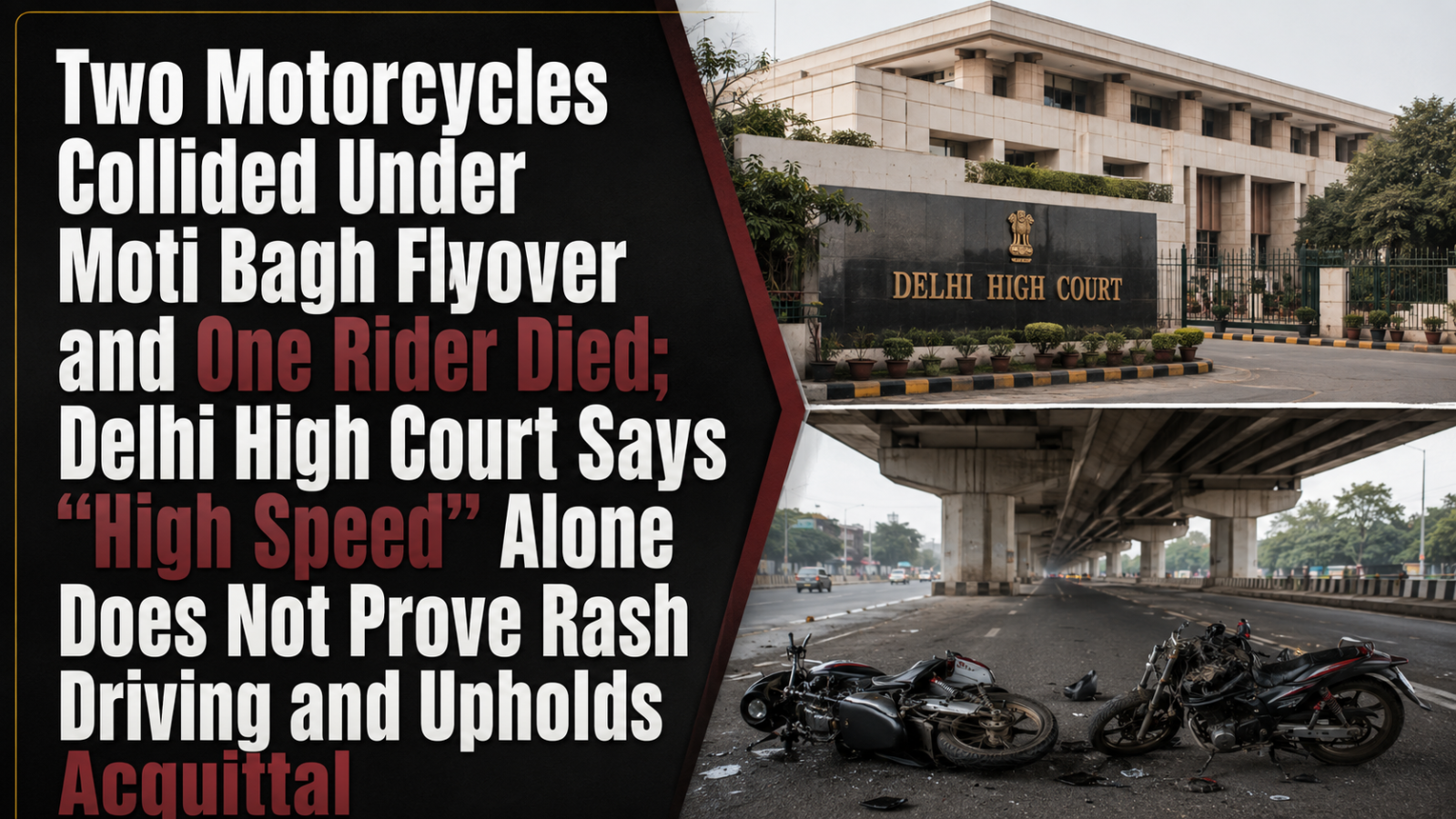
Pillion Rider Called Motorcyclist Fast and Negligent but Could Not Explain How; Delhi High Court Refuses to Reverse Acquittal
Facts
On 4 July 2011, at approximately 11:00 p.m., Vijay Lal was riding a motorcycle near the Moti Bagh flyover in New Delhi. A friend was travelling with him as the pillion rider.
According to the prosecution, another motorcycle ridden by Ram Prakash came from the direction of Rao Tula Ram Marg and struck Vijay Lal’s motorcycle.
All three persons fell and suffered injuries. Vijay Lal sustained serious injuries and subsequently died.
The pillion rider gave a statement on 5 July 2011, based on which First Information Report Number 108 of 2011 was registered at South Campus Police Station.
After investigation, Ram Prakash was prosecuted for offences under:
- Section 279 of the Indian Penal Code, 1860 — rash or negligent driving on a public road;
- Section 337 — causing hurt by a rash or negligent act; and
- Section 304A — causing death by a rash or negligent act not amounting to culpable homicide.
Ram Prakash denied the allegations. In his statement under Section 313 of the Code of Criminal Procedure, 1973, he claimed that Vijay Lal was riding rashly, struck his motorcycle and caused the collision. He also claimed that Vijay Lal and the pillion rider were intoxicated.
The Metropolitan Magistrate at Patiala House Courts acquitted Ram Prakash on 28 January 2016.
The Government of the National Capital Territory of Delhi filed an appeal under Section 378(1) of the Code of Criminal Procedure seeking reversal of the acquittal.
Issues
- Whether the prosecution established that Ram Prakash was riding his motorcycle rashly or negligently.
- Whether the eyewitness’s use of expressions such as “high speed” and “rash and negligent” was sufficient to prove the offences.
- Whether the site plan and surrounding circumstances established how the collision occurred.
- Whether the medical and post-mortem evidence proved that Ram Prakash’s negligent act directly caused Vijay Lal’s death.
- Whether the principle of res ipsa loquitur, meaning that the event speaks for itself, could be applied to presume criminal negligence.
- Whether the Trial Court’s acquittal represented a reasonable possible view of the evidence.
- Whether the High Court should interfere with an acquittal carrying a reinforced presumption of innocence.
Petitioner/Appellant’s Arguments
The State argued that the Trial Court failed to properly appreciate the evidence.
It contended that:
- The pillion rider was an injured eyewitness who had directly witnessed the collision.
- He consistently identified Ram Prakash as the rider of the other motorcycle.
- He stated that Ram Prakash was travelling at great speed and driving rashly and negligently.
- His testimony was corroborated by the Medico-Legal Certificates recording the injuries.
- The post-mortem report established that Vijay Lal died from the injuries sustained in the accident.
- The combined eyewitness and medical evidence was sufficient to prove the offences.
- The Trial Court’s acquittal should therefore be reversed.
Respondent’s Arguments
Ram Prakash was not represented during the final hearing because the lawyers were on strike. There had also been no representation on the preceding date.
The High Court therefore examined the appeal on its merits after independently reviewing the complete record.
During the trial, Ram Prakash had maintained that:
- He was not riding rashly or negligently.
- Vijay Lal was the person riding recklessly.
- Vijay Lal’s motorcycle struck his motorcycle.
- He also fell and suffered serious injuries.
- The prosecution had presented a version contrary to what actually occurred.
- The deceased and the pillion rider had consumed alcohol.
Ram Prakash did not produce independent oral or documentary evidence in defence.
Analysis of the Law
Section 279 of the Indian Penal Code
To establish an offence under Section 279, the prosecution must prove that:
- The accused was driving or riding on a public road; and
- The vehicle was being driven so rashly or negligently as to endanger human life or make injury likely.
The occurrence of an accident by itself is not enough.
Section 337 of the Indian Penal Code
Section 337 applies where hurt is caused by an act performed so rashly or negligently as to endanger human life or personal safety.
A direct connection between the negligent act and the injury must be proved.
Section 304A of the Indian Penal Code
For conviction under Section 304A, the prosecution must establish:
- A person died;
- The accused caused the death;
- The death resulted directly from the accused’s rash or negligent act; and
- The act did not amount to culpable homicide.
Criminal negligence requires gross and culpable failure to exercise the care expected from a reasonable person. Mere error of judgment or an ordinary accident is insufficient.
Appeal Against Acquittal
The High Court possesses the power to reassess the entire evidence in an appeal against acquittal. However, an acquitted person receives a double presumption of innocence:
- The ordinary presumption that every accused is innocent until proved guilty; and
- The additional reinforcement arising from the Trial Court’s acquittal.
If two reasonable conclusions are possible from the evidence, the appellate court should ordinarily not replace the acquittal with a conviction.
Precedent Analysis
Bani Singh and Others v. State of Uttar Pradesh, (1996) 4 Supreme Court Cases 720
The Supreme Court held that a criminal appeal may be decided on merits after examining the record even if counsel for a party remains absent.
The Delhi High Court relied on this decision to hear the appeal despite the absence of representation for Ram Prakash.
Chandrappa v. State of Karnataka, (2007) 4 Supreme Court Cases 415
The Supreme Court explained that an appellate court may fully review the evidence in an acquittal appeal.
However, where two reasonable views are possible, the view supporting acquittal should not be disturbed.
Rajesh Prasad v. State of Bihar, (2022) 3 Supreme Court Cases 471
This decision reaffirmed the double presumption of innocence available to an acquitted accused and the need for caution before reversing an acquittal.
Babu Sahebogouda Rudragoudar v. State of Karnataka, (2024) 8 Supreme Court Cases 149
The Supreme Court reiterated that expressions such as “compelling reasons” or “strong circumstances” do not legally restrict appellate powers. They emphasise the judicial reluctance to disturb a plausible acquittal.
Ram Kumar v. State of Haryana, 1995 Supplement (1) Supreme Court Cases 248
The Supreme Court held that the High Court’s power to reassess evidence in an acquittal appeal is extensive.
Nevertheless, due weight must be given to:
- The Trial Court’s assessment of witnesses;
- The accused’s presumption of innocence;
- The benefit of reasonable doubt; and
- The Trial Judge’s opportunity to personally observe witnesses.
Naresh Giri v. State of Madhya Pradesh, (2008) 1 Supreme Court Cases 791
The Supreme Court held that Section 304A applies where death is directly caused by a rash or negligent act without intention or knowledge sufficient to constitute culpable homicide.
Rashness and criminal negligence are essential ingredients.
State of Karnataka v. Satish, (1998) 8 Supreme Court Cases 493
The Supreme Court held that merely describing a vehicle as being driven at “high speed” does not prove rashness or negligence.
Speed is a relative concept. The prosecution must produce evidence explaining why the speed or manner of driving was dangerous in the particular circumstances.
Court’s Reasoning
The pillion rider was the only eyewitness to the collision. He stated that Ram Prakash was riding at “great speed” and in a “rash and negligent” manner.
However, he did not explain:
- The approximate speed of Ram Prakash’s motorcycle;
- The specific dangerous manoeuvre performed by him;
- Which rider had the right of way;
- Whether Ram Prakash violated the traffic signal; or
- How the manner of riding amounted to criminal negligence.
During cross-examination, the eyewitness stated that:
- Vijay Lal’s motorcycle was travelling at approximately 40 kilometres per hour;
- They were taking a right turn;
- Ram Prakash’s motorcycle struck the left side of their motorcycle; and
- The traffic signal at the location was functioning.
The evidence did not establish which motorcyclist had crossed or disobeyed the traffic signal.
The site plan was also insufficient because:
- It did not state the width of the road;
- It did not clarify the path followed by each motorcycle;
- It did not explain the signal arrangement; and
- It did not demonstrate the precise negligent act attributed to Ram Prakash.
The medical evidence proved that injuries occurred and Vijay Lal died. However, it could not independently prove whose riding was rash or negligent.
The Court held that “high speed” is a relative expression. Without evidence of the actual speed, road conditions, traffic position or dangerous manoeuvre, criminal rashness could not be presumed.
The doctrine of res ipsa loquitur could not be used merely because a serious collision occurred. In a criminal prosecution, the burden remained upon the State to prove every essential ingredient beyond reasonable doubt.
The Trial Court’s conclusion was reasonable and plausible. Accordingly, the reinforced presumption arising from Ram Prakash’s acquittal could not be displaced.
Conclusion
The Delhi High Court held that:
- The collision and Vijay Lal’s death were proved.
- The prosecution failed to prove how Ram Prakash’s riding was rash or negligent.
- The eyewitness’s general allegation of “high speed” was insufficient.
- The site plan and other evidence did not establish who violated the traffic signal.
- The medical evidence did not prove the manner in which the accident occurred.
- Criminal negligence could not be presumed merely from the accident.
- The Trial Court’s view was reasonable and did not suffer from any legal or factual infirmity.
The State’s appeal was dismissed, Ram Prakash’s acquittal under Sections 279, 337 and 304A of the Indian Penal Code was upheld, and all pending applications were closed.
Case Details
Case: State, Government of the National Capital Territory of Delhi v. Ram Prakash
Neutral Citation: 2026:DHC:5727
Court: High Court of Delhi at New Delhi
Case Number: Criminal Appeal Number 804 of 2017
Judge: Justice Chandrasekharan Sudha
Reserved On: 15 July 2026
Pronounced On: 20 July 2026
Result: State’s appeal dismissed; Ram Prakash’s acquittal for rash driving, causing hurt and causing death by negligence upheld.