Supreme Court Restores Shahdol and Katni Sand Auctions, Rejects Cancellation Based Solely on Lower Repeat Bids, Directs Conditional Allotment to Both Successful Mining Bidders

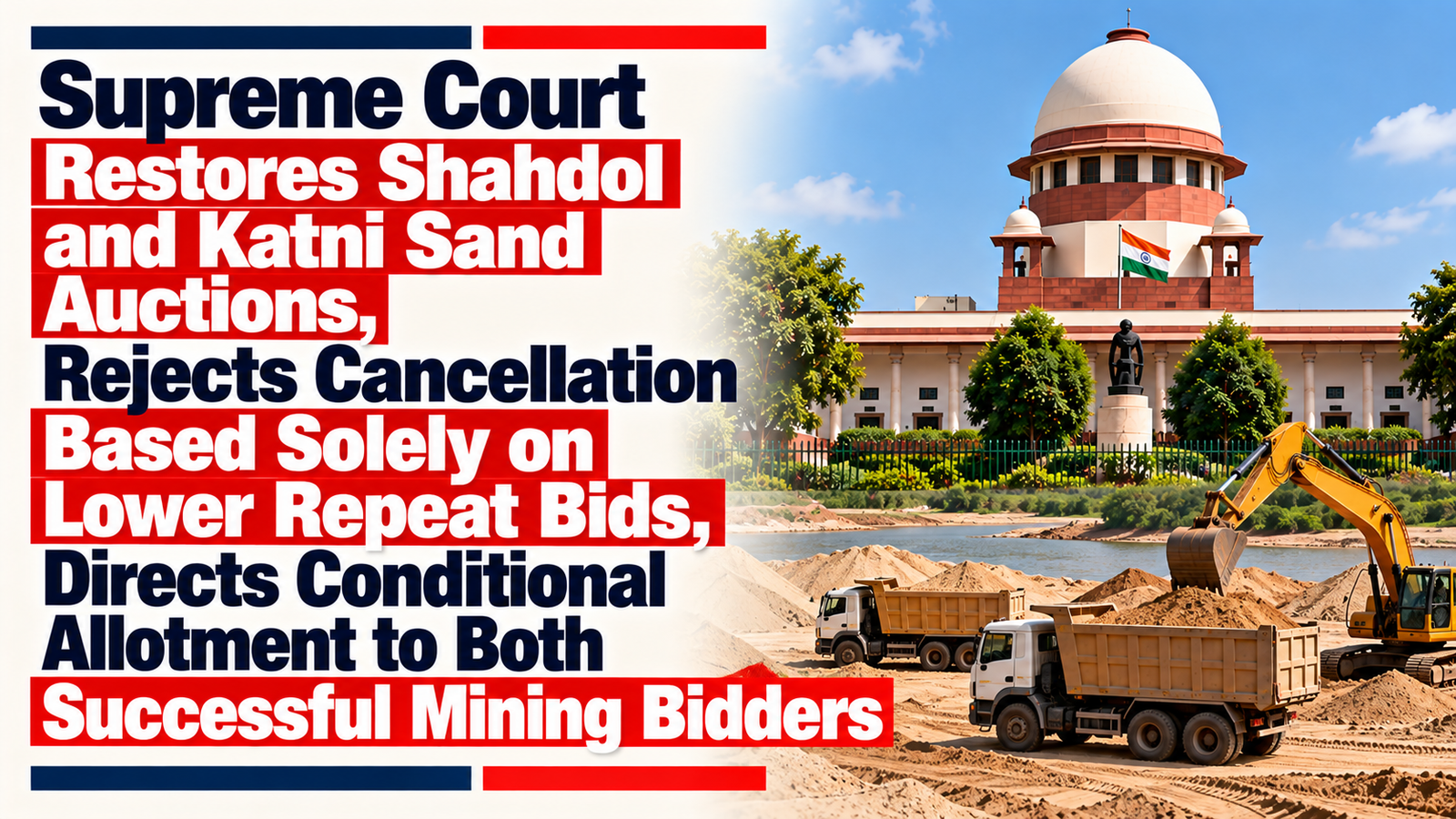
Earlier Higher Contract Prices Cannot Alone Defeat Fresh Competitive Mining Auctions: Supreme Court Restores Shahdol and Katni Results and Orders Conditional Allotments Under Tender Terms
Facts
Sahakar Global Ltd. and Dhanlaxmi Merchandise Pvt. Ltd. formerly operated sand-mining groups in Shahdol and Katni districts, Madhya Pradesh, respectively, under three-year agreements. Their earlier annual bids were ₹68,84,25,999 (Shahdol) and ₹64,77,66,000 (Katni). Both surrendered the contracts in 2025 under the then-applicable Rule 16 of the Madhya Pradesh Sand Rules, 2019. Sahakar had separately disputed the availability of statutory clearances for all 34 Shahdol mines; Dhanlaxmi attributed Katni’s surrender to commercial difficulties, not a comparable permissions dispute. The State Mining Corporation re-tendered both groups in September 2025. Following competitive e-auctions on 10 October, Sahakar emerged highest bidder at ₹48,20,40,000 for Shahdol and Dhanlaxmi at ₹54,07,41,111 for Katni—both annual bids above the respective reserve prices of ₹44 crore and ₹50 crore. The Corporation’s Board nevertheless cancelled both processes on 19 November 2025, citing reductions of approximately 29.98% and 16.52% from the contractors’ earlier bids. The Madhya Pradesh High Court upheld cancellation on 18 March 2026.
Issues
Whether an authority can reject valid above-reserve H1 bids primarily because the same bidders had surrendered earlier contracts at higher rates; whether tender clauses conferring cancellation discretion eliminate scrutiny under Article 14; whether the stricter January 2026 surrender rules could affect the earlier auction; and whether successful judicial challenge warranted restoration of the original process or remand, given a subsequent tender.
Petitioner’s Arguments
Both appellants argued that surrender and re-participation were lawful under Rule 16 as it stood in 2025; neither was barred or blacklisted, and both were accepted as technically eligible. Seven bidders competed in Shahdol and five in Katni, producing genuine price discovery above reserve, without any identified collusion or manipulation. Sahakar emphasised that its earlier higher bid assumed a larger mining opportunity than was then available with environmental permissions. Dhanlaxmi submitted that its earlier commercial miscalculation could not indefinitely set the minimum price for Katni. Both maintained that historical rates could be relevant but were not proof of current market value, and that the January 2026 prohibition on re-bidding after surrender operated prospectively.
Respondent’s Arguments
The State and Corporation submitted that an H1 bidder has no vested right to an award, no letters of intent had issued, and Clauses 6.6.3 and 26 expressly permitted cancellation. The same contractors had re-entered bids for the same groups and notified quantities at materially reduced rates, justifying the Board’s concern for public mineral revenue. The Corporation disputed any established breach of the old Shahdol agreement, said the Katni mines held the required permissions, and relied on its commercial discretion and higher initial figures emerging in the later Shahdol auction. Subsequent bidders likewise urged protection of the later tender process.
Analysis of the Law
Rule 16, before amendment, authorised surrender upon prescribed notice and conditions, required re-tendering and imposed no automatic disqualification or earlier-bid floor upon the former operator. The amendment dated 30 January 2026 introduced a three-year participation restriction and recovery mechanisms prospectively; it could not retrospectively determine eligibility in October 2025. A reserve price is a minimum threshold, not a promise of acceptance, and H1 status is not itself a concluded contract. Nevertheless, a public corporation must exercise cancellation discretion consistently with Article 14. Its assessment of inadequate market return requires relevant contemporaneous material, not merely comparison with a historical contractual commitment. Judicial review examines the rationality of the process, not the court’s preferred price.
Precedent Analysis
Ramana Dayaram Shetty v. International Airport Authority and Star Enterprises v. CIDCO require non-arbitrary treatment in State contracting. Food Corporation of India v. Kamdhenu Cattle Feed Industries recognises fairness and legitimate expectation without making the highest offer automatically binding. Tata Cellular v. Union of India, Jagdish Mandal and N.G. Projects counsel restraint in reviewing commercial choices. Haryana Urban Development Authority v. Orchid Infrastructure confirms that H1 is not enough, while illustrating reliance on actual market comparisons. Golden Food Products India v. State of Uttar Pradesh, identified as particularly relevant, holds that a lawfully conducted auction cannot be discarded on an unsupported expectation of a higher return. The Court also referred to M.P. Power Management Co. v. Sky Power and Subodh Kumar Singh Rathour concerning fairness in public contracts.
Court’s Reasoning
The Bench found actual competition, accepted technical eligibility, above-reserve final offers and no findings of cartelisation or procedural defect. The Corporation had knowingly invited the previous operators under the 2025 rules. Its Board treated the difference between successive annual bids as proof of lost revenue without a contemporaneous valuation or comparably current evidence that the fresh amounts were inadequate. The earlier offers did not permanently establish market value; the Shahdol environmental-clearance dispute made a bare historical comparison especially problematic. Although the High Court correctly recognised the absence of a vested H1 right, it failed to test whether the stated cancellation reason was substantively supported. Remand merely to revisit that rejected comparison would undermine effective relief. The later, differently regulated auction could not retrospectively validate the cancellation.
Conclusion
On 14 October 2026, the Supreme Court allowed both appeals, set aside the High Court judgment, quashed cancellation for Shahdol and Katni, and restored the September 2025 auction. Within two weeks, each appellant must unconditionally affirm its original final annual bid. The Corporation then has two further weeks to specify outstanding deposits, securities and formalities, and must complete approvals, letters of intent and agreements within six weeks after compliance. The February 2026 re-tender cannot proceed for these groups; later participants’ deposits or guarantees must be returned or released within four weeks, subject to independent liabilities. Old-contract dues, statutory mining permissions and the validity of the 2026 amendment remain unaffected. No costs were ordered.
Case: M/s Dhanlaxmi Merchandise Pvt. Ltd. v. State of Madhya Pradesh & Ors.; connected with Sahakar Global Ltd. v. State of Madhya Pradesh & Ors.
Court: Supreme Court of India, Civil Appellate Jurisdiction
Case Number: Civil Appeals Nos. 13749 and 13750 of 2026 (SLP (C) Nos. 11388 and 11160 of 2026); 2026 INSC 1125
Judge: Justices Aravind Kumar and Vipul M. Pancholi
Date: 14 October 2026
Result: Both appeals allowed; 2025 Shahdol and Katni auction cancellations quashed; original processes restored with conditional completion directions; no costs.