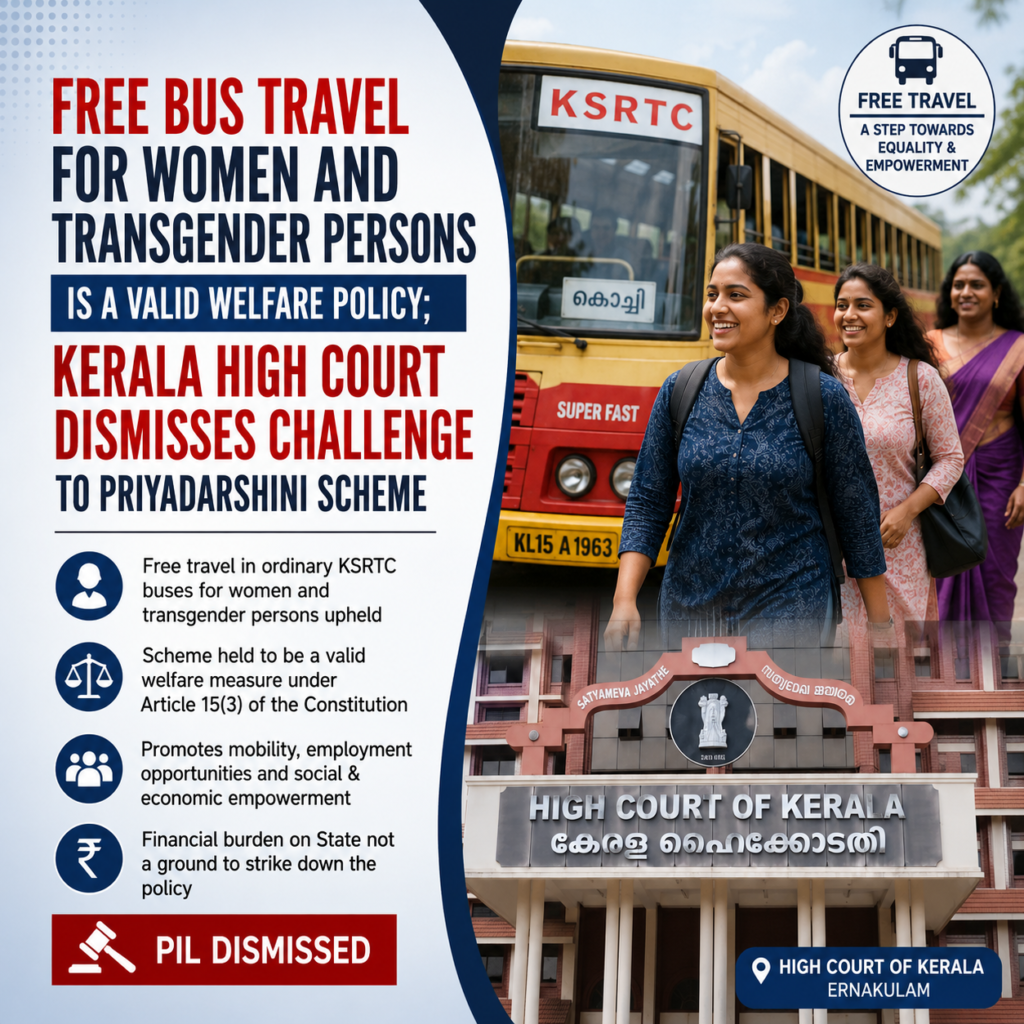
Free Bus Travel for Women and Transgender Persons Is a Valid Welfare Policy; Kerala High Court Dismisses Challenge to Priyadarshini Scheme

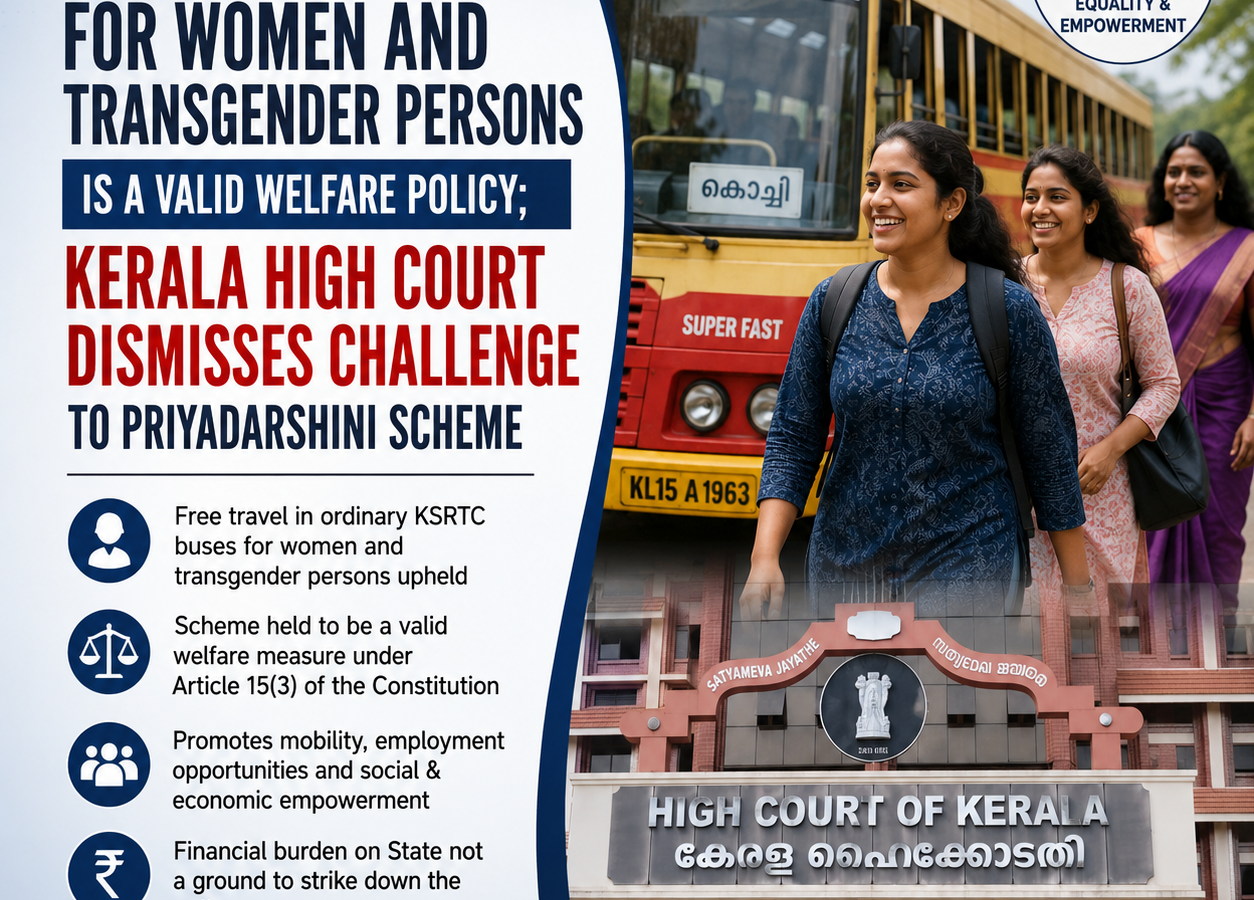
State Can Provide Free Bus Travel to Women Under Article 15(3): Kerala High Court Upholds Priyadarshini Scheme
The Kerala High Court has upheld the Kerala Government’s “Priyadarshini Scheme,” which provides free travel to women and transgender persons in ordinary Kerala State Road Transport Corporation buses.
A Division Bench comprising Chief Justice Soumen Sen and Justice Syam Kumar V.M. dismissed a public interest litigation challenging the scheme as discriminatory, financially burdensome and unsupported by empirical data.
The Court held that the scheme was a permissible special provision under Article 15(3) of the Constitution and was intended to advance unrestricted mobility, employment opportunities and the social and economic empowerment of women and transgender persons.
Facts
The Kerala Government issued an order dated 11 June 2026 introducing the Priyadarshini Scheme, under which women and transgender persons of all ages were permitted to travel free of cost in ordinary KSRTC buses throughout the State.
The scheme came into operation on 15 June 2026.
Muhammed Firdouz, claiming to be a public-spirited citizen and taxpayer, filed a public interest litigation challenging the Government Order and seeking discontinuation of the free-travel facility.
The petitioner alleged that the scheme had been implemented without conducting any policy study, financial assessment or empirical analysis identifying the disadvantage sought to be addressed.
It was further alleged that the scheme originated from an election manifesto and was formally implemented immediately after the Government assumed office, without sufficient policy reasoning.
The petitioner argued that the scheme extended free travel to every woman irrespective of income, residence, employment status or actual need. This included affluent women and women visiting Kerala as tourists.
The State defended the scheme as a welfare measure intended to promote unrestricted mobility, employment participation and the social and economic empowerment of women and transgender persons.
The Government clarified that the entire financial burden of the scheme would be borne by the State and that KSRTC’s contractual obligations and operational expenses would be protected through appropriate financial arrangements.
Issues
The principal issues before the Court were:
- Whether granting free travel in ordinary KSRTC buses exclusively to women and transgender persons violated Articles 14 and 15(1) of the Constitution.
- Whether the scheme was over-inclusive because it extended the benefit to all women irrespective of income, residence, employment or vulnerability.
- Whether Article 15(3) permitted a universal welfare measure for women without identifying a narrowly defined disadvantaged class.
- Whether the absence of an empirical study, policy assessment or specific financial analysis rendered the scheme arbitrary.
- Whether the Court could interfere with the Government’s policy decision on the ground that the scheme imposed a substantial burden upon the State exchequer.
- Whether the fact that the scheme originated from an election promise affected its constitutional validity.
Petitioner’s Arguments
The petitioner argued that the Government Order was arbitrary and violated Article 14 because it extended free travel to all women irrespective of their economic, social or educational status.
It was contended that the classification was over-inclusive and had no rational nexus with the stated objective of promoting women’s social and economic advancement.
The petitioner relied upon the example of an affluent woman or a woman tourist from another State receiving free travel despite having no connection with Kerala’s welfare objectives.
According to the petitioner, the cost of such travel would be borne by Kerala’s taxpayers without advancing any identifiable constitutional objective.
The petitioner distinguished the scheme from targeted benefits such as:
- reservation of seats for women;
- free or concessional travel for female students;
- benefits for women below the poverty line;
- transport facilities for pregnant and nursing women; and
- safe travel for women working night shifts.
It was argued that such measures addressed identified disadvantages and defined beneficiary groups, whereas the Priyadarshini Scheme indiscriminately benefited all women and transgender persons.
The petitioner further submitted that discrimination between male and female passengers solely on the ground of sex violated Article 15(1).
It was argued that Article 15(3) permitted only purposive, targeted and proportionate provisions for women and could not justify an unrestricted benefit to every woman.
The petitioner also contended that the scheme could cost approximately ₹2 crore per day and therefore violated the State’s fiduciary duty in relation to public funds.
Reliance was placed upon decisions relating to reasonable classification, including State of West Bengal v. Anwar Ali Sarkar and Budhan Choudhry v. State of Bihar.
The petitioner also relied upon Anuj Garg v. Hotel Association of India to argue that a measure favouring women could not automatically receive constitutional protection merely because it was described as beneficial.
Respondent’s Arguments
The State argued that the challenge was legally untenable and that the scheme pursued a clear welfare objective.
The Advocate General submitted that the scheme was intended to remove restrictions on women’s mobility and create a fully participatory and vibrant society.
It was argued that easier access to safe and affordable public transport would increase employment opportunities, particularly for working-class women, and advance their social and economic empowerment.
The State submitted that the policy was consistent with the Directive Principles of State Policy and the constitutional objective of correcting the historical social and economic disadvantages experienced by women.
It was further argued that Article 14 prohibited hostile discrimination but permitted reasonable classification in the public interest.
The classification in favour of women and transgender persons was said to have a direct nexus with mobility, employment participation and empowerment.
The State contended that a policy decision could not be invalidated merely because affluent women or non-residents might also receive incidental benefits.
The Advocate General also submitted that courts must exercise restraint while reviewing welfare and economic policies.
The Government clarified that the entire financial expenditure would be borne by the State and that KSRTC would be indemnified for the loss of fare revenue and protected against additional financial burdens.
KSRTC adopted the State’s submissions and argued that the scheme expressly provided for financial support from the Government.
Analysis of the Law
The Court first examined the scope of judicial review over governmental policy decisions.
It observed that courts do not ordinarily examine the wisdom, soundness or desirability of a policy. Judicial interference is justified only where the policy is unconstitutional, contrary to a statute, manifestly arbitrary or legally perverse.
The Court relied upon the principle that the framing of schemes intended to improve living standards or livelihoods falls primarily within the policy domain of the State.
Where a scheme serves a public purpose and expenditure is authorised through the appropriate legislative and financial process, the Court’s power of review remains limited.
The Court also observed that greater judicial deference is ordinarily shown in matters involving economic policy and allocation of State resources.
Article 15(3) and Special Provisions for Women
The Court rejected the argument that Article 15(3) permits only benefits that do not disadvantage men.
Article 15(3) expressly enables the State to make special provisions for women and children. It operates as an exception to the prohibition against discrimination under Article 15(1).
The Court held that the State may validly grant a benefit to women even where men do not receive the same benefit, provided the measure serves a legitimate welfare or empowerment objective.
The classification under the Priyadarshini Scheme was not based merely upon biological sex. It was supported by considerations including:
- unrestricted mobility;
- access to safe and affordable public transport;
- increased participation in employment;
- social inclusion;
- economic empowerment; and
- historical disadvantages experienced by women.
The Court held that these considerations supplied a rational constitutional basis for the scheme.
Universal Benefit and Alleged Over-Inclusiveness
The Court rejected the contention that the scheme became unconstitutional because it covered every woman irrespective of income or employment status.
It held that the State was entitled to frame a universal welfare measure if it considered unrestricted mobility itself to be an instrument of empowerment.
The Court declined to substitute its own view regarding whether the scheme should have contained an income ceiling, residence requirement or other restrictions.
The possible inclusion of affluent women or tourists did not by itself destroy the scheme’s broader public purpose.
Absence of Empirical Study
The Court held that the scheme could not be invalidated merely because the petitioner alleged the absence of a detailed empirical study.
The Government Order itself disclosed its policy objectives, including unrestricted mobility, employment opportunities and social and economic empowerment.
Once the policy fell within the State’s constitutional and welfare functions, the Court could not prescribe the precise manner in which the Government should formulate or implement it.
Financial Burden
The Court observed that the Government had considered the financial implications while issuing the order.
The Government had undertaken to bear the entire expenditure and protect KSRTC’s financial and operational obligations.
The Court held that it was not its function to assess whether the chosen expenditure was prudent or economically optimal, unless constitutional or statutory illegality was established.
Election Manifesto
The Court rejected the argument that the scheme was invalid merely because it had originated from an election manifesto.
An electoral promise does not automatically become unconstitutional or amount to a corrupt practice.
Where the resulting scheme serves a public purpose and advances Directive Principles of State Policy, judicial interference remains limited.
Precedent Analysis
S. Subramaniam Balaji v. State of Tamil Nadu
The Supreme Court held that the question whether the State should introduce a scheme to improve living standards or livelihoods falls primarily within governmental policy.
Courts have limited authority to interfere where the scheme serves a public purpose and the expenditure is supported by an appropriation.
The Kerala High Court relied upon this decision to uphold the State’s freedom to formulate welfare schemes.
State of Tamil Nadu v. National South Indian River Interlinking Agriculturist Association
The Supreme Court reiterated that courts cannot examine the wisdom or soundness of a policy decision.
Judicial review is confined to testing whether the policy violates fundamental rights or other constitutional provisions.
R.K. Garg v. Union of India
This decision recognised the need for greater judicial deference in matters concerning economic and fiscal policy.
The Court relied upon this principle while declining to assess the financial wisdom of the free-travel scheme.
Dattatraya Motiram More v. State of Bombay
The Bombay High Court held that Article 15(3) permits the State to discriminate in favour of women without violating Article 15(1).
The provision would become meaningless if it permitted only those facilities that could not possibly be enjoyed by men.
This judgment formed a central part of the Kerala High Court’s reasoning.
Government of Andhra Pradesh v. P.B. Vijayakumar
The Supreme Court recognised that Article 15(3) acknowledges the historical social and economic disadvantages suffered by women and permits affirmative measures intended to enable their equal participation in national life.
Vijay Lakshmi v. Punjab University
The decision was relied upon to support the validity of reasonable classification in favour of women and the limited scope of interference with policy choices.
Ramesh Kamal v. State of Himachal Pradesh
The Himachal Pradesh High Court upheld a fare concession for women travelling in ordinary State transport buses.
The objectives of providing safe and affordable travel and improving women’s participation in economic activity were held to be consistent with Article 14.
STA Operators Ekta Manch v. Government of NCT of Delhi
The Delhi High Court held that a transport concession for women could not be declared unconstitutional merely because it created a financial burden upon the State or transport operators.
Samatha v. State of Andhra Pradesh
The Supreme Court held that courts should uphold governmental efforts aimed at reducing economic inequalities, protecting weaker sections and implementing social-justice objectives reflected in the Directive Principles.
State of West Bengal v. Anwar Ali Sarkar and Budhan Choudhry v. State of Bihar
These decisions laid down the traditional test of reasonable classification requiring an intelligible differentia and a rational nexus with the object sought to be achieved.
The Court found that the Priyadarshini Scheme satisfied this test because the classification was connected with mobility, employment and empowerment.
Anuj Garg v. Hotel Association of India
The petitioner relied upon this decision to argue that measures ostensibly protecting women must be scrutinised for stereotypes and paternalism.
The Court found that the Priyadarshini Scheme was not based upon a restrictive stereotype. It expanded women’s mobility and participation rather than limiting their choices.
Court’s Reasoning
The Court held that the Priyadarshini Scheme was a valid affirmative welfare measure intended to advance constitutionally recognised objectives.
The Government had not granted free travel merely because the beneficiaries were women or transgender persons. The classification was also based upon the need to improve mobility, employment access, social participation and economic empowerment.
The Court observed that women have historically faced social and economic barriers that affect their ability to participate equally in public and economic life.
Affordable and unrestricted public transport could legitimately be used as an instrument to reduce those barriers.
The Court rejected the argument that Article 15(3) required every special measure to be narrowly targeted according to income, employment or vulnerability.
The design and scope of a welfare scheme fall within the policy discretion of the Government unless the resulting classification is manifestly unreasonable or unconstitutional.
The inclusion of all women did not invalidate the scheme. The Court held that universal access could itself promote the policy objective of unrestricted mobility.
The Court further found that the Government had addressed the financial consequences by undertaking to bear the entire cost of the scheme and protect KSRTC’s operations.
It was not for the Court to determine whether another policy design would have been more efficient or financially prudent.
No constitutional or statutory illegality was established. The challenge was therefore held to be without merit.
Conclusion
The Kerala High Court dismissed the public interest litigation and upheld the Government Order implementing the Priyadarshini Scheme.
The Court held that:
- free travel for women and transgender persons in ordinary KSRTC buses is a valid welfare measure;
- the scheme does not violate Articles 14 or 15(1);
- Article 15(3) permits the State to make special provisions in favour of women;
- the scheme has a rational connection with unrestricted mobility, employment opportunities and social and economic empowerment;
- the absence of an income ceiling or narrower eligibility criteria does not make the scheme unconstitutional;
- courts cannot interfere merely because the scheme creates a financial burden upon the State;
- electoral origin does not invalidate a welfare scheme serving a public purpose; and
- no statutory illegality, arbitrariness or constitutional infirmity was established.
Case: Muhammed Firdouz v. State of Kerala & Anr.
Court: High Court of Kerala at Ernakulam
Case Number: W.P.(PIL) No. 122 of 2026
Judge: Chief Justice Soumen Sen and Justice Syam Kumar V.M.
Date: 22 June 2026
Result: Public interest litigation dismissed; Kerala Government’s Priyadarshini Scheme granting free travel to women and transgender persons in ordinary KSRTC buses upheld.