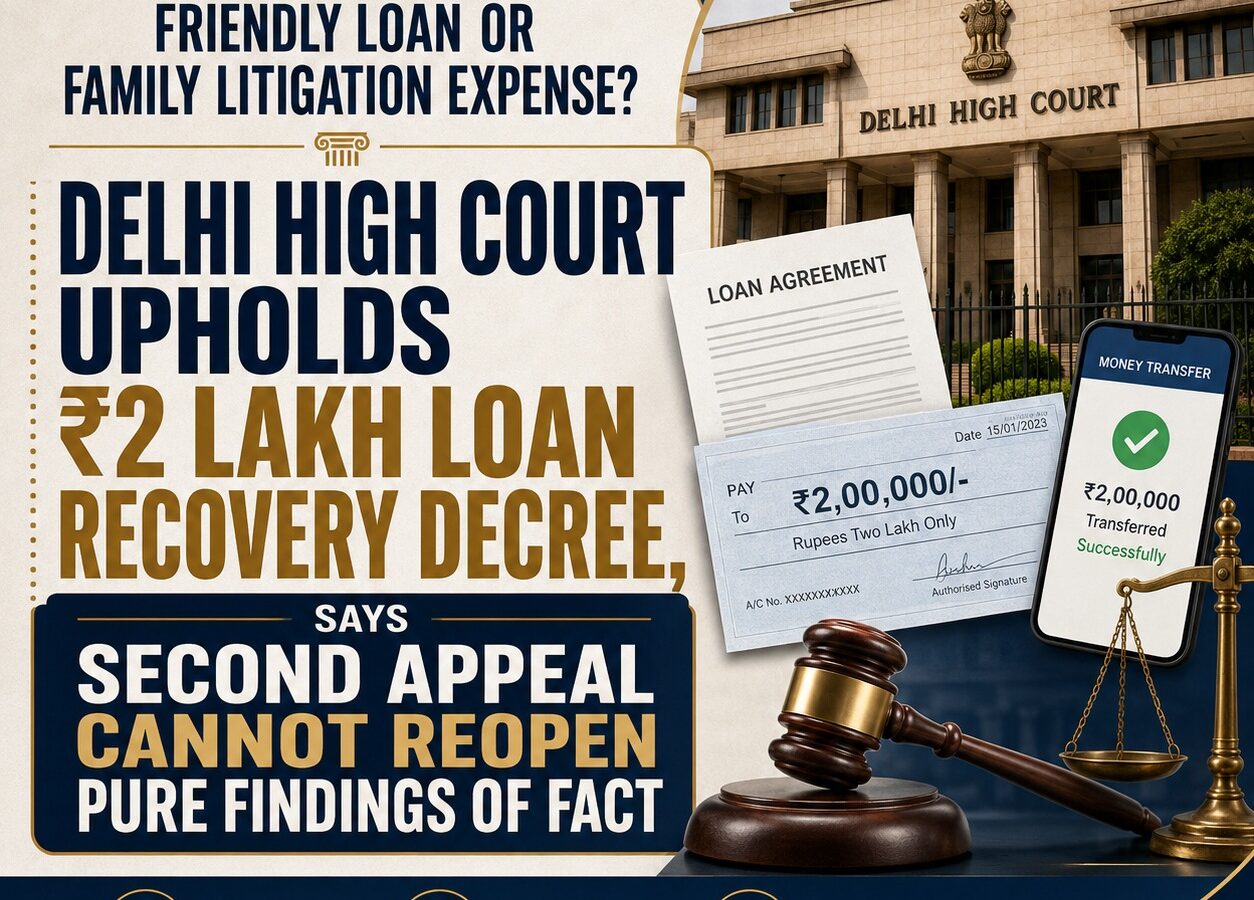
Friendly Loan Or Family Litigation Expense? Delhi High Court Upholds ₹2 Lakh Loan Recovery Decree, Says Second Appeal Cannot Reopen Pure Findings Of Fact

Court: Delhi High Court
Case: Regular Second Appeal under Section 100 CPC
Case No.: RSA No. 184/2024 & CM APPL. 62781/2024
Judge: Justice Neena Bansal Krishna
Reserved On: 9 April 2026
Pronounced On: 10 June 2026
Court’s Decision
The Delhi High Court dismissed the Regular Second Appeal filed by the appellant/defendant against concurrent findings of the Civil Judge and the District Judge.
The Court held that the appellant had failed to raise any substantial question of law under Section 100 of the Code of Civil Procedure, 1908. The dispute raised by the appellant was purely factual in nature, and both the Trial Court and First Appellate Court had already appreciated the evidence and concluded that the amount of ₹2,00,000 was a loan which the appellant had failed to repay.
Accordingly, the appeal was dismissed as being without merit, and the pending applications were also disposed of.
Facts
The plaintiff/respondent, who was carrying on business as sole proprietor of M/s Western Wear Inc., filed a civil suit for recovery of ₹2,00,000 along with interest.
According to the plaintiff, in May 2009, the defendant/appellant requested for a friendly loan. The plaintiff advanced ₹2,00,000 through two cheques of ₹1,00,000 each dated 04.05.2009 and 06.05.2009. The cheques were encashed by the defendant on 22.05.2009.
The plaintiff claimed that the loan was to be repaid within six months. However, despite expiry of the agreed period, repeated demands, and legal notice dated 21.02.2011, the defendant failed to repay the amount. Therefore, the recovery suit was filed.
The defendant denied that the amount was a loan. His case was that the plaintiff was liable to contribute towards litigation expenses allegedly incurred by the defendant’s father in relation to ancestral/family property situated at Bhatinda, Punjab. The defendant claimed that the plaintiff’s share of litigation expenses was ₹5,02,000 and that the two cheques totalling ₹2,00,000 were not a loan but partial payment towards those expenses.
Issues Before The Court
The Trial Court had framed issues including:
- Whether the plaintiff had locus standi to file the suit.
- Whether the suit was without cause of action.
- Whether proper court fee had been paid.
- Whether the plaintiff was entitled to the suit amount.
- Whether the plaintiff was entitled to interest.
- Relief.
In the Regular Second Appeal before the High Court, the appellant attempted to raise the following substantial questions of law:
- Whether the First Appellate Court erred by not adjudicating the application under Order XLI Rule 27 CPC for additional documents.
- Whether the Trial Court wrongly closed the evidence of remaining defence witnesses.
- Whether the Trial Court and First Appellate Court wrongly shifted the onus of proof on Issues No. 4 and 5.
Appellant’s Arguments
The appellant argued that he was a Government Officer and had sufficient financial resources, including about ₹5 lakh in his PF account, and could have easily taken a loan from cheaper sources such as his PF account or employee credit society. Therefore, according to him, there was no probability of him taking a friendly loan from the plaintiff.
He further argued that the relationship between the parties was strained due to family property disputes and litigation expenses in respect of the Bhatinda property. According to the appellant, the ₹2,00,000 received from the plaintiff was actually towards reimbursement of the plaintiff’s share of litigation expenses and not a loan.
The appellant also contended that the Trial Court closed his evidence under a bona fide mistake after examination of DW1 and DW2, though three more witnesses were necessary to prove that the amount was connected to litigation expenses and sale proceeds of the Bhatinda property.
He also argued that the onus on Issues No. 4 and 5 was wrongly shifted to him, even though the burden was on the plaintiff to prove the loan transaction.
Respondent’s Arguments
The respondent/plaintiff maintained that ₹2,00,000 had been advanced as a friendly loan to the appellant.
The respondent denied that the amount had anything to do with Bhatinda property litigation. He submitted that the litigation regarding the Bhatinda property had no relevance to the loan transaction. It was also argued that the property litigation was much earlier, whereas the loan transaction took place in May 2009.
The respondent further relied upon the testimony of PW2 Kanwal Krishan Garg, the counsel in the Bhatinda property matter, who stated that the professional fee was paid by the plaintiff and that the litigation expenses were not as alleged by the appellant.
The respondent also opposed the plea for additional evidence, contending that the appellant had adequate opportunity before the Trial Court and was now attempting to fill lacunae in his case.
Evidence Considered
The plaintiff examined himself as PW1. PW2 Kanwal Krishan Garg supported the plaintiff’s version regarding the Bhatinda litigation. PW3, an official from Kotak Mahindra Bank, produced the bank records relating to the two cheques.
The defendant examined himself as DW1 and also examined DW2 Manoj Kumar.
The Trial Court found that the two cheques of ₹1,00,000 each had been issued by the plaintiff and encashed by the defendant. This was proved through bank records and was also admitted by the defendant.
The plaintiff also proved his ITR Verification Form for the year 2010–2011 along with the balance sheet, where the loan of ₹2,00,000 advanced to the defendant was reflected as an asset.
In cross-examination, the defendant admitted receiving two cheques of ₹1,00,000 each in his bank account from the plaintiff.
Court’s Analysis
The High Court found that the plaintiff’s case was supported by cogent evidence. The receipt of ₹2,00,000 by the appellant was admitted. The bank records supported the cheque transaction. The plaintiff’s ITR and balance sheet also reflected the amount as a loan advanced to the defendant.
The Court noted that the appellant’s only defence was that the amount represented reimbursement of litigation expenses allegedly payable by the plaintiff. However, the appellant failed to establish this defence.
The Court agreed with the Trial Court that the documents relied upon by the defendant did not prove his case. The alleged family settlement dated 21.05.2008 was actually a sale deed in respect of a shop in the Bhatinda property and not a family settlement. The Court further noted that the appellant’s father was not a party to that document and had already passed away on 10.03.2007, whereas the sale deed was executed on 21.05.2008.
The Court also observed that the document did not establish that ₹2,00,000 was paid towards the plaintiff’s share of litigation expenses.
The other family settlement dated 19.08.1996 also remained unproved and did not mention any liability of the plaintiff to pay ₹5,02,000 towards litigation expenses.
The testimony of DW2 Manoj Kumar also did not help the appellant because he admitted that no amount was given or received in his presence. Therefore, he was not competent to prove or disprove the loan transaction.
On the other hand, PW2 Kanwal Krishan Garg, who had represented the parties in the earlier litigation, stated that his professional fee was paid by the plaintiff and that the total litigation expenses before the Trial Court and Appellate Court did not exceed ₹15,000 in all. His testimony remained unshaken in cross-examination.
Order XLI Rule 27 CPC / Additional Evidence
The High Court rejected the appellant’s contention that he should be allowed to examine additional witnesses.
The Court held that the appellant had himself chosen not to examine the three remaining witnesses and had closed his evidence after examining himself and DW2. Therefore, he could not later claim inadvertence.
The Court held that the application for additional evidence was merely an attempt to fill lacunae in the evidence and had no merit.
Section 100 CPC Finding
The High Court held that in a Regular Second Appeal under Section 100 CPC, the appellant must raise a substantial question of law.
In the present case, the questions projected by the appellant were purely factual. Both the Civil Judge and District Judge had already appreciated and re-appreciated the evidence and had arrived at the conclusion that the amount was a loan which remained unpaid.
Therefore, no substantial question of law arose in the appeal.
Precedent
No specific precedent was discussed or relied upon in the judgment. The decision turned on appreciation of evidence and the settled scope of interference in a Regular Second Appeal under Section 100 CPC.
Reasoning
The High Court dismissed the appeal for the following reasons:
- The defendant admitted receiving ₹2,00,000 through two cheques from the plaintiff.
- The cheque transaction was supported by bank records.
- The plaintiff’s ITR and balance sheet reflected the amount as a loan.
- The appellant failed to prove that the amount was linked to litigation expenses.
- The documents relied upon by the appellant did not establish the alleged liability of ₹5,02,000.
- The alleged family settlement/sale deed did not support the appellant’s defence.
- DW2 was not a competent witness to prove or disprove the transaction as no amount was given or received in his presence.
- PW2’s testimony regarding litigation expenses supported the plaintiff and remained unshaken.
- The request for additional evidence was only an attempt to fill gaps in the defence.
- The grounds raised were factual and did not constitute any substantial question of law.
Conclusion
The Delhi High Court held that the appellant had failed to show any substantial question of law warranting interference in second appeal.
The concurrent findings of the Trial Court and First Appellate Court were upheld. The recovery decree in favour of the plaintiff for ₹2,20,000 with interest @ 8% per annum on ₹2,00,000 from the date of filing of the suit till the date of decree remained undisturbed.
The Regular Second Appeal was dismissed as being without merit.
Implications
This judgment reinforces that a second appeal under Section 100 CPC cannot be used to reopen factual disputes already decided by two courts.
Where the receipt of money is admitted and documentary evidence such as bank records and ITR entries support the plaintiff’s case, the defendant must prove any alternative explanation with credible evidence.
The judgment also clarifies that additional evidence at the appellate stage cannot be permitted merely to fill lacunae after a party has voluntarily closed its evidence before the Trial Court.