


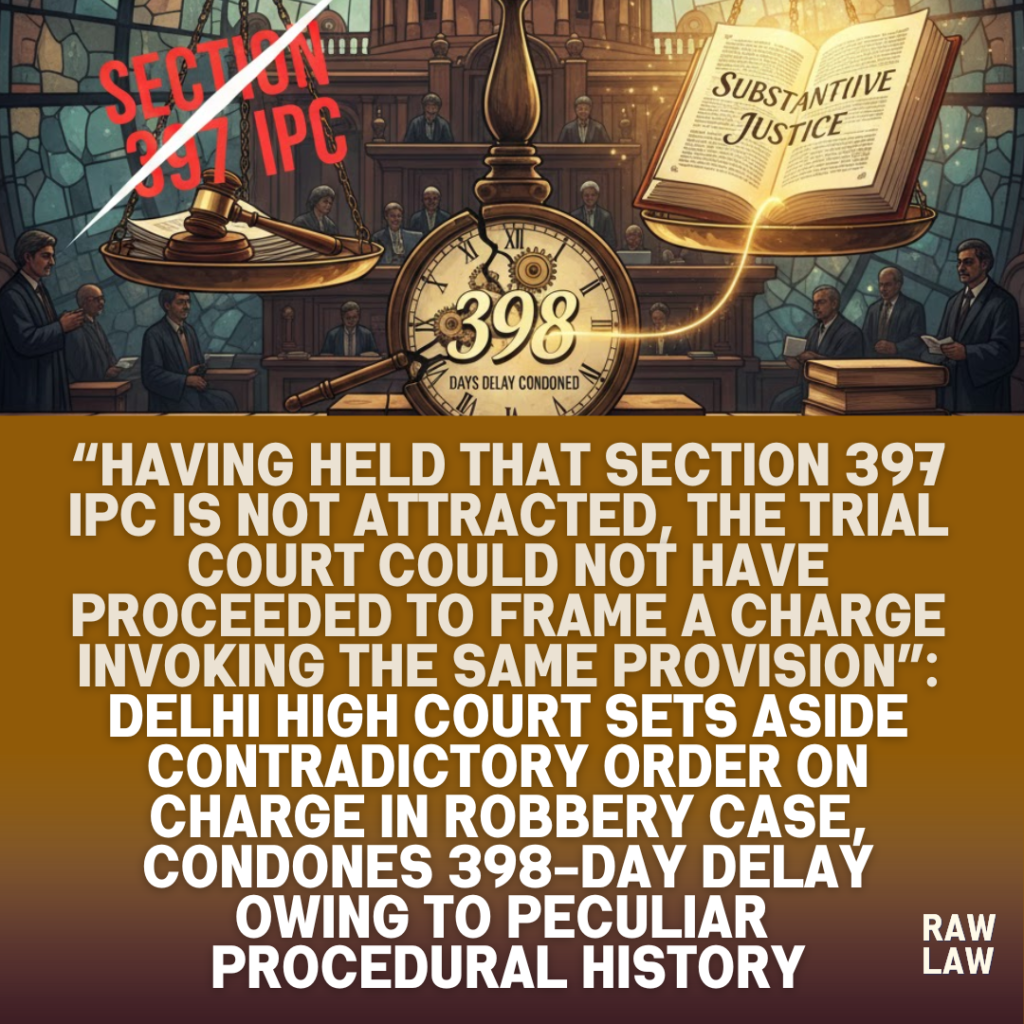
HEADNOTE
Rahul v. State (Govt. of NCT of Delhi)
Court: High Court of Delhi
Bench: Swarana Kanta Sharma
Date of Judgment: 10 December 2025
Citation: CRL.REV.P. 1161/2024
Laws / Sections Involved: Sections 392, 397, 120-B, 34 IPC; Section 25 Arms Act, 1959; Section 39 Arms Act; Section 5 Limitation Act, 1963
Keywords: Framing of charge, Section 397 IPC, criminal conspiracy, contradictory findings, remand for fresh order, condonation of delay
Summary:
The Delhi High Court condoned a delay of 398 days and set aside a trial court’s order framing charges against an accused for robbery with use of a deadly weapon, holding that the order suffered from patent contradictions. While the trial court expressly recorded that Section 397 IPC was not attracted to the petitioner—who was alleged to be driving the vehicle and not using the weapon—it nonetheless framed charges under Section 120-B read with Section 397 IPC. The High Court found this approach legally unsustainable, particularly when sanction under the Arms Act and the FSL report were still awaited. Emphasising the necessity of consistency and application of mind at the stage of charge, the Court remanded the matter for a fresh order on charge after completion of investigation formalities.
Court’s decision
The Delhi High Court allowed the criminal revision petition, condoned the delay of 398 days in filing the revision, and set aside the impugned order dated 10 May 2023 framing charges against the petitioner. The Court held that the trial court’s order reflected clear internal contradictions and lack of application of mind. It remanded the matter to the trial court with directions to pass a fresh order on charge after the prosecution places on record the supplementary charge-sheet, the FSL report, and the requisite sanction under Section 39 of the Arms Act, if obtained. The Court clarified that it had expressed no opinion on the merits of the case.
Facts
On 17 February 2022, the complainant was travelling in his car from Preet Vihar to Dilshad Garden with the petitioner Rahul as his driver. Near the Anand Vihar T-point, the car was stopped, allegedly on the pretext of a punctured tyre. Two unknown persons entered the vehicle from the rear. One of them allegedly snatched the complainant’s iPhone and pressed a pistol-like object against his waist, threatening him. The petitioner allegedly continued driving with the complainant and the assailants until the complainant raised an alarm near Jhilmil. While the two unknown persons fled, the petitioner allegedly escaped with the complainant’s car. An FIR under Sections 392/397/34 IPC was registered. During investigation, the car was recovered abandoned, and a country-made pistol was allegedly recovered at the instance of the petitioner.
Issues
The principal issues before the High Court were whether the trial court could frame a charge under Section 120-B read with Section 397 IPC after expressly holding that Section 397 IPC was not attracted against the petitioner, and whether such contradictory findings vitiated the order on charge. The Court also examined whether delay of 398 days in filing the revision deserved condonation and whether the matter required remand for fresh consideration after completion of pending investigative formalities.
Petitioner’s arguments
The petitioner contended that the trial court had categorically recorded that Section 397 IPC applies only to the offender who actually uses a deadly weapon and that, as per the prosecution’s own case, the petitioner did not use any weapon. Despite this finding, the trial court proceeded to frame a charge under Section 120-B read with Section 397 IPC, rendering the order self-contradictory. It was also argued that sanction under Section 39 of the Arms Act had not been received and that reliance on the alleged recovery of a pistol was premature. The delay in filing the revision was explained by the unusual gap between the operative order and the formal framing of charges.
Respondent’s arguments
The State opposed the petition, submitting that there was sufficient material to raise grave suspicion against the petitioner, including the manner in which the incident unfolded and the alleged recovery of a weapon. It was argued that the petitioner’s conduct prima facie indicated participation in a criminal conspiracy with the co-assailants and justified framing of charges. The State contended that inconsistencies, if any, could be addressed during trial.
Analysis of the law
The High Court reiterated that at the stage of framing of charge, courts are required to examine whether there exists grave suspicion based on material on record, but such assessment must be consistent and coherent. Where a court records a clear finding that an essential ingredient of an offence is not made out, it cannot, in the same breath, proceed to frame a charge invoking that very offence. The Court also underscored that invocation of provisions under the Arms Act requires statutory sanction and completion of forensic examination, without which reliance on alleged recoveries is legally infirm.
Precedent analysis
The Court relied on settled principles that Section 397 IPC is attracted only against the offender who actually uses a deadly weapon during commission of robbery, and not against every participant by virtue of common intention or conspiracy. It also applied established jurisprudence that contradictory or mechanically framed charges undermine fair trial guarantees and warrant interference in revision. The approach aligns with Supreme Court authority requiring careful application of mind at the stage of charge.
Court’s reasoning
Justice Swarana Kanta Sharma observed that the impugned order contained irreconcilable findings. While the trial court unequivocally held that Section 397 IPC was not attracted to the petitioner, it nonetheless framed a charge under Section 120-B read with Section 397 IPC. Similarly, despite acknowledging the absence of sanction under the Arms Act, the trial court relied on the alleged recovery of a pistol. These inconsistencies indicated haste and lack of application of mind. The Court found it appropriate to remand the matter so that a fresh and legally sustainable order on charge could be passed after completion of investigation requirements.
Conclusion
The High Court set aside the impugned order on charge and directed the trial court to reconsider the matter afresh after the prosecution files the supplementary charge-sheet, FSL report, and Arms Act sanction, if any. Both parties were directed to address arguments on charge without seeking unnecessary adjournments. The revision petition was disposed of accordingly.
Implications
This judgment reinforces the requirement of consistency and judicial discipline at the stage of framing of charge. It clarifies that courts cannot invoke penal provisions in conspiracy merely to circumvent statutory ingredients expressly found to be absent. The ruling also highlights the importance of completing investigation formalities, including forensic reports and statutory sanctions, before drawing adverse inferences against an accused.
CASE LAW REFERENCES
• Ashfaq v. State (Govt. of NCT of Delhi) – Section 397 IPC applies only to the offender who uses the deadly weapon
• State of Bihar v. Ramesh Singh – Standard of “grave suspicion” at stage of charge
• Prafulla Kumar Samal – Requirement of application of mind while framing charges
FAQs
Q1. Can Section 397 IPC be applied to a conspirator who did not use a weapon?
No. Courts have consistently held that Section 397 applies only to the offender who actually uses the deadly weapon.
Q2. Can a court frame contradictory charges?
No. Contradictory findings at the stage of charge indicate non-application of mind and can be set aside in revision.
Q3. What happens if Arms Act sanction is pending?
Charges relying on alleged weapon recovery should await statutory sanction and forensic reports.