

Court’s decision
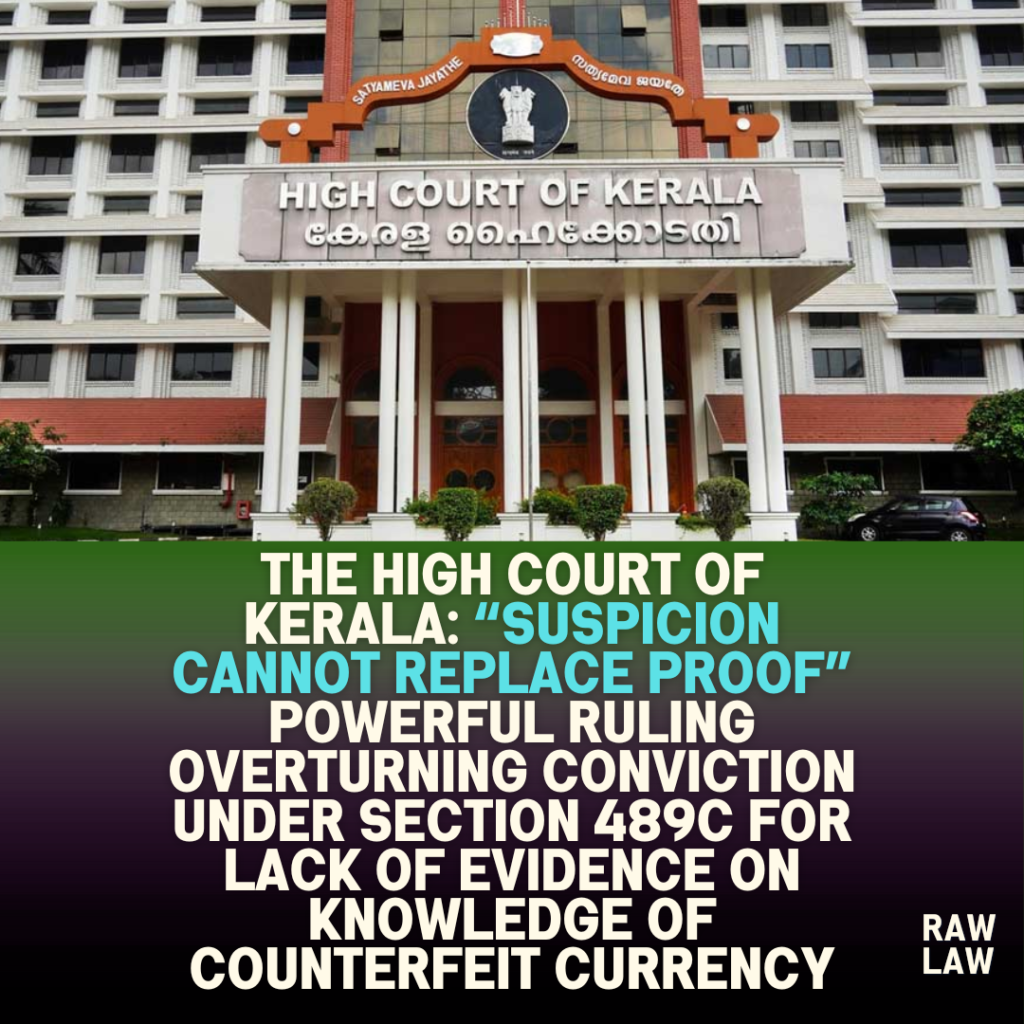
The High Court of Kerala allowed the criminal appeal and set aside the conviction imposed for the offence of possessing counterfeit currency under Section 489C of the Penal Code. The Court held that the prosecution failed to establish the essential ingredients of the offence—particularly the crucial requirement that the accused must have knowledge or reason to believe that the currency was counterfeit. The Court found serious procedural lapses, improper reliance on inadmissible statements under Section 162 of the Criminal Procedure Code, and complete failure to put crucial incriminating circumstances to the accused under Section 313. The Court acquitted the accused, granting benefit of doubt.
Facts
The prosecution alleged that the accused was found with a 100-dollar American note at night near an airport road and attempted to exchange it as genuine. Based on this information, the Sub Inspector prepared a seizure mahazar and sent the currency note for examination by a bank officer, who allegedly declared it counterfeit. The prosecution relied on three witnesses, including two public witnesses who turned hostile and one police witness who claimed the accused attempted to exchange the note. The accused stated under Section 313 that he was a head-load worker who received the dollar from a group of foreigners for loading their bags and that a dispute later arose because the note appeared torn and suspicious.
Issues
The primary issue was whether the conviction under Section 489C could be sustained when the prosecution failed to prove that the accused had knowledge or reason to believe that the note was counterfeit. Another issue was whether the trial court erred by placing reliance on portions of police statements under Section 161—which are barred by Section 162 CrPC—rather than on substantive evidence. A further issue was whether incriminating circumstances, including knowledge of counterfeit nature, must be mandatorily put to the accused under Section 313 before using them to convict.
Petitioner’s arguments
The petitioner argued that the prosecution completely failed to establish the essential ingredient of knowledge and that mere possession of a counterfeit note cannot constitute an offence under Section 489C. He submitted that the accused had explained how he received the note in the normal course of work as a porter, and the evidence suggested a dispute between co-workers rather than an attempt to exchange counterfeit currency. The petitioner emphasised that the bank officer who declared the note counterfeit was not examined and that the trial court’s reliance on unproved case-diary statements was illegal. He also highlighted that no question regarding knowledge or intention was put to the accused under Section 313.
Respondent’s arguments
The prosecution contended that the police officer’s testimony and the mahazar established that the accused attempted to exchange the dollar note, showing knowledge. It argued that the manager’s opinion recorded in the mahazar and FIR was sufficient to show counterfeit nature. The prosecution also relied on the officer’s statement that the accused was involved in a quarrel relating to the note being fake. It argued that even though witnesses turned hostile, the testimony of the detecting officer and recovery of the note was adequate to sustain conviction.
Analysis of the law
The High Court emphasised that Section 489C requires proof of possession coupled with conscious knowledge that the note is counterfeit. The Court reiterated that mere recovery of a fake note does not constitute an offence unless the mental element is proven. The Court analysed Section 162 CrPC, stressing that police statements cannot be used as substantive evidence and may only be used for contradiction. It also discussed the mandatory requirement under Section 313, noting that failure to put essential circumstances to the accused vitiates the conviction. The Court held that the trial court’s findings were based on inadmissible evidence and legal misapplication.
Precedent analysis
The Court relied on multiple binding precedents:
K. Hasim v. State of Tamil Nadu (AIR 2005 SC 128)
Held that Section 489C applies to counterfeit currency of any country, and possession must be accompanied by knowledge. Applied here to show the scope of the offence.
Mathai Verghese (AIR 1987 SC 33)
Held that the term “currency notes” covers foreign currency. Applied to confirm applicability of Section 489C.
Hazari Lal v. State (Delhi Administration) (1980) 2 SCC 390
Held that statements under Section 161 cannot be used as substantive evidence—relied upon to invalidate the trial court’s approach.
Baldev Singh v. State of Punjab (1990) 4 SCC 692)
Reaffirmed the strict bar under Section 162 CrPC.
Tahsildar Singh v. State of U.P. (1959 Cri LJ 1231)
Established limitations on use of police statements.
Umashanker v. State of Chhattisgarh (AIR 2001 SC 3074)
Held that failure to put questions under Section 313 regarding counterfeit nature is fatal.
M. Mammutti / NDPS line of cases
Applied to clarify that incriminating materials must always be put to the accused.
These precedents collectively led the Court to conclude that the conviction was unsustainable. crla-no-318-of-2009-629930
Court’s reasoning
The High Court noted that both public witnesses turned hostile and denied any transaction with the accused. The only supporting evidence came from the detecting officer, whose testimony was partly based on hearsay. The Court found that the trial court had impermissibly treated Section 161 statements as substantive proof by invoking the presumption of official acts—an approach contrary to Section 162. The Court also highlighted that the bank manager was neither examined nor proved as an expert. Crucially, the Court observed that no questions regarding knowledge, intention, or attempted exchange were put to the accused under Section 313, making the conviction legally unsound. The Court held that these defects struck at the root of the prosecution case.
Conclusion
The High Court held that prosecution failed to prove knowledge or intention as required under Section 489C. The sole reliance on a partially hearsay police witness, absence of expert examination of the counterfeit note, use of inadmissible Section 161 statements, and violation of Section 313 obligations cumulatively entitled the accused to benefit of doubt. The conviction and sentence were set aside. The accused was acquitted, and bail bonds were cancelled.
Implications
This judgment reinforces that strict compliance with evidentiary and procedural safeguards is essential in counterfeit currency cases. It clarifies that knowledge is the heart of Section 489C and cannot be inferred casually. The ruling safeguards against wrongful convictions by emphasising that courts cannot rely on inadmissible police statements or unproved expert opinions. It also strengthens the jurisprudence that failure to comply with Section 313 renders convictions unsafe. The decision will guide trial courts on proper appreciation of hostile witnesses and mandatory procedural safeguards.


