

HEADNOTE
Peddinti Siva v. Indian Coast Guard through its Director General & Ors.
Court: High Court of Delhi
Bench: Justice C. Hari Shankar and Justice Om Prakash Shukla
Date of Judgment: 12 December 2025
Citation: W.P.(C) 18891/2025
Laws / Sections Involved: Articles 14, 16 and 226 Constitution of India; Recruitment Medical Standards (Indian Coast Guard)
Keywords: Indian Coast Guard recruitment, medical disqualification, gynaecomastia, DME RME gap, judicial review recruitment, Armed Forces medical standards
Summary:
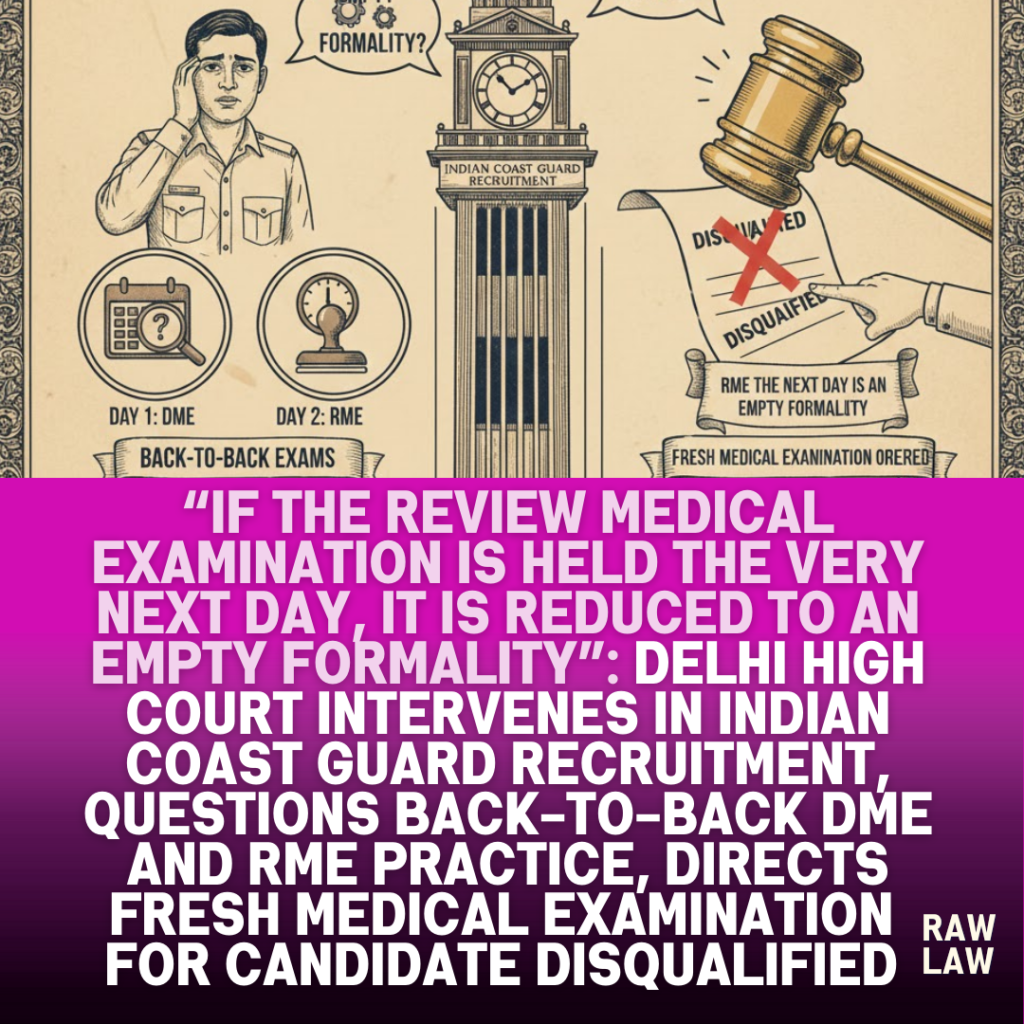
The Delhi High Court intervened in an Indian Coast Guard recruitment case where a candidate was disqualified on medical grounds for Stage I Gynaecomastia after both the Detailed Medical Examination (DME) and Review Medical Examination (RME) were conducted on consecutive days. Observing that such back-to-back examinations reduce the review process to an “empty formality,” the Court issued prospective directions mandating a reasonable and meaningful gap between DME and RME. Considering medical literature that describes Gynaecomastia as a non-serious and often reversible condition, the Court directed a fresh medical examination at the Army Research and Referral Hospital. While clarifying that the petitioner could only be considered for a future recruitment batch, the Court’s ruling lays down important safeguards to ensure fairness and substantive review in medical disqualification cases across armed and paramilitary forces.
Court’s decision
The Delhi High Court disposed of the writ petition by granting relief to the petitioner and issuing significant directions governing medical examinations in recruitment to the Indian Coast Guard and other uniformed forces. While not straightaway setting aside the petitioner’s disqualification, the Court directed that he be subjected to a fresh medical examination at the Army Research and Referral Hospital to determine whether he continued to suffer from Gynaecomastia. Importantly, the Court also issued prospective directions requiring that, in future cases, there must be a reasonable and meaningful gap between the Detailed Medical Examination and the Review Medical Examination, so that the review process does not become a mere ritual devoid of substantive value.
Facts
The petitioner had applied for recruitment to the post of Navik (General Duty) in the Indian Coast Guard. As part of the selection process, he underwent a Detailed Medical Examination on 9 September 2025. During this examination, he was declared medically unfit on the ground that he was suffering from Stage I Gynaecomastia. Exercising his right to seek review, the petitioner underwent a Review Medical Examination on the very next day, 10 September 2025. The RME confirmed the findings of the DME, and the petitioner was consequently disqualified from recruitment. Aggrieved by the manner in which the medical review was conducted, the petitioner approached the Delhi High Court challenging his disqualification.
Issues
The principal issues before the High Court were whether conducting the Review Medical Examination immediately after the Detailed Medical Examination defeats the purpose of a review, and whether such a practice is fair and reasonable in recruitment processes governed by constitutional guarantees of equality and fairness. The Court was also required to consider whether disqualification on the basis of Stage I Gynaecomastia, a condition described in medical literature as often non-serious and reversible, warranted re-examination in the interests of justice.
Petitioner’s arguments
The petitioner contended that the medical review process was illusory and arbitrary, as both the DME and RME were conducted on consecutive days. It was argued that there was no realistic possibility of any medical improvement or reconsideration within such a short span, rendering the RME meaningless. The petitioner submitted that Stage I Gynaecomastia is a minor condition which may be transient and often linked to factors such as obesity, and that disqualification without a meaningful opportunity for review violated principles of fairness and proportionality. He therefore sought a fresh medical examination by an independent and specialised medical institution.
Respondent’s arguments
The respondents, representing the Indian Coast Guard and Union authorities, defended the recruitment process and submitted that the medical examinations were conducted strictly in accordance with prescribed standards. It was contended that there is no statutory requirement prescribing a minimum gap between the DME and RME, and that the petitioner had already availed the remedy of review as provided under the recruitment rules. The respondents also pointed out that the recruitment batch for which the petitioner had applied was nearing completion, and any relief granted should not disturb ongoing recruitment processes.
Analysis of the law
The High Court examined the nature and purpose of the Review Medical Examination in recruitment processes. It emphasised that a review mechanism must be substantive and meaningful, rather than a procedural formality. The Court noted that although the rules may not prescribe a mandatory time gap between DME and RME, constitutional principles of fairness under Articles 14 and 16 require that a candidate be given a genuine opportunity to contest an adverse medical finding. The Court stressed that administrative convenience cannot override substantive fairness, particularly in high-stakes recruitment processes where a candidate’s career prospects are at stake.
Precedent analysis
The Bench referred to its earlier decision in Deepak v. Indian Coast Guard, where it had noted the absence of a stipulated time gap between DME and RME despite candidates being granted up to 21 days to file an appeal. Building upon this jurisprudence, the Court observed that repeated cases had come before it where the DME and RME were conducted on consecutive days, invariably resulting in identical findings. Such a pattern, the Court observed, undermines the very rationale of providing a review mechanism. The present judgment therefore marks a further evolution in judicial scrutiny of recruitment medical standards.
Court’s reasoning
Justice C. Hari Shankar, speaking for the Bench, observed that holding the RME on the very next day after the DME effectively renders the review an “empty formality.” The Court reasoned that for many minor or borderline medical conditions, including Gynaecomastia, symptoms may change or improve over a short period with appropriate intervention such as weight reduction or lifestyle changes. The absence of any meaningful interval between examinations deprives candidates of the benefit of review envisaged by the recruitment framework. While the Court declined to prescribe a fixed minimum time gap, it directed that examining boards must ensure a reasonable and meaningful interval in future cases, guided by medical prudence and fairness.
Conclusion
In the specific facts of the case, the High Court directed that the petitioner be re-examined by doctors at the Army Research and Referral Hospital on a specified date. The petitioner undertook to abide by the outcome of this examination. The Court clarified that if the petitioner is found medically fit, he would only be considered for recruitment against a future batch, and not the ongoing one, thereby balancing individual relief with administrative practicality. The writ petition was accordingly disposed of with prospective directions aimed at reforming recruitment medical review practices.
Implications
This judgment has far-reaching implications for recruitment processes across the Indian Coast Guard, armed forces, and paramilitary organisations. By mandating a meaningful gap between initial and review medical examinations, the Court has strengthened procedural fairness and reduced the risk of arbitrary medical disqualifications. The ruling recognises the evolving understanding of medical conditions and underscores that recruitment standards must be applied with sensitivity, proportionality, and constitutional fairness. It is likely to prompt institutional reforms in medical examination protocols and reduce litigation arising from mechanical disqualifications.
CASE LAW REFERENCES
• Deepak v. Indian Coast Guard – Noted absence of mandated gap between DME and RME
• Union of India v. Pushpa Rani – Judicial review permissible where recruitment process is arbitrary
• Avtar Singh v. Union of India – Fairness and proportionality in recruitment decisions
FAQs
Q1. Can medical disqualification in armed forces recruitment be challenged in court?
Yes. Courts can intervene where the medical review process is arbitrary or violates principles of fairness.
Q2. Is Gynaecomastia always a ground for disqualification?
Not necessarily. Courts have recognised that early-stage Gynaecomastia may be minor or reversible, warranting careful medical assessment.
Q3. What did the Delhi High Court direct regarding DME and RME?
The Court directed that there must be a reasonable and meaningful gap between the two examinations so that the review is not a mere formality.
Also Read: Delhi High Court refuses to quash criminal case alleging forged Will despite pending civil disputes


