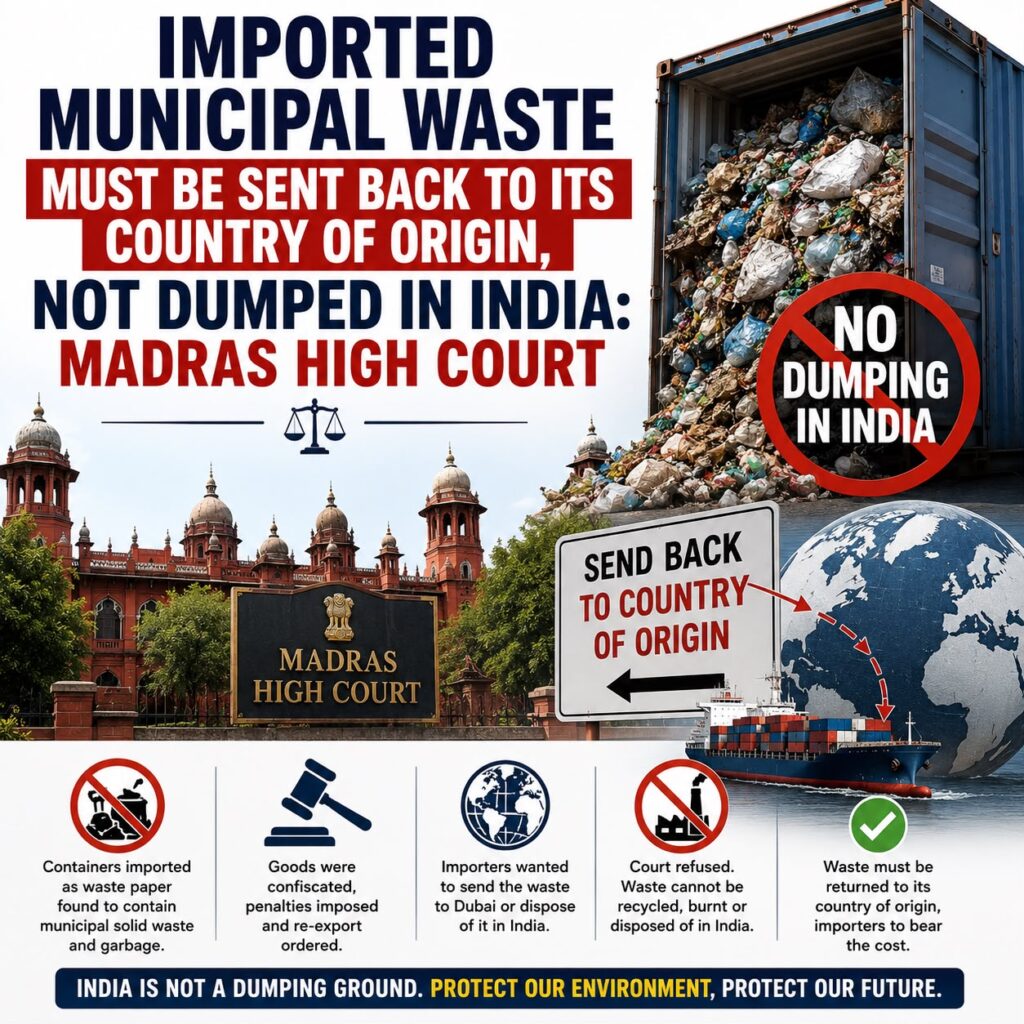
Imported Municipal Waste Must Be Sent Back to Its Country of Origin, Not Dumped in India: Madras High Court

India Cannot Become a Dumping Ground for Foreign Waste: Madras High Court Rejects Importers’ Re-Export Plan to Dubai
Facts
M/s Sripathi Paper and Boards Private Limited and M/s Rajarajeswari Krafts Private Limited are paper manufacturers that import waste paper for use as raw material.
In 2022, the companies imported several consignments declared in the customs documents as “Waste Paper – News & Pams” and “Waste Paper – ONP 6”. The consignments originated from suppliers in Canada, the United States and Singapore.
Upon inspection at the Tuticorin Port, the Customs Department, Directorate of Revenue Intelligence and Tamil Nadu Pollution Control Board found that the containers did not merely contain recyclable waste paper.
They contained municipal solid waste, including:
- used plastic bottles;
- street sweepings;
- food-stained paper and plastic packets;
- broken glass bottles;
- plastic and paper containers; and
- discarded soft-drink cans.
The goods were detained and subsequently seized because municipal solid waste cannot lawfully be imported into India under the Customs Act and the Hazardous and Other Wastes (Management and Transboundary Movement) Rules, 2016.
After adjudication, the Customs authorities found that the consignments had been misdeclared. The goods were confiscated, penalties were imposed and the importers were directed to re-export the waste to the countries from which it had originated.
The companies accepted the adjudication orders, paid the penalties and initially requested their foreign suppliers to take back the consignments.
However, the suppliers later requested that the goods be sent to Dubai instead of being returned to Canada and the United States.
The importers approached the Madras High Court seeking:
- permission to re-export the waste to Dubai;
- alternatively, permission to recycle or dispose of the waste within India;
- waiver of container detention, ground rent and demurrage charges;
- directions requiring the Customs authorities to bear those charges; and
- action against the shipping line and Container Freight Station operators for refusing to honour waiver communications.
The shipping line claimed detention charges exceeding ₹42 crore but offered to settle the claims of both importers for a consolidated amount of ₹4 crore, apart from re-export freight charges.
Issues
- Whether the Customs adjudication orders confiscating the goods, imposing penalties and directing re-export were legally valid.
- Whether prohibited municipal waste imported into India could be re-exported to Dubai instead of being returned to its countries of origin.
- Whether the waste could alternatively be recycled, incinerated or otherwise disposed of within India.
- Whether the importers were liable to pay container detention, demurrage, ground rent and related charges.
- Whether the waiver communications issued by the Customs authorities prevented shipping lines and Container Freight Stations from recovering those charges.
- Whether re-export could be delayed or stopped because of disputes regarding detention and storage charges.
- What further directions were necessary to prevent India from becoming a destination for foreign municipal waste.
Petitioner’s Arguments
The importers argued that Rule 15(2) of the Hazardous and Other Wastes Rules required illegal waste to be “re-exported” but did not expressly state that it must be returned only to the country from which it came.
They submitted that sending the containers to Dubai would be significantly cheaper than returning them to Canada or the United States.
They relied on communications from the foreign suppliers agreeing to receive the goods at Jebel Ali Port, Dubai.
The petitioners cited a Kerala High Court judgment to contend that there was no statutory prohibition against re-exporting prohibited goods to a third country.
They also argued that the waste could be dealt with inside India through cement kilns, waste-to-energy facilities or other authorised recycling and disposal processes.
According to them, the relevant Office Memorandum permitted disposal of certain contaminated imported waste after payment of a prescribed percentage of its value.
On detention and demurrage charges, the petitioners argued that the Customs authorities had issued communications directing waiver of such charges.
They contended that those directions were binding upon the shipping line and Container Freight Station operators under the Handling of Cargo in Customs Areas Regulations, 2009 and the Sea Cargo Manifest and Transhipment Regulations, 2018.
The petitioners further blamed the Customs authorities for delay in completing the adjudication proceedings. They argued that the goods had remained detained for an extended period because of official delay and that they should not be made liable for the resulting charges.
They therefore sought either complete waiver or a direction requiring the Customs Department to bear the financial burden.
Respondent’s Arguments
The Customs authorities argued that the consignments contained prohibited municipal solid waste and had been deliberately misdeclared as waste paper.
They submitted that the petitioners had accepted the adjudication findings, paid the penalties and allowed the orders to become final without filing statutory appeals under Section 128 of the Customs Act.
The authorities argued that Rule 15(2) required the waste to be returned to the country of export and did not permit the importers to choose a cheaper third-country destination.
They also relied upon India’s obligations under the Basel Convention, which places responsibility for illegal movement of hazardous and other waste upon the exporter and the State of export.
The Pollution Control Board confirmed that the consignments contained prohibited municipal waste and plastic contaminants.
The shipping line argued that the detention resulted from the importers’ own illegal conduct and misdeclaration.
It submitted that an importer found guilty of customs violations could not claim a waiver of detention and demurrage charges.
The shipping line claimed that the total detention charges payable by the two importers exceeded ₹42 crore. However, as a concession, it agreed to accept a consolidated sum of ₹4 crore, along with the freight required to return the containers to their countries of origin.
The Container Freight Station operators also argued that they were entitled to recover storage and related charges and that the prolonged retention of the cargo was attributable to the importers.
Analysis of the Law
The Court examined Rule 15(2) of the Hazardous and Other Wastes (Management and Transboundary Movement) Rules, 2016.
The provision requires an importer responsible for an illegal import to re-export the waste at its own cost within 90 days. The Port and Customs authorities are responsible for ensuring compliance.
The Court placed particular emphasis on the use of the word “re-export”.
It held that “re-export” is different from a fresh “export”. Re-export requires the goods to be returned to the place or country from which they entered India.
Allowing an importer to redirect illegally imported waste to another developing country merely because transportation is cheaper would undermine the statutory objective.
The Court interpreted the Rules consistently with the Basel Convention on the Control of Transboundary Movements of Hazardous Wastes and Their Disposal.
Article 9(2) of the Convention requires illegally transported waste to be taken back by the exporter or generator into the State of export.
The statutory and international framework therefore fixes responsibility on the exporter and the country from which the waste originated.
The Court also rejected the argument that the goods could be retained and processed in India.
Municipal solid waste is an expressly prohibited contaminant in imported waste-paper consignments. Provisions allowing limited treatment of permissible contaminants exceeding threshold limits could not be applied to waste whose import itself was prohibited.
The Court held that permitting local disposal would defeat the purpose of the Rules and effectively convert India into a disposal destination for waste generated abroad.
On detention and demurrage, the Court applied the principle that an importer found responsible for misdeclaration and import of prohibited goods remains liable for the commercial consequences of that conduct.
Waiver certificates cannot automatically erase the contractual and regulatory rights of shipping lines or custodians where penal violations have been established against the importer.
At the same time, disputes over charges could not be allowed to prevent the urgent removal of environmentally harmful waste from Indian territory.
Precedent Analysis
The petitioners relied upon M/s Hassoun Manufactures India Pvt. Ltd. v. Commissioner of Customs, where the Kerala High Court had permitted re-export to a country other than the country of origin.
The Madras High Court did not apply that approach to the present facts.
It held that the meaning of re-export had to be understood in the context of Rule 15(2) and India’s obligations under the Basel Convention, which require illegal waste to be returned to the State of export.
The petitioners also relied on decisions of the Customs, Excise and Service Tax Appellate Tribunal in Uniglobal Paper Pvt. Ltd. and Krishna Tissue Pvt. Ltd. concerning disposal of imported waste.
The Court found those decisions inapplicable because the present consignments contained expressly prohibited municipal solid waste and not merely permissible contaminants exceeding prescribed limits.
On detention charges, the Customs authorities and shipping line relied upon M/s K. Steamship Agencies Pvt. Ltd. v. M/s Balaji Dekors.
That decision held that detention or demurrage waiver cannot ordinarily benefit an importer who has been found guilty of misdeclaration or another penal violation.
The Court also considered Muscles Fusion FZE v. Principal Commissioner of Customs and Global Impex v. Manager, CELEBI, which recognised the rights of carriers and custodians to recover detention and demurrage charges despite customs intervention.
The judgment further referred to ITC Ltd. v. Norasia Container Lines Ltd., where the Court had criticised attempts by developed countries to use developing countries as dumping grounds for municipal waste.
The Court also relied upon the Supreme Court’s environmental reasoning in State of Telangana v. Mohd. Abdul Qasim, particularly the recognition that ecosystems are entitled to exist, survive and thrive and that environmental protection is linked with constitutional duties and the right to life.
Court’s Reasoning
The Court first upheld the adjudication orders.
It found that the importers had participated in the customs proceedings, accepted the findings, sought leniency, paid the penalties and failed to use the statutory appellate remedy.
Their later challenge through writ petitions was therefore belated and legally unsustainable.
The Court also found no procedural or jurisdictional defect in the adjudication process.
On the proposed re-export to Dubai, the Court held that the request was legally impermissible.
The waste had originated from Canada and the United States. It was therefore required to be returned to those countries.
The importers could not transfer responsibility for illegal waste to a third country simply because doing so was financially convenient.
The Court described the international dumping of waste by developed countries into developing nations as a form of “waste colonialism”.
Such practices shift the environmental and social cost of waste disposal onto economically vulnerable countries and threaten their public health, ecological security and sovereignty.
The Court held that one illegality could not be corrected by facilitating another.
It also found the request for disposal within India contrary to environmental law and public policy.
India already faces a serious domestic solid-waste problem. Allowing imported municipal waste to be recycled or burnt within the country would defeat the very prohibition against its import.
The Court noted that the two importing companies had followed strikingly similar courses of conduct and used nearly identical communications when dealing with the foreign suppliers.
It expressed concern that the imports were not accidental and had been designed to introduce municipal waste into India under the label of recyclable paper.
On detention and storage charges, the Court held that the importers remained liable.
However, it directed that disputes regarding the exact amount should not obstruct re-export because continued storage of the waste in India posed an environmental risk.
The Court accepted the shipping line’s offer to settle its aggregate detention claim for ₹4 crore, in addition to freight charges, while leaving the parties free to pursue other claims before the appropriate forum.
The Court further directed the Government of India to consider:
- amending the relevant Office Memorandum to expressly require prohibited waste to be returned to its port of origin;
- raising repeated violations by foreign exporters through diplomatic channels;
- seeking action against such exporters under the laws of their countries; and
- improving domestic waste-paper segregation so that dependence on imported waste paper can be reduced.
The judgment also observed that knowingly importing prohibited waste may invite prosecution under the Environment (Protection) Act.
It further stated that where an investigation establishes that the act was knowingly and purposely committed in a manner endangering India’s sovereignty, the authorities may examine the applicability of Section 152 of the Bharatiya Nyaya Sanhita. This observation was framed as a direction for consideration in appropriate cases rather than a finding of criminal guilt in the present writ proceedings.
Conclusion
The Madras High Court rejected all the principal reliefs sought by both importing companies.
It upheld the confiscation, penalty and re-export orders and directed that the municipal waste be returned to the respective countries and ports of origin within 60 days.
The Court ordered that:
- the waste must not be sent to Dubai;
- it cannot be recycled or disposed of within India;
- the importers must arrange and pay for re-export;
- the Container Freight Stations may raise detention and demurrage bills against the importers;
- disputes regarding charges must not stop re-export;
- the two importers are jointly liable to pay ₹4 crore to the shipping line, apart from freight charges;
- if re-export is not completed within 60 days, each importer must pay environmental compensation of ₹50,000 per day from the 61st day;
- the Tamil Nadu Pollution Control Board may recover that compensation under the Polluter Pays Principle;
- failure to re-export may result in prosecution of the companies, directors and responsible persons under the Environment (Protection) Act; and
- each petitioner must pay ₹10,000 as costs.
The judgment sends a clear message that India cannot be used as a dumping ground for foreign municipal waste and that importers responsible for illegal waste consignments must bear the cost of returning them to their source.
Case Details
Case: M/s Sripathi Paper and Boards Private Limited and M/s Rajarajeswari Krafts Private Limited v. Commissioner of Customs & Others
Court: Madurai Bench of the Madras High Court
Case Numbers: W.P.(MD) Nos. 24097, 24098, 24099, 24101, 24102, 24103 and 24104 of 2024
Judge: Justice D. Bharatha Chakravarthy
Date: 19 June 2026
Result: Petitions rejected; waste ordered to be re-exported to countries of origin within 60 days, with charges and environmental compensation imposed