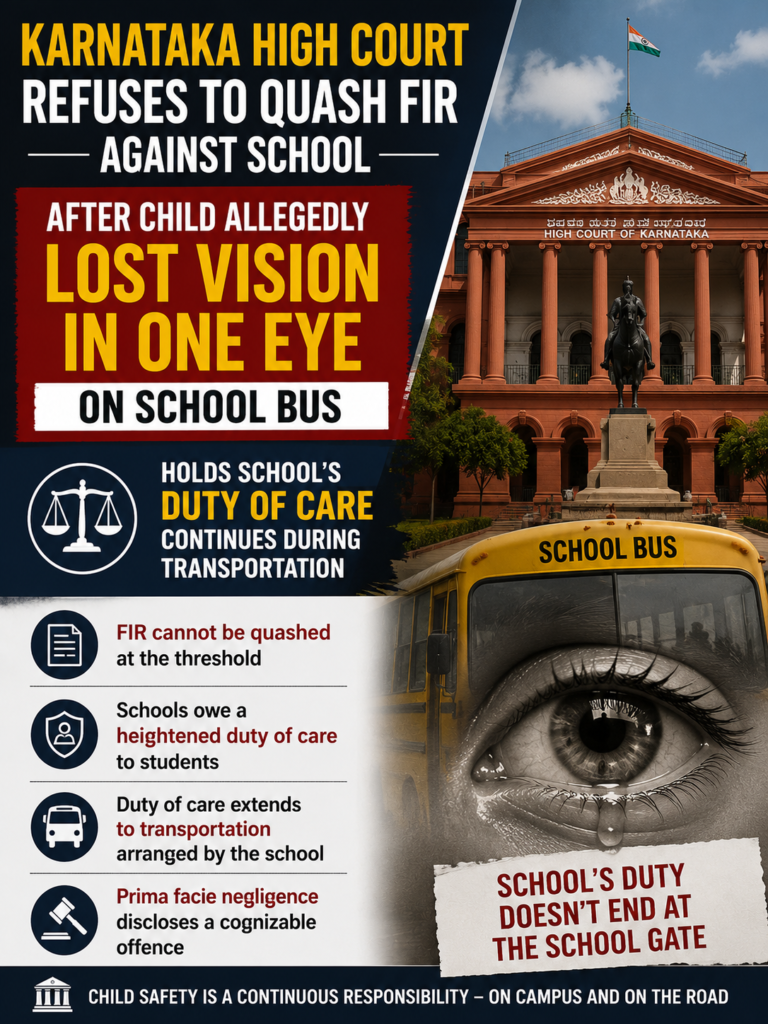
Karnataka High Court Refuses to Quash FIR Against School After Child Allegedly Lost Vision in One Eye on School Bus, Holds School’s Duty of Care Continues During Transportation

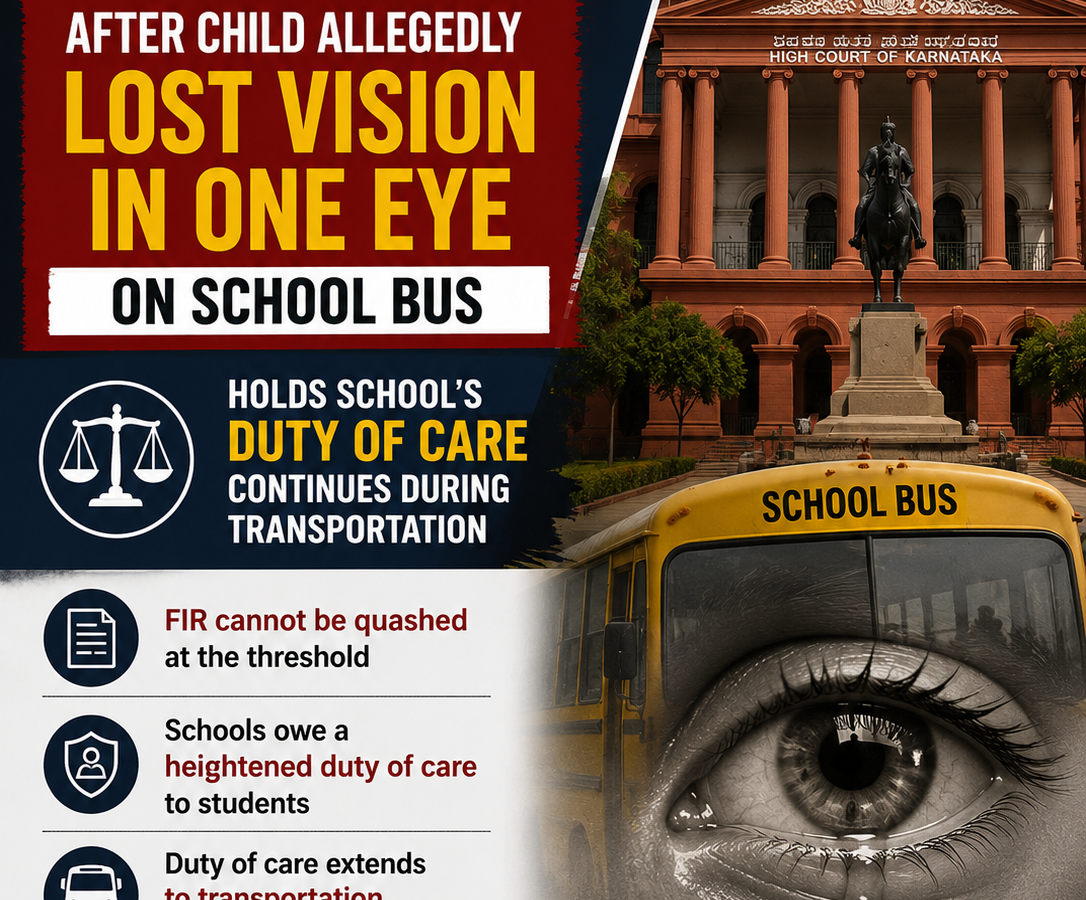
School Cannot Escape Investigation Merely Because Another Student Caused the Injury, Karnataka High Court Holds School Bus Is an Extension of the School
Facts
The petitioner was the management of Divyajyothi School, represented by its Headmaster. It approached the Karnataka High Court seeking quashing of Crime No. 94 of 2025 registered at Koppa Police Station, Mandya, for the offence punishable under Section 125(a) of the Bharatiya Nyaya Sanhita, 2023.
The second respondent’s son was studying in the fourth standard at the petitioner-school. On 1 August 2025, he was travelling home in School Bus No. 5 along with several other students.
During the journey, some children allegedly carried and sprayed coloured confetti or sparklers inside the bus. The substance entered the child’s eyes. After being dropped near his residence, the child complained of a severe burning sensation.
The child was subsequently taken to different hospitals for treatment. According to the complaint, the injury caused irreversible damage and loss of vision in one eye.
The medical documents reproduced in the judgment, including the disability certificate and Unique Disability Identity Card on pages 7 and 8, recorded blindness and permanent disability assessed at 40% to the whole body.
The child’s mother lodged the complaint on 5 September 2025, alleging negligence on the part of the school management. She alleged that:
- there was no proper supervision inside the school bus;
- an attendant was not present;
- the CCTV camera installed in the bus was not functioning; and
- the school failed to prevent children from carrying and using potentially dangerous material inside the bus.
A Coordinate Bench had earlier stayed further investigation against the school management on 27 October 2025. The school thereafter sought complete quashing of the FIR under Section 482 of the Code of Criminal Procedure, corresponding to Section 528 of the Bharatiya Nagarik Suraksha Sanhita, 2023.
Issues
- Whether the FIR against the school management disclosed the ingredients of the offence under Section 125(a) of the Bharatiya Nyaya Sanhita.
- Whether the school management could be held potentially responsible for an injury caused by the act of another child inside the school bus.
- Whether the duty of care owed by a school extends to the transportation of students in a school bus.
- Whether the alleged absence of an attendant and the alleged non-functioning CCTV camera required investigation.
- Whether the proceedings should be quashed at the FIR stage on the ground that the incident was an unforeseen act of childish mischief.
- Whether determining the school management’s criminal negligence at the threshold would amount to conducting an impermissible mini-trial.
Petitioner’s Arguments
The school management argued that it had taken all necessary safety precautions.
It submitted that:
- an attendant was present in the bus;
- a CCTV camera had been installed;
- the school had taken the precautions reasonably expected of it; and
- it was unclear what additional measures could have been adopted to prevent the incident.
The petitioner contended that the unfortunate injury was caused by the act of another child and could not automatically be attributed to the school management.
It was argued that the incident occurred inside the school bus after school hours and that the management could not be criminally prosecuted for every unforeseen act committed by a student during transportation.
The petitioner therefore submitted that the necessary element of rashness or criminal negligence was absent and sought quashing of the FIR and all consequential proceedings.
Respondent’s Arguments
State of Karnataka
The State opposed the petition and relied upon the investigation materials.
It submitted that the CCTV camera, although installed, was allegedly not functioning. It was also alleged that no attendant was present in the bus when the incident occurred.
According to the State, whether the school had complied with its safety obligations and whether the omissions amounted to criminal negligence were matters requiring investigation.
The State emphasised the seriousness of the consequence, namely the child’s permanent loss of vision and 40% disability.
Complainant
The complainant argued that the school’s responsibility did not begin and end within the classroom.
Once a child was entrusted to the school, the duty of care continued until the child was safely returned to the custody of the parent.
The school bus was described as an extension of the school itself and not a separate space outside the responsibility of the institution.
It was submitted that terminating the investigation at the threshold would:
- prevent the determination of criminal accountability;
- obstruct examination of the alleged safety failures; and
- prejudice the complainant’s pursuit of consequential remedies, including compensation.
Analysis of the Law
Scope of power to quash an FIR
The Court held that an FIR is not required to contain an exhaustive account of every fact, piece of evidence, offence and legal consequence.
Its primary purpose is to set the criminal law in motion.
At the quashing stage, the Court is not expected to weigh the defence against the allegations or decide disputed questions of fact. It must ordinarily examine whether the allegations, taken at face value, disclose an offence requiring investigation.
The Court held that it could not conduct a mini-trial to determine whether an attendant was actually present, whether the CCTV was functioning or whether the school had taken sufficient precautions.
School’s duty of care during transportation
The Court held that a school which undertakes to transport young children assumes a heightened duty of care.
The responsibility of the institution continues during the child’s journey in the school bus. The bus is an extension of the school for the purpose of student safety.
The school cannot disclaim responsibility merely because the formal classroom hours have ended.
The Court observed that the duty continues from the time the child enters the custody of the school until the child is safely restored to the parent or guardian.
Statutory transportation requirements
The Court referred to the Karnataka Educational Institutions (Classification, Regulation and Prescription of Curricula, etc.) (Amendment) Rules, 2018.
Section 1C dealing with transportation prescribes safety measures for school vehicles.
The Rules require, among other things:
- a teacher or attendant to accompany children in the school bus until the last stop;
- a responsible person or security staff to supervise the movement of vehicles during pickup and drop-off; and
- the school management to oversee compliance with transportation safeguards.
The Court held that these were mandatory statutory obligations and not merely optional safety recommendations.
Ingredients of Section 125(a) of the BNS
Section 125 penalises a person who acts rashly or negligently in a manner endangering human life or personal safety.
Clause (a) applies where such rash or negligent conduct causes hurt. It provides for imprisonment extending to six months, a fine extending to ₹5,000, or both.
The Court noted that Section 125(a) corresponds broadly to Sections 336 and 337 of the Indian Penal Code.
To attract the provision, the alleged rash or negligent act or omission must be attributable to the accused.
In the present case, the complaint alleged specific omissions by the school management:
- absence of an attendant;
- failure to supervise children;
- failure to maintain a functioning CCTV system;
- failure to prevent dangerous material from being carried or used inside the bus; and
- failure to implement and enforce adequate safety instructions.
The Court held that these allegations, when accepted at face value, satisfied the threshold requirements of Section 125(a) and warranted investigation.
Criminal liability for the act of another child
The Court rejected the argument that the involvement of another child automatically absolved the school management.
The immediate act may have been committed by a student, but the issue was whether the injury became possible or more likely because of an independent failure of supervision by the school.
The school’s potential liability therefore depended not merely upon who sprayed the substance but upon whether the management failed to comply with its duty of care.
That question required investigation and could not be conclusively decided at the FIR stage.
Matters requiring investigation
The Court identified several questions that had to be examined by the investigating agency:
- whether an attendant was actually present in the bus;
- whether the CCTV camera was functional or merely installed as an ornamental measure;
- whether children were permitted to carry dangerous or prohibited articles;
- whether the school had issued adequate safety instructions;
- whether those instructions were enforced;
- whether there was sufficient supervision during transportation; and
- whether any act or omission of the management contributed to the injury.
These were factual matters that could be determined only after collection and examination of evidence.
Precedent Analysis
The judgment did not undertake a detailed analysis of named judicial precedents. Its conclusion was principally based upon:
- the statutory ingredients of Section 125(a) of the Bharatiya Nyaya Sanhita;
- the transportation obligations under the Karnataka Educational Institutions Rules, 2018;
- the settled limitations on the High Court’s power to quash an FIR; and
- the distinction between examining whether allegations disclose an offence and conducting a full assessment of criminal culpability.
The Court applied the settled principle that disputed factual defences should ordinarily not be adjudicated in proceedings for quashing an FIR.
The school’s claims that an attendant was present, that reasonable precautions were taken and that the incident was solely attributable to another child were treated as matters of defence to be investigated rather than grounds for terminating the proceedings at inception.
Court’s Reasoning
The Court found that the basic facts of the incident were not seriously disputed. The injury occurred inside the petitioner-school’s bus while several children were being transported home.
The consequence was not a minor or temporary injury. The medical records showed permanent visual impairment and disability assessed at 40%.
The Court held that the school’s duty of care was particularly strict because the passengers were young children who could not be expected to independently safeguard themselves against every danger.
The allegation that another child caused the immediate injury did not answer whether the incident could have been prevented through proper supervision.
The Court observed that school-bus safety was not a matter of charity or administrative convenience. It was a solemn statutory obligation.
The allegations relating to the absence of an attendant, the non-functioning CCTV camera and failure to supervise the students directly concerned compliance with that obligation.
The Court clarified that the school might ultimately establish that it was not criminally negligent. However, such a finding could be reached only after investigation.
Quashing the FIR at that stage would prematurely prevent the investigating agency from determining the relevant facts.
The Court therefore held that the complaint disclosed the ingredients of Section 125(a) of the BNS and that continuation of the investigation was necessary.
Conclusion
The Karnataka High Court dismissed the petition filed by Divyajyothi School Management.
It refused to quash Crime No. 94 of 2025 registered under Section 125(a) of the Bharatiya Nyaya Sanhita.
The Court held that:
- the school bus was an extension of the school;
- the school’s duty of care continued until the child was safely returned to the parent;
- the statutory rules required an attendant to accompany children in the bus;
- the allegations regarding absence of supervision and non-functioning CCTV required investigation;
- the school could not be absolved at the threshold merely because the immediate act was committed by another child; and
- the precise question of criminal negligence could be determined only after investigation.
The interim protection against investigation therefore ceased, and the Court directed that the investigation must proceed.
Case: Divyajyothi School Management v. State of Karnataka and Another
Court: High Court of Karnataka at Bengaluru
Case Number: Criminal Petition No. 13718 of 2025
Judge: Justice M. Nagaprasanna
Date: 23 June 2026
Result: Petition dismissed; request to quash FIR No. 94 of 2025 rejected, and investigation under Section 125(a) of the Bharatiya Nyaya Sanhita directed to continue.
Karnataka High Court Refuses to Quash FIR Against School After Child Allegedly Lost Vision in One Eye on School Bus, Holds School’s Duty of Care Continues During Transportation
School Cannot Escape Investigation Merely Because Another Student Caused the Injury, Karnataka High Court Holds School Bus Is an Extension of the School
Facts
The petitioner was the management of Divyajyothi School, represented by its Headmaster. It approached the Karnataka High Court seeking quashing of Crime No. 94 of 2025 registered at Koppa Police Station, Mandya, for the offence punishable under Section 125(a) of the Bharatiya Nyaya Sanhita, 2023.
The second respondent’s son was studying in the fourth standard at the petitioner-school. On 1 August 2025, he was travelling home in School Bus No. 5 along with several other students.
During the journey, some children allegedly carried and sprayed coloured confetti or sparklers inside the bus. The substance entered the child’s eyes. After being dropped near his residence, the child complained of a severe burning sensation.
The child was subsequently taken to different hospitals for treatment. According to the complaint, the injury caused irreversible damage and loss of vision in one eye.
The medical documents reproduced in the judgment, including the disability certificate and Unique Disability Identity Card on pages 7 and 8, recorded blindness and permanent disability assessed at 40% to the whole body.
The child’s mother lodged the complaint on 5 September 2025, alleging negligence on the part of the school management. She alleged that:
- there was no proper supervision inside the school bus;
- an attendant was not present;
- the CCTV camera installed in the bus was not functioning; and
- the school failed to prevent children from carrying and using potentially dangerous material inside the bus.
A Coordinate Bench had earlier stayed further investigation against the school management on 27 October 2025. The school thereafter sought complete quashing of the FIR under Section 482 of the Code of Criminal Procedure, corresponding to Section 528 of the Bharatiya Nagarik Suraksha Sanhita, 2023.
Issues
- Whether the FIR against the school management disclosed the ingredients of the offence under Section 125(a) of the Bharatiya Nyaya Sanhita.
- Whether the school management could be held potentially responsible for an injury caused by the act of another child inside the school bus.
- Whether the duty of care owed by a school extends to the transportation of students in a school bus.
- Whether the alleged absence of an attendant and the alleged non-functioning CCTV camera required investigation.
- Whether the proceedings should be quashed at the FIR stage on the ground that the incident was an unforeseen act of childish mischief.
- Whether determining the school management’s criminal negligence at the threshold would amount to conducting an impermissible mini-trial.
Petitioner’s Arguments
The school management argued that it had taken all necessary safety precautions.
It submitted that:
- an attendant was present in the bus;
- a CCTV camera had been installed;
- the school had taken the precautions reasonably expected of it; and
- it was unclear what additional measures could have been adopted to prevent the incident.
The petitioner contended that the unfortunate injury was caused by the act of another child and could not automatically be attributed to the school management.
It was argued that the incident occurred inside the school bus after school hours and that the management could not be criminally prosecuted for every unforeseen act committed by a student during transportation.
The petitioner therefore submitted that the necessary element of rashness or criminal negligence was absent and sought quashing of the FIR and all consequential proceedings.
Respondent’s Arguments
State of Karnataka
The State opposed the petition and relied upon the investigation materials.
It submitted that the CCTV camera, although installed, was allegedly not functioning. It was also alleged that no attendant was present in the bus when the incident occurred.
According to the State, whether the school had complied with its safety obligations and whether the omissions amounted to criminal negligence were matters requiring investigation.
The State emphasised the seriousness of the consequence, namely the child’s permanent loss of vision and 40% disability.
Complainant
The complainant argued that the school’s responsibility did not begin and end within the classroom.
Once a child was entrusted to the school, the duty of care continued until the child was safely returned to the custody of the parent.
The school bus was described as an extension of the school itself and not a separate space outside the responsibility of the institution.
It was submitted that terminating the investigation at the threshold would:
- prevent the determination of criminal accountability;
- obstruct examination of the alleged safety failures; and
- prejudice the complainant’s pursuit of consequential remedies, including compensation.
Analysis of the Law
Scope of power to quash an FIR
The Court held that an FIR is not required to contain an exhaustive account of every fact, piece of evidence, offence and legal consequence.
Its primary purpose is to set the criminal law in motion.
At the quashing stage, the Court is not expected to weigh the defence against the allegations or decide disputed questions of fact. It must ordinarily examine whether the allegations, taken at face value, disclose an offence requiring investigation.
The Court held that it could not conduct a mini-trial to determine whether an attendant was actually present, whether the CCTV was functioning or whether the school had taken sufficient precautions.
School’s duty of care during transportation
The Court held that a school which undertakes to transport young children assumes a heightened duty of care.
The responsibility of the institution continues during the child’s journey in the school bus. The bus is an extension of the school for the purpose of student safety.
The school cannot disclaim responsibility merely because the formal classroom hours have ended.
The Court observed that the duty continues from the time the child enters the custody of the school until the child is safely restored to the parent or guardian.
Statutory transportation requirements
The Court referred to the Karnataka Educational Institutions (Classification, Regulation and Prescription of Curricula, etc.) (Amendment) Rules, 2018.
Section 1C dealing with transportation prescribes safety measures for school vehicles.
The Rules require, among other things:
- a teacher or attendant to accompany children in the school bus until the last stop;
- a responsible person or security staff to supervise the movement of vehicles during pickup and drop-off; and
- the school management to oversee compliance with transportation safeguards.
The Court held that these were mandatory statutory obligations and not merely optional safety recommendations.
Ingredients of Section 125(a) of the BNS
Section 125 penalises a person who acts rashly or negligently in a manner endangering human life or personal safety.
Clause (a) applies where such rash or negligent conduct causes hurt. It provides for imprisonment extending to six months, a fine extending to ₹5,000, or both.
The Court noted that Section 125(a) corresponds broadly to Sections 336 and 337 of the Indian Penal Code.
To attract the provision, the alleged rash or negligent act or omission must be attributable to the accused.
In the present case, the complaint alleged specific omissions by the school management:
- absence of an attendant;
- failure to supervise children;
- failure to maintain a functioning CCTV system;
- failure to prevent dangerous material from being carried or used inside the bus; and
- failure to implement and enforce adequate safety instructions.
The Court held that these allegations, when accepted at face value, satisfied the threshold requirements of Section 125(a) and warranted investigation.
Criminal liability for the act of another child
The Court rejected the argument that the involvement of another child automatically absolved the school management.
The immediate act may have been committed by a student, but the issue was whether the injury became possible or more likely because of an independent failure of supervision by the school.
The school’s potential liability therefore depended not merely upon who sprayed the substance but upon whether the management failed to comply with its duty of care.
That question required investigation and could not be conclusively decided at the FIR stage.
Matters requiring investigation
The Court identified several questions that had to be examined by the investigating agency:
- whether an attendant was actually present in the bus;
- whether the CCTV camera was functional or merely installed as an ornamental measure;
- whether children were permitted to carry dangerous or prohibited articles;
- whether the school had issued adequate safety instructions;
- whether those instructions were enforced;
- whether there was sufficient supervision during transportation; and
- whether any act or omission of the management contributed to the injury.
These were factual matters that could be determined only after collection and examination of evidence.
Precedent Analysis
The judgment did not undertake a detailed analysis of named judicial precedents. Its conclusion was principally based upon:
- the statutory ingredients of Section 125(a) of the Bharatiya Nyaya Sanhita;
- the transportation obligations under the Karnataka Educational Institutions Rules, 2018;
- the settled limitations on the High Court’s power to quash an FIR; and
- the distinction between examining whether allegations disclose an offence and conducting a full assessment of criminal culpability.
The Court applied the settled principle that disputed factual defences should ordinarily not be adjudicated in proceedings for quashing an FIR.
The school’s claims that an attendant was present, that reasonable precautions were taken and that the incident was solely attributable to another child were treated as matters of defence to be investigated rather than grounds for terminating the proceedings at inception.
Court’s Reasoning
The Court found that the basic facts of the incident were not seriously disputed. The injury occurred inside the petitioner-school’s bus while several children were being transported home.
The consequence was not a minor or temporary injury. The medical records showed permanent visual impairment and disability assessed at 40%.
The Court held that the school’s duty of care was particularly strict because the passengers were young children who could not be expected to independently safeguard themselves against every danger.
The allegation that another child caused the immediate injury did not answer whether the incident could have been prevented through proper supervision.
The Court observed that school-bus safety was not a matter of charity or administrative convenience. It was a solemn statutory obligation.
The allegations relating to the absence of an attendant, the non-functioning CCTV camera and failure to supervise the students directly concerned compliance with that obligation.
The Court clarified that the school might ultimately establish that it was not criminally negligent. However, such a finding could be reached only after investigation.
Quashing the FIR at that stage would prematurely prevent the investigating agency from determining the relevant facts.
The Court therefore held that the complaint disclosed the ingredients of Section 125(a) of the BNS and that continuation of the investigation was necessary.
Conclusion
The Karnataka High Court dismissed the petition filed by Divyajyothi School Management.
It refused to quash Crime No. 94 of 2025 registered under Section 125(a) of the Bharatiya Nyaya Sanhita.
The Court held that:
- the school bus was an extension of the school;
- the school’s duty of care continued until the child was safely returned to the parent;
- the statutory rules required an attendant to accompany children in the bus;
- the allegations regarding absence of supervision and non-functioning CCTV required investigation;
- the school could not be absolved at the threshold merely because the immediate act was committed by another child; and
- the precise question of criminal negligence could be determined only after investigation.
The interim protection against investigation therefore ceased, and the Court directed that the investigation must proceed.
Case: Divyajyothi School Management v. State of Karnataka and Another
Court: High Court of Karnataka at Bengaluru
Case Number: Criminal Petition No. 13718 of 2025
Judge: Justice M. Nagaprasanna
Date: 23 June 2026
Result: Petition dismissed; request to quash FIR No. 94 of 2025 rejected, and investigation under Section 125(a) of the Bharatiya Nyaya Sanhita directed to continue.