

Court’s decision
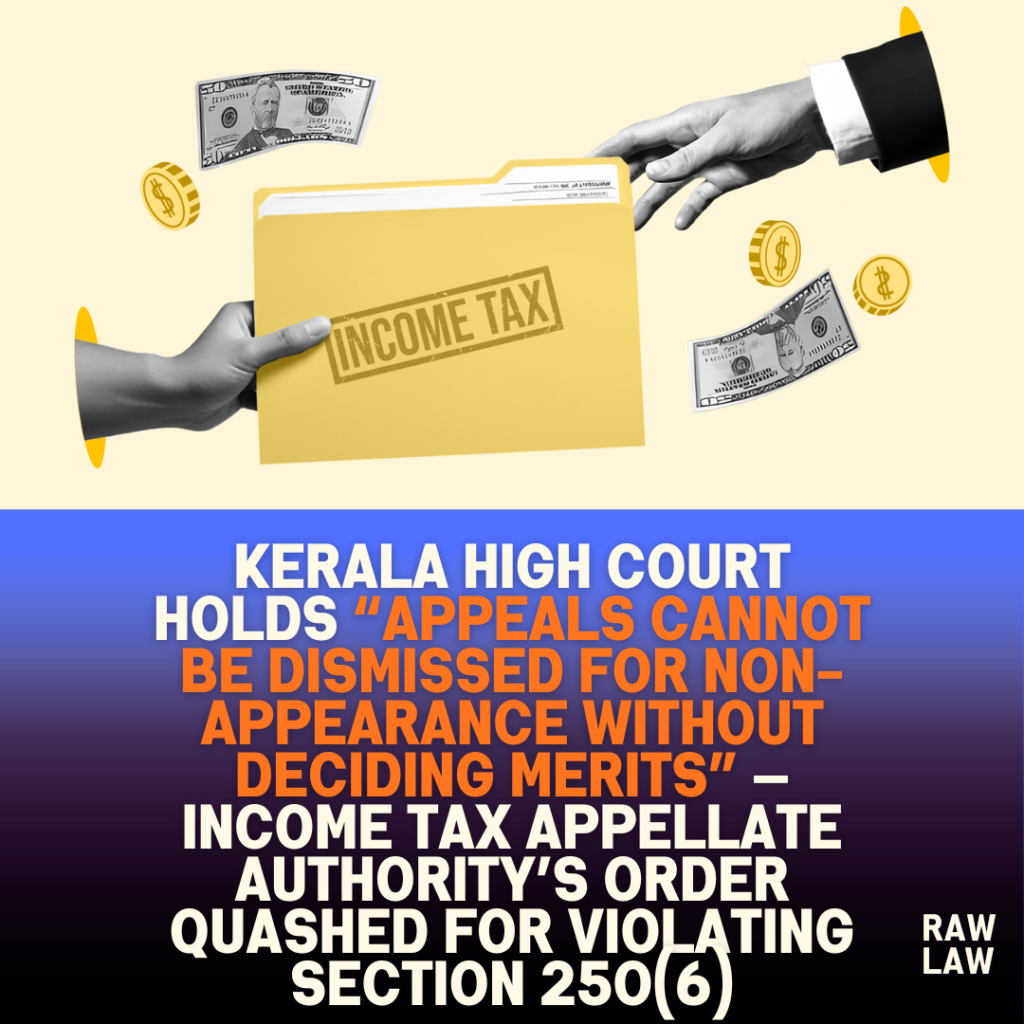
The Kerala High Court allowed the writ petition and quashed the appellate order passed by the first appellate authority, holding that dismissal of a statutory appeal solely on the ground of non-appearance is impermissible in law. The Court held that Section 250(6) of the Income Tax Act mandates that every appellate order must set out the points for determination, the decision thereon, and the reasons for such decision.
The Court observed that the appellate authority had rejected the appeal mechanically without examining the grounds raised or adjudicating the merits of the assessment. Such an approach, the Court held, defeats the statutory scheme of appellate adjudication and violates principles of natural justice.
Accordingly, the impugned appellate order was set aside, and the matter was remitted to the appellate authority with a direction to reconsider the appeal on merits after affording the assessee a reasonable opportunity of being heard, and to pass a reasoned order in accordance with law.
Facts
The assessee, an elderly individual, was subjected to an assessment under the Income Tax Act for the relevant assessment year, resulting in a demand. Aggrieved by the assessment order, the assessee preferred a statutory appeal before the Commissioner of Income Tax (Appeals) in accordance with law.
During the pendency of the appeal, notices were issued by the appellate authority fixing the matter for hearing. Owing to circumstances stated by the assessee, there was no effective appearance on the scheduled dates. Without examining the grounds of appeal or the merits of the assessment, the appellate authority dismissed the appeal solely on the ground of non-appearance.
The assessee approached the High Court under Article 226 of the Constitution, contending that the appellate order was contrary to Section 250(6) of the Act and that dismissal for default without adjudication on merits was legally unsustainable.
Issues
Whether an income tax appeal can be dismissed solely on the ground of non-appearance of the appellant.
Whether Section 250(6) mandates adjudication of appeals on merits irrespective of appearance.
Whether an appellate order without determination of issues and reasons is legally sustainable.
Whether dismissal for default violates principles of natural justice and statutory duty of the appellate authority.
Petitioner’s Arguments
The assessee contended that Section 250(6) imposes a mandatory obligation on the appellate authority to decide the appeal on merits by framing points for determination and recording findings thereon. It was argued that absence of appearance does not absolve the authority of its statutory duty to adjudicate.
It was further submitted that none of the provisions of Section 250 permit dismissal of an appeal for default. The assessee argued that the appellate authority acts in a quasi-judicial capacity and cannot dispose of appeals in a summary manner without examining the grounds raised.
The assessee relied on settled jurisprudence holding that tax appeals must be decided on merits and that procedural lapses cannot defeat substantive statutory rights.
Respondent’s Arguments
The Revenue contended that the assessee failed to cooperate with the appellate proceedings despite issuance of notices, and therefore the appellate authority was justified in dismissing the appeal.
It was argued that repeated non-appearance indicated lack of diligence on the part of the assessee, and that the appellate authority could not be compelled to indefinitely adjourn matters.
The Revenue sought to sustain the impugned order by contending that sufficient opportunity had been granted and that no interference was warranted under writ jurisdiction.
Analysis of the law
The High Court examined the scheme of Section 250 of the Income Tax Act, with specific emphasis on sub-section (6). It held that the language of Section 250(6) is mandatory and leaves no discretion with the appellate authority to bypass adjudication on merits.
The Court observed that the “points for determination” referred to in Section 250(6) can only be the grounds raised in the appeal. Non-appearance of the appellant cannot constitute a point for determination. Therefore, an order dismissing an appeal solely for non-appearance is fundamentally contrary to the statutory mandate.
The Court further held that appellate authorities under fiscal statutes perform quasi-judicial functions and are bound by principles of natural justice, including reasoned decision-making.
Precedent Analysis
The Court relied on earlier High Court decisions interpreting Section 250(6), which consistently held that dismissal of appeals for default is impermissible. It applied the principle that tax appeals must be decided on merits, even if the appellant is absent.
Judicial precedents emphasising that statutory appellate remedies cannot be rendered illusory by procedural dismissals were followed. The Court also drew support from decisions holding that reasoned orders are an integral component of fair adjudication.
These precedents conclusively governed the controversy and rendered the impugned order unsustainable.
Court’s Reasoning
The Court found that the impugned appellate order contained no discussion on the grounds of appeal, no framing of points for determination, and no reasons addressing the merits of the assessment.
The Court held that such an order was in clear violation of Section 250(6) and amounted to abdication of statutory duty. It rejected the Revenue’s contention that non-appearance justified dismissal, holding that the proper course in such cases is to decide the appeal ex parte on merits.
Accordingly, the Court held that interference under writ jurisdiction was warranted to prevent miscarriage of justice.
Conclusion
The High Court quashed the appellate order and remanded the matter to the appellate authority for fresh consideration on merits. The authority was directed to afford reasonable opportunity to the assessee and to pass a reasoned order in accordance with Section 250(6).
Implications
This judgment reinforces the mandatory nature of Section 250(6) and provides strong protection to taxpayers against arbitrary dismissal of appeals. It clarifies that appellate authorities cannot short-circuit adjudication on the pretext of non-appearance.
The ruling strengthens procedural fairness in tax administration and ensures that statutory appellate remedies remain effective and meaningful.


