Lilavati Trust’s ₹1,000 Crore Defamation Suit Against HDFC Bank Suffers Setback: Bombay High Court Refuses To Silence Bank’s Public Clarifications

Court’s Decision
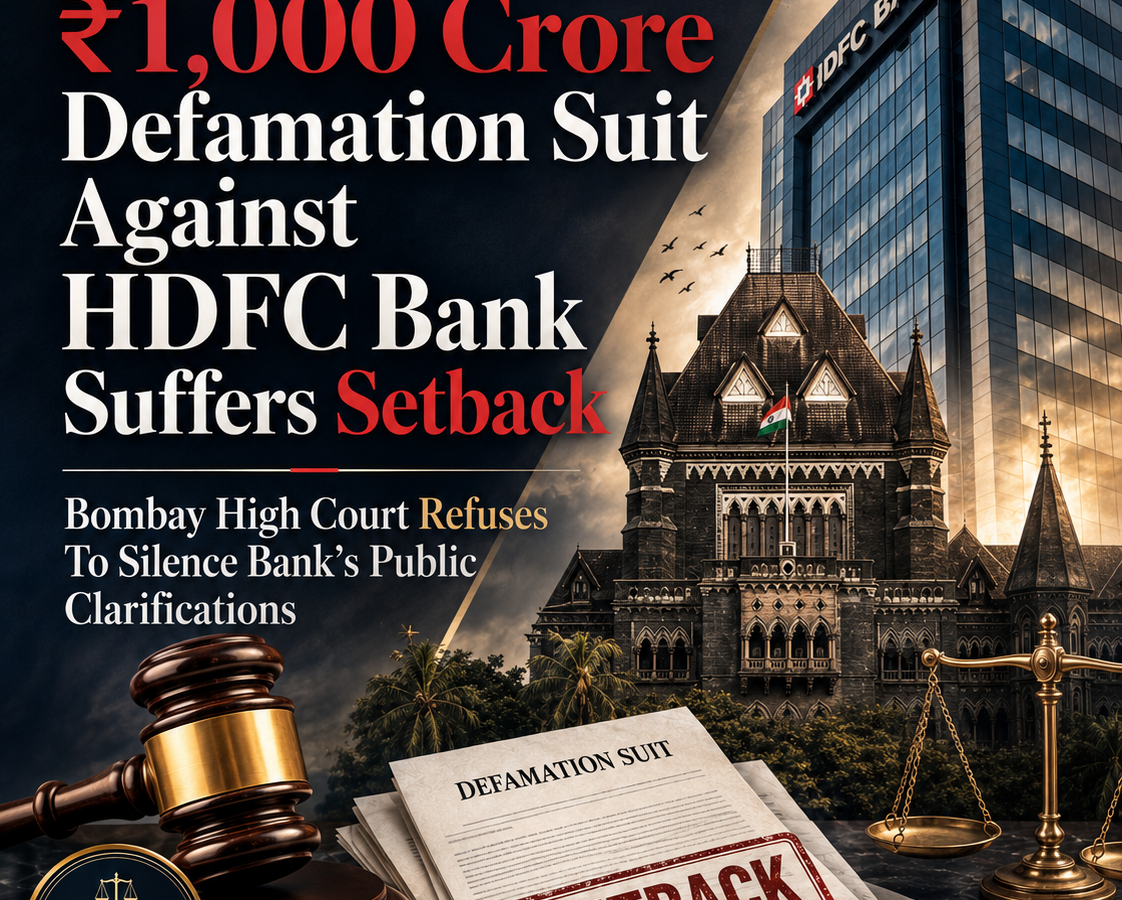
The Bombay High Court dismissed Interim Application No. 3095 of 2025 filed by Lilavati Kirtilal Mehta Trust and Prashant Kishor Mehta in their ₹1,000 crore defamation suit against HDFC Bank Limited and others. The Plaintiffs had sought interim injunctions restraining HDFC Bank from making allegedly defamatory statements, removal of statements already published, and related reliefs against social media intermediaries. The Court refused interim relief and imposed ₹5,00,000 costs on the Plaintiffs, payable to HDFC Bank within six weeks.
Facts
The Plaintiffs alleged that HDFC Bank, its executives, X Corp. and Meta had circulated defamatory statements concerning Prashant Mehta, Lilavati Trust and alleged loan defaults. The statements complained of included HDFC Bank’s email to Free Press Journal, a media statement on the Bank’s website, and a press release dated June 8, 2025. These statements referred to Prashant Mehta and his family owing substantial amounts to HDFC Bank, recovery actions continuing for over two decades, and multiple vexatious legal proceedings allegedly launched to frustrate recovery.
The Plaintiffs argued that neither Lilavati Trust nor Prashant Mehta had borrowed money from HDFC Bank, and that HDFC Bank had distorted the legal position by suggesting personal liability. According to them, Prashant Mehta was brought into recovery proceedings only as legal representative of his late father, and his liability, if any, was limited to the estate inherited. They alleged that HDFC Bank’s statements were half-truths intended to damage reputation.
Issues
The core issue was whether HDFC Bank’s statements were prima facie defamatory and whether the Plaintiffs were entitled to an interim injunction restraining HDFC Bank from publishing or continuing those statements.
The Court also examined whether HDFC Bank’s statements were bona fide, made in public interest, based on sufficient material, or whether they amounted to retaliatory defamation.
Plaintiffs’ Arguments
The Plaintiffs contended that an ordinary reader would understand HDFC Bank’s statements to mean that Lilavati Trust and Prashant Mehta had personally borrowed money and defaulted. They argued that this would lower their reputation in the eyes of right-thinking members of society. They further submitted that a defendant cannot answer alleged defamation by retaliating with defamatory statements.
The Plaintiffs relied on the Bombay High Court’s defamation jurisprudence to argue that a bare plea of justification is not enough at the interim stage; the defendant must show bona fides, public interest, reasonable verification and sufficient supporting material.
Respondents’ Arguments
HDFC Bank argued that every statement complained of was factually accurate and supported by the record. It relied upon recovery proceedings, DRT orders, recovery certificates, prior writ proceedings and judicial findings to show that substantial amounts were owed and that recovery had been delayed through repeated litigation.
HDFC Bank submitted that Lilavati Trust had itself entered the public dispute by making serious allegations against the Bank and its senior officials. It argued that its statements were merely bona fide clarifications issued in response to a media campaign and not defamatory.
Analysis of the Law
The Court applied the Indian standard for interim injunctions in defamation cases. It accepted that in India, unlike the English position, a mere plea of justification is not sufficient to defeat interim relief. The defendant must show that the statements were made bona fide, in public interest, after reasonable precaution, and on sufficient material capable of being tested for truth and veracity.
However, after applying this stricter test, the Court found that HDFC Bank’s statements were supported by strong material and were not prima facie defamatory.
Precedent Analysis
The Court considered the principles from Shree Maheshwar Hydel Power Corporation Ltd. v. Chitroopa Patil & Anr. and Indian Express (P) Ltd. v. Unmesh Padmakar Gujarathi on interim injunctions in defamation cases. The judgment also referred to the earlier Bombay High Court line of cases including Dr. Yashwant Trivedi v. Indian Express Newspapers (Bombay) Pvt. Ltd., Purshottam Odhnvji Solanki v. Sheela Bhatta, Mrs. Betty Kapadia v. Magna Publishing Co. Ltd., and Indian Express Newspapers (Bombay) Ltd. v. Magna Publishing Co. Ltd.
The Plaintiffs also relied upon Kunwar Radha Krishen Pratap Singh v. H.S. Bates, I.C.S. to argue that defamation by retaliation is impermissible. The Court considered this argument but found that HDFC Bank’s response was not retaliatory defamation, but a factual clarification.
Court’s Reasoning
The Court held that the statement that Prashant Mehta and his family owed substantial amounts to HDFC Bank was prima facie supported by recovery certificates issued in DRT proceedings. It observed that the issuance of a recovery certificate indicated that money was owed and rejected the argument that final adjudication was necessary before HDFC Bank could state the same.
The Court further held that the statement regarding recovery and enforcement proceedings continuing for over 20 years was factually accurate and supported by strong material. It observed that a listed bank has a responsibility to explain its position when serious allegations are made against it in the public domain.
On the allegation that the Plaintiffs had launched vexatious proceedings, the Court relied on prior judicial findings and observed that allegations of culpable homicide against a bank and its officials, made by litigants who had not paid despite recovery certificates and court directions, could prima facie be regarded as intimidatory and vexatious.
The Court also noted that HDFC Bank was constrained to issue statements to present its version of true and accurate facts, especially after a sustained media campaign. It held that the statements were prima facie factual, bona fide, and necessary as an institutional response.
Conclusion
The Court held that the Plaintiffs failed to establish a strong prima facie case that HDFC Bank’s statements were defamatory. It found that the statements were based on strong material, represented a bona fide clarification, were made in public interest, and were not retaliatory defamation.
The Court refused to gag HDFC Bank, observing that such restraint would expose the Bank to the risk of being unable to respond to continued attacks. It held that the balance of convenience lay in favour of HDFC Bank and dismissed the interim application with ₹5 lakh costs.
Implications
This judgment is significant because it reinforces that interim gag orders in defamation suits are not granted merely because reputational injury is alleged. Where the defendant demonstrates a factual foundation, strong supporting material, bona fide conduct and public interest, courts may refuse to restrain speech at the interim stage.
The order also protects the right of institutions, especially listed banks, to issue factual clarifications when serious public allegations are made against them. At the same time, the Court kept open the possibility of final relief after trial if the prima facie view changes on evidence.