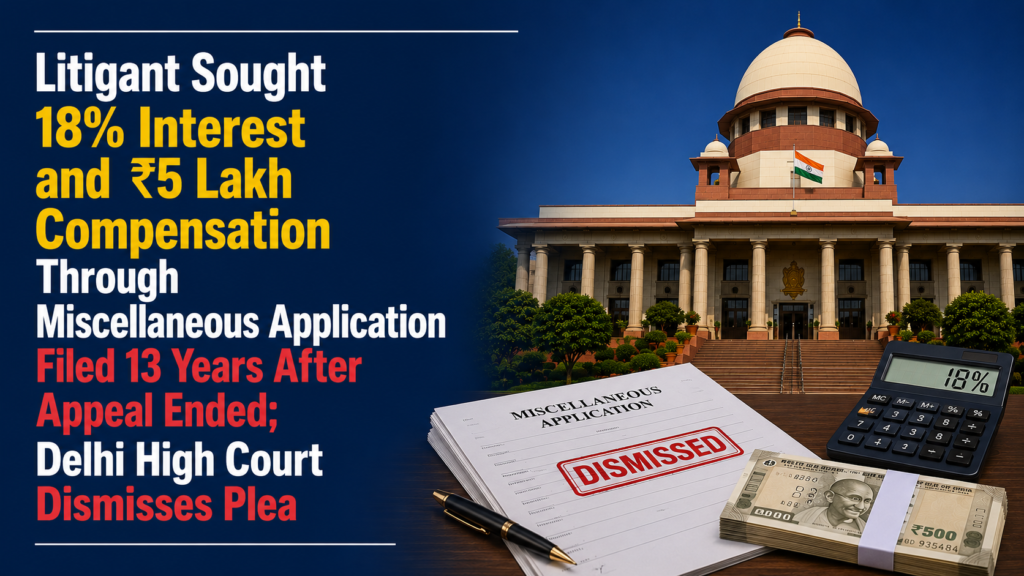
Litigant Sought 18% Interest and ₹5 Lakh Compensation Through Miscellaneous Application Filed 13 Years After Appeal Ended; Delhi High Court Dismisses Plea

Delhi High Court Holds Disposed Appeal Cannot Be Reopened Through Miscellaneous Application Seeking Fresh Monetary Reliefs
Facts
The application was filed by Tilak Raj Gogia, son of the appellant, in an appeal (EFA(OS) 16/2012) that had already been finally disposed of by the Delhi High Court on 23 January 2013.
The applicant sought several fresh reliefs, including:
- enhancement of interest to 18% per annum;
- payment of costs;
- compensation of ₹5 lakh for alleged harassment;
- transportation charges;
- reimbursement of expenses incurred in various execution proceedings;
- payment of further interest allegedly payable from 18 January 1989.
The respondent, Delhi Development Authority (DDA), objected to the maintainability of the application, contending that the appeal had attained finality long ago and the Court lacked jurisdiction to entertain fresh substantive claims.
The applicant’s claims were substantially founded upon a later judgment dated 15 April 2026 rendered in EX.S.A. 4/2019, which arose independently after the appeal had already concluded.
The Division Bench first examined whether it possessed jurisdiction to entertain such an application before considering the merits.
Issues
The Court considered:
- Whether a miscellaneous application could be maintained after final disposal of an appeal.
- Whether the High Court retained jurisdiction once the appeal had attained finality.
- Whether fresh monetary claims based on subsequent events could be entertained in concluded proceedings.
- Whether Section 151 CPC or the provisions cited by the applicant empowered the Court to reopen the matter.
- Whether repeated attempts to claim pendente lite and future interest constituted an abuse of the judicial process.
Applicant’s Arguments
The applicant sought:
- enhancement of the interest awarded;
- payment of further pendente lite and future interest;
- costs allegedly awarded in subsequent proceedings;
- compensation for harassment and transportation;
- reimbursement of litigation expenses.
He relied upon:
- Sections 96 to 104 CPC;
- Order XXXIV Rule 11 CPC;
and requested the Court to award additional monetary reliefs and reopen the earlier proceedings.
The applicant also sought implementation of benefits allegedly flowing from the later judgment dated 15 April 2026.
Respondent’s Arguments
The Delhi Development Authority submitted that:
- the appeal had already been finally decided in 2013;
- the High Court had become functus officio;
- the present application sought fresh substantive reliefs rather than implementation of the earlier judgment;
- the applicant was attempting to reopen issues that had repeatedly been adjudicated by competent courts.
The respondent therefore contended that the application was wholly non-maintainable.
Analysis of the Law
Finality of Judicial Proceedings
The Division Bench emphasised that once an appeal is finally disposed of, the proceedings come to an end.
After disposal, the Court cannot entertain fresh substantive claims through miscellaneous applications unless expressly authorised by law.
The applicant was not seeking clarification or implementation of the 2013 judgment.
Instead, he sought:
- fresh compensation;
- enhanced interest;
- additional costs;
- reimbursement of expenses;
- enforcement of rights allegedly arising from later litigation.
The Court held that such reliefs necessarily required reopening matters that had already attained finality, which the law does not permit.
Court Becomes Functus Officio
The Court reiterated the settled principle that after final adjudication a court becomes functus officio.
Its jurisdiction ends except to the limited extent specifically recognised by law.
A miscellaneous application cannot revive proceedings that have already concluded.
The Court observed that permitting such applications would destroy the certainty and finality of litigation.
Miscellaneous Application Cannot Replace Appeal or Review
Looking beyond the label attached to the application, the Court examined its true substance.
It held that the applicant was effectively seeking:
- reconsideration of concluded issues;
- enhancement of reliefs;
- fresh adjudication of claims already decided.
Such reliefs could not be obtained through a miscellaneous application.
The Court observed that miscellaneous applications cannot become substitutes for:
- appeals;
- reviews;
- other statutory remedies.
Subsequent Cause of Action Requires Independent Proceedings
A substantial portion of the applicant’s claims was based upon the judgment dated 15 April 2026 passed in EX.S.A. 4/2019.
The Court held that this subsequent judgment created, if at all, an independent cause of action.
Such subsequent developments could not revive an appeal disposed of more than thirteen years earlier.
If the applicant believed any rights arose from the later judgment, the appropriate remedy lay in proceedings flowing from that judgment—not in reopening the concluded appeal.
Section 151 CPC Cannot Create Jurisdiction
The Court rejected reliance on Section 151 CPC.
It reiterated that inherent powers:
- supplement procedure;
- do not create jurisdiction;
- cannot override express provisions of law;
- cannot defeat the doctrine of finality.
Similarly, Sections 96–104 CPC and Order XXXIV Rule 11 were held to have no application because:
- they relate to appellate remedies and mortgage suits;
- they do not authorise reopening finally concluded proceedings.
Precedent Analysis
State of Punjab v. Davinder Pal Singh Bhullar
The Supreme Court held that repeated attempts to re-agitate issues already decided amount to an abuse of the process of court.
The Delhi High Court relied upon this principle to hold that successive miscellaneous applications cannot reopen concluded litigation.
State of Uttar Pradesh v. Brahm Datt Sharma
The Supreme Court ruled that after a writ petition has been finally disposed of, subsequent events giving rise to a fresh cause of action cannot be agitated by filing a miscellaneous application in the disposed matter.
The proper course is to institute independent proceedings.
The Division Bench found this principle directly applicable.
Court’s Reasoning
The Court observed that:
- the appeal ended in 2013;
- the present claims arose primarily from a 2026 judgment;
- the applicant sought entirely fresh substantive monetary reliefs;
- the issue of pendente lite and future interest had already been repeatedly examined by the Executing Court, review proceedings and the High Court.
The Court concluded that:
- it lacked jurisdiction to entertain the application;
- the proceedings had long attained finality;
- repeated attempts to reopen them constituted an abuse of the judicial process.
The Court also noted that if such applications were permitted, every dissatisfied litigant could repeatedly revive concluded proceedings by filing miscellaneous applications, defeating the principle of finality.
Conclusion
The Delhi High Court dismissed the miscellaneous application.
The Court held that:
- the appeal had attained finality in 2013;
- the Court had become functus officio;
- fresh claims based upon later events could not be entertained in concluded proceedings;
- Section 151 CPC could not be invoked to create jurisdiction or reopen finally decided matters;
- the applicant’s attempt amounted to an impermissible effort to relitigate issues already settled.
Accordingly, the application was held to be wholly misconceived and not maintainable.
Key Takeaways
- A court becomes functus officio after finally disposing of a matter.
- Miscellaneous applications cannot substitute statutory remedies such as appeal or review.
- Fresh causes of action arising after disposal must be pursued through independent proceedings.
- Section 151 CPC supplements procedure but cannot create jurisdiction.
- Courts strongly protect the doctrine of finality of litigation.
- Repeated attempts to reopen settled issues may constitute abuse of the process of court.
- Subsequent judgments cannot revive proceedings that have already concluded.
Case Details
Case: Brij Lal & Sons v. Delhi Development Authority
Court: Delhi High Court (Division Bench)
Case Number: EFA(OS) 16/2012
Judges: Justice Vivek Chaudhary and Justice Renu Bhatnagar
Reserved On: 26 May 2026
Date of Decision: 24 July 2026
Result: Miscellaneous application dismissed as not maintainable. The Court held that a disposed appeal could not be revived to entertain fresh substantive claims based on subsequent events or judgments.