


1. Court’s decision
A Division Bench of the Madras High Court allowed a writ petition filed by the Union of India and postal department authorities challenging an order passed by the Central Administrative Tribunal concerning compassionate appointment.
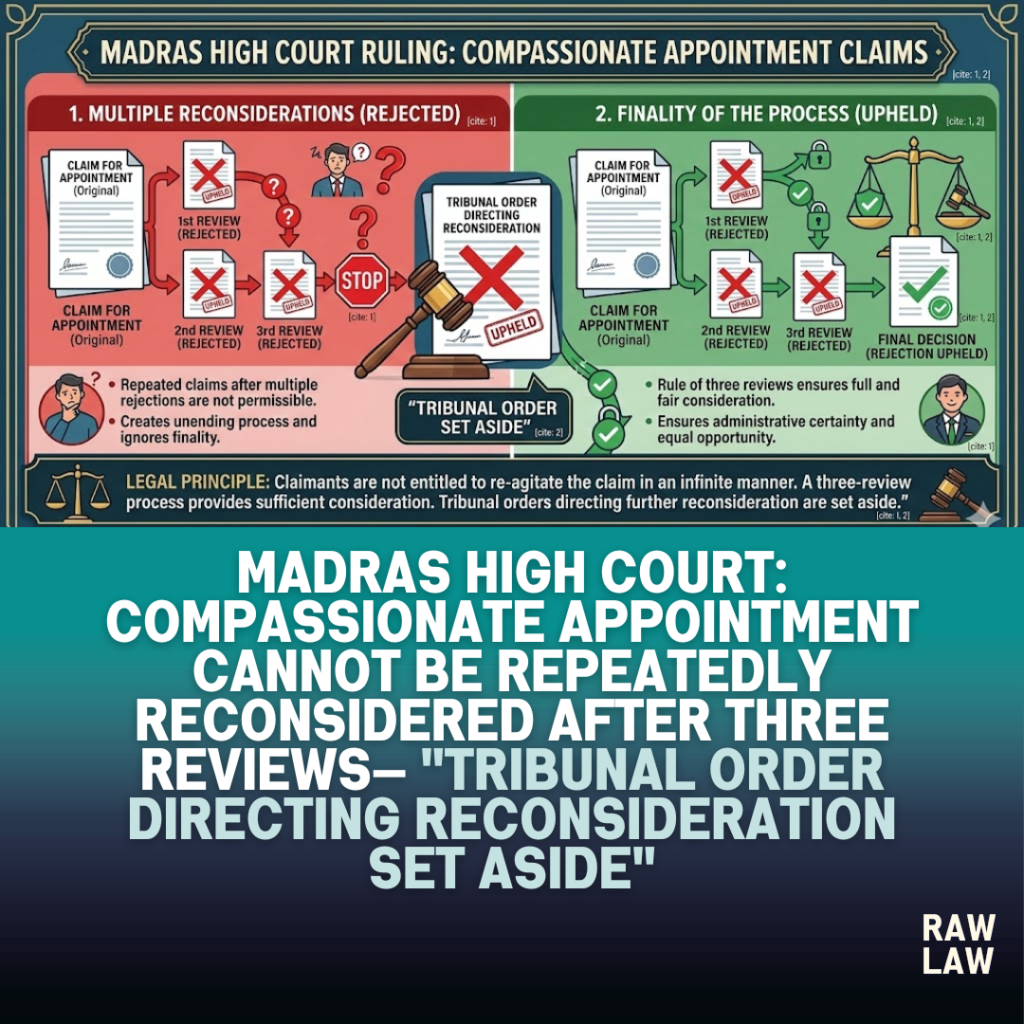
The High Court held that the tribunal had erred in directing reconsideration of a request for compassionate appointment after the claim had already been considered multiple times and rejected by the competent authority.
The Court set aside the tribunal’s order and ruled that the attempt to substitute another family member as the candidate for compassionate appointment was contrary to the governing scheme.
2. Facts
The dispute arose after a postal department employee working as a postman died while in service.
Following his death, his widow applied for compassionate appointment for her elder son under the department’s compassionate appointment scheme.
Under the scheme, candidates are evaluated by the Circle Relaxation Committee based on Relative Merit Points (RMP), and only 5% of vacancies earmarked for direct recruitment can be filled through compassionate appointment.
The application of the elder son was considered by the committee in three different review cycles—2012, 2015, and 2019–2020. In each review, the candidate received an RMP score lower than the minimum score of candidates who were actually selected for compassionate appointment.
Consequently, the claim for compassionate appointment was rejected.
3. Issues
The High Court examined several key legal issues.
First, whether a request for compassionate appointment can be reconsidered indefinitely after repeated rejection by the competent authority.
Second, whether a family member can substitute another candidate after the initial application for compassionate appointment has already been rejected.
Third, whether the tribunal was justified in directing reconsideration of the claim despite the scheme governing compassionate appointments.
4. Petitioner’s arguments
The postal department argued that the compassionate appointment scheme clearly limits the number of times a case may be considered.
According to the department, the claim for compassionate appointment had already been reviewed three times by the Circle Relaxation Committee.
Each time, the candidate’s Relative Merit Points were lower than those of the candidates selected for appointment.
The department further argued that the scheme does not permit substitution of another family member after rejection of the original claim. Therefore, the tribunal erred in directing reconsideration of the claim for compassionate appointment in favour of another son of the deceased employee.
5. Respondent’s arguments
The widow and her son argued that the family had been suffering financial hardship after the death of the employee.
They contended that the earlier application for compassionate appointment had not been properly assessed by the authorities in light of the family’s financial condition.
It was further argued that the elder son was unable to take up employment due to physical challenges, and therefore the request was made to grant compassionate appointment to the younger son.
The respondents maintained that the tribunal had correctly directed the authorities to reconsider the claim in the next meeting of the Circle Relaxation Committee.
6. Analysis of the law
The Court analysed the purpose and structure of compassionate appointment schemes in public employment.
Compassionate appointment is intended to provide immediate relief to families facing financial hardship due to the death of a government employee while in service.
However, such appointments are an exception to the general rule of recruitment through open competition and must therefore strictly comply with the governing scheme.
The Court observed that the scheme restricts compassionate appointments to a limited percentage of available vacancies and requires evaluation based on Relative Merit Points to ensure fairness among applicants.
7. Precedent analysis
The Court referred to its earlier decision in a similar case concerning compassionate appointment claims considered multiple times by the Circle Relaxation Committee.
In that decision, the Court had held that when an application for compassionate appointment has already been considered three times without success, the claim cannot remain pending indefinitely.
The Court emphasised that allowing repeated reconsideration would unfairly block opportunities for other deserving applicants awaiting consideration under the limited quota of compassionate appointments.
8. Court’s reasoning
The High Court observed that the claim of the deceased employee’s family had already been examined in three separate committee meetings.
In each instance, the candidate failed to secure sufficient Relative Merit Points to qualify for appointment.
The Court further noted that the scheme does not permit substitution of another family member after the claim has already been rejected.
Allowing such substitution would effectively circumvent the scheme governing compassionate appointments and create a precedent for indefinite reconsideration of rejected claims.
The Court therefore concluded that the tribunal failed to appreciate the factual and legal framework governing compassionate appointments.
9. Conclusion
The High Court held that the tribunal’s order directing reconsideration of the claim for compassionate appointment was legally unsustainable.
Since the application had already been considered and rejected in three committee reviews, the claim could not be revived by seeking appointment for another family member.
Accordingly, the writ petition was allowed and the order of the tribunal was set aside.
10. Implications
The judgment reinforces the principle that compassionate appointment schemes must be applied strictly within their prescribed framework.
By preventing repeated reconsideration of rejected claims, the ruling ensures fairness among applicants competing for the limited quota of compassionate appointments.
The decision also clarifies that substitution of candidates within a family after rejection of the original claim is not permissible unless expressly allowed by the governing scheme.
This ruling will guide administrative authorities and tribunals when dealing with compassionate appointment disputes involving repeated claims or substitution of candidates.
Case Law References
- Earlier Madras High Court ruling on compassionate appointment reconsideration: The Court held that claims for compassionate appointment cannot be considered indefinitely when the applicant fails to secure sufficient merit points after multiple reviews.
FAQs
1. How many times can a compassionate appointment request be considered?
In many government schemes, the request is reviewed only a limited number of times—often up to three reviews by the competent committee. After that, the claim generally cannot be reconsidered.
2. Can a different family member be substituted after rejection of compassionate appointment?
No. Unless the scheme expressly permits substitution, replacing the original applicant with another family member after rejection is not allowed.
3. Why do courts strictly regulate compassionate appointment claims?
Compassionate appointments are exceptions to normal recruitment rules and are limited to a small percentage of vacancies. Therefore, courts ensure that such schemes are applied strictly and fairly.