


1. Court’s decision
A Division Bench of the Madras High Court dismissed multiple writ petitions filed by the Government of Puducherry and the Directorate of Health and Family Welfare challenging orders of the Central Administrative Tribunal granting relief to several contractual medical officers.
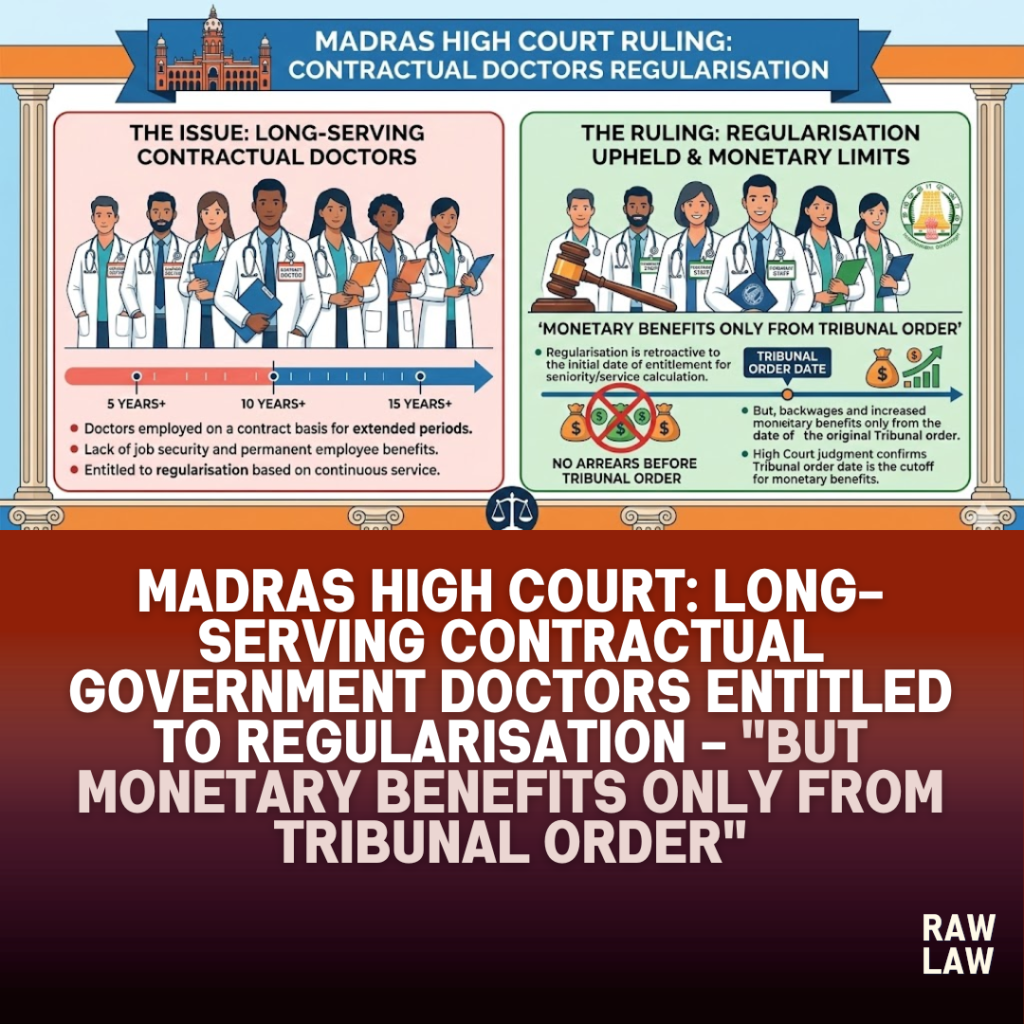
The Court upheld the tribunal’s direction granting regularisation to the doctors who had served continuously on contract for long periods. However, it modified the relief relating to monetary benefits, clarifying that while the doctors would receive notional regularisation from the initial date of appointment, they would be entitled to actual financial benefits only from the date of the tribunal’s order.
2. Facts
The dispute arose from the engagement of several doctors as General Duty Medical Officers in the Puducherry health services. These doctors had initially been appointed on a contractual basis through walk-in interviews for short periods of 120 days.
Their appointments were extended repeatedly to address temporary vacancies arising due to resignation, desertion, or absence of regular doctors. According to the government, these contractual engagements were purely temporary stop-gap arrangements until regular recruitment could be completed through the Union Public Service Commission.
The contractual doctors later participated in the recruitment process conducted by the UPSC but were unsuccessful in securing regular appointment. Following this, they approached the Central Administrative Tribunal seeking regularisation of their services from the date of their initial contractual appointment.
3. Issues
The High Court considered whether contractual doctors who had been engaged repeatedly for long periods were entitled to regularisation of their services.
Another issue was whether the Central Administrative Tribunal had correctly relied upon previous Supreme Court judgments dealing with similar claims of contractual employees seeking regularisation.
The Court also examined whether regularisation could be granted when the initial appointments were not made strictly in accordance with recruitment rules governing the post.
4. Petitioner’s arguments
The government argued that the appointments of the doctors were purely contractual and were made only as a temporary measure to address short-term vacancies. According to the government, such appointments did not follow the statutory recruitment rules framed under Article 309 of the Constitution.
It was further submitted that regularisation of these contractual employees would effectively permit a backdoor entry into public service, bypassing the competitive recruitment process conducted by the UPSC.
The government also argued that the tribunal had wrongly relied upon a Supreme Court judgment granting relief to certain similarly placed doctors. According to the petitioners, the Supreme Court had specifically stated that the relief granted in that case was based on peculiar facts and should not be treated as a precedent.
5. Respondent’s arguments
The contractual doctors contended that they were fully qualified for the posts and had been selected through a process involving notification and interviews. Their names had also been sponsored through the employment exchange.
They argued that they had been continuously engaged by the government for several years performing the same duties as regular medical officers. According to them, this prolonged engagement created a legitimate expectation that their services would eventually be regularised.
The respondents further argued that other similarly placed doctors had received relief from the Supreme Court in earlier litigation. They therefore claimed that denying them similar treatment would amount to discrimination.
6. Analysis of the law
The High Court examined the legal principles governing regularisation of contractual employees in government service. Courts have consistently held that appointments made outside the recruitment rules cannot ordinarily be regularised because doing so would undermine the constitutional requirement of equal opportunity in public employment.
However, courts have also recognised that exceptional circumstances may arise when employees have served continuously for long periods under the government and removal of such employees would result in hardship and administrative disruption.
In such cases, courts sometimes grant limited relief by recognising the service rendered and granting notional benefits without awarding full financial arrears.
7. Precedent analysis
The Court examined earlier decisions of the Supreme Court relating to contractual medical officers and other government employees. In one case, the Supreme Court granted relief to doctors who had served for long periods on contractual appointments, noting the hardship faced by them.
However, the Supreme Court had also clarified that the relief granted in that case was based on its specific facts and should not be treated as a binding precedent.
The High Court also referred to a later Supreme Court judgment which recognised that employees who had been continuously engaged by the government for more than a decade may be entitled to certain protections in service.
8. Court’s reasoning
The High Court observed that the doctors had been continuously engaged by the government for extended periods and had been performing essential medical duties. The Court therefore considered it appropriate to grant them the benefit of regularisation in line with the broader principles recognised in earlier judgments.
However, the Court also balanced this relief against the need to protect the integrity of the recruitment process. To achieve this balance, the Court clarified that the doctors would receive only notional regularisation from their initial date of appointment.
The Court further held that they would not be entitled to arrears of salary or other financial benefits for the earlier period. Instead, actual monetary benefits would become payable only from the date of the tribunal’s order.
9. Conclusion
The High Court dismissed the writ petitions filed by the government and upheld the tribunal’s direction granting regularisation to the contractual doctors.
However, the Court modified the relief relating to financial benefits, holding that the doctors would receive notional regularisation from their initial appointment date but would receive monetary benefits only from the date of the tribunal’s order.
10. Implications
The judgment highlights the judiciary’s effort to balance two competing principles in public employment law: the need to uphold recruitment rules and the need to protect employees who have served the government for extended periods.
By granting notional regularisation without arrears, the Court recognised the service rendered by the doctors while avoiding the financial burden that full retrospective regularisation might impose on the government.
The ruling may influence similar disputes involving contractual government employees who have served for long periods but whose initial appointments were not made through the regular recruitment process.
Case Law References
- Kailash Ben T. Solangi Case (Supreme Court)
The Supreme Court granted relief to contractual medical officers who had served for long periods, recognising the hardship faced by them but clarifying that the decision was based on the peculiar facts of that case. - Bhola Nath v. State of Jharkhand (Supreme Court)
The Court recognised that employees continuously engaged for extended periods by the government may deserve protection in service and may be entitled to regularisation in appropriate circumstances.
FAQs
1. Can contractual government doctors be regularised in service?
Courts may grant regularisation in exceptional cases where doctors have served continuously for long periods and removal would cause hardship, but such regularisation is often limited to notional benefits.
2. What is notional regularisation in service law?
Notional regularisation means that an employee’s service is recognised from an earlier date for seniority or pension purposes, but they do not receive salary arrears for that earlier period.
3. Does failure in a regular recruitment process prevent regularisation?
While failure in recruitment is a factor, courts may still grant limited relief if the employee has served the government continuously for many years and exceptional circumstances exist.