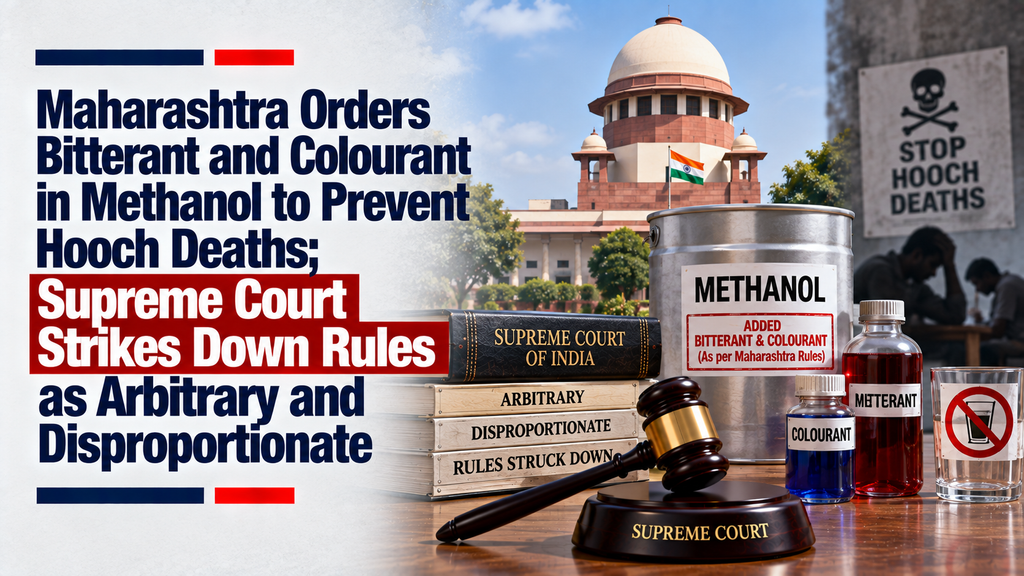
Maharashtra Orders Bitterant and Colourant in Methanol to Prevent Hooch Deaths; Supreme Court Strikes Down Rules as Arbitrary and Disproportionate

Methanol Rules Meant to Prevent Hooch Deaths Cripple Legitimate Industries Without Stopping Illegal Diversion; Supreme Court Strikes Them Down
Facts
The Supreme Court considered challenges to Rules 18A and 18B of the Maharashtra Poisons Rules, 1972, introduced through a State notification dated 21 January 2011.
The rules were introduced against the backdrop of a devastating 1991 hooch tragedy at Chhaya Bar in Andheri, Mumbai, where around 250 persons consumed spurious liquor without knowing that it contained methanol, resulting in approximately 93 deaths. A committee headed by P.R. Parthasarthy was subsequently constituted to examine the causes and recommend preventive measures.
The 2011 amendment imposed two significant restrictions.
Rule 18A(1) required a methanol seller to ascertain the purchaser’s intended use by verifying a Form A licence.
Rule 18A(2) prohibited sale of methanol to non-drug manufacturers unless every 100 litres was mixed with one gram of methylene carmine as colourant and four grams of denatonium saccharide as bitterant.
Rule 18B provided for confiscation of methanol found in possession without a valid Form A licence.
Industrial users challenged these restrictions, arguing that adding colourant and bitterant contaminated methanol and made it unsuitable for manufacturing downstream products.
Issues
The principal question before the Supreme Court was:
Whether Rules 18A and 18B of the Maharashtra Poisons Rules were arbitrary, disproportionate and unreasonable, thereby violating Articles 14 and 19(1)(g) of the Constitution.
The Court had to balance two competing considerations:
- the State’s legitimate obligation to prevent deaths caused by methanol-laced spurious liquor; and
- the fundamental right of legitimate industries to carry on trade and business without disproportionate restrictions.
Petitioners’ Arguments
The petitioners argued that methanol is an essential raw material for products including formaldehyde, paraformaldehyde, disinfectants, paints, resins and decorative laminates.
Adding mandatory bitterant and colourant would alter the raw material and consequently affect the quality, acceptability and commercial viability of finished industrial products.
They contended that the restrictions were disproportionate and arbitrary and therefore violated Articles 14 and 19(1)(g).
They also pointed out that methanol was already subject to several regulatory safeguards governing storage and transportation.
Another significant objection concerned the licensing structure. Form A did not specify the ultimate use of methanol, making the requirement that a seller ascertain the purchaser’s intended use merely by examining Form A inherently problematic.
The petitioners further alleged that the prescribed colourant contained carcinogenic material.
Respondent-State’s Arguments
Maharashtra defended the rules as necessary public-health measures.
The State argued that methanol can be indistinguishably mixed with liquor and cause fatal consequences. Adding colourant would permit visual identification, while adding bitterant would make accidental or intentional consumption more difficult.
It argued that the State was merely regulating sale, not prohibiting the manufacture or import of methanol.
According to Maharashtra, safeguards applicable during transportation did not adequately prevent subsequent diversion, illegal resale or use in illicit liquor.
The State therefore maintained that the restrictions had a direct nexus with preventing misuse and protecting human life.
Analysis of the Law
Subordinate Legislation Can Be Tested for Arbitrariness
The Supreme Court reiterated that subordinate legislation can be challenged where it:
- lacks legislative competence;
- violates fundamental or constitutional rights;
- exceeds the parent statute;
- conflicts with another statutory provision;
- involves bad faith;
- is manifestly arbitrary or unreasonable; or
- exceeds the limits of the enabling legislation.
The Court emphasised that a legitimate governmental objective is not enough. The means adopted must have a reasonable and proximate nexus with the objective and must be proportionate to the burden imposed on constitutional rights.
Rule 18A(1): Licensing Restriction Was Disproportionate
The Court identified a fundamental anomaly.
A Form A licence was essentially granted to persons selling or possessing poison for sale. Yet Rule 18A(1) required an industrial purchaser of methanol to possess the same Form A licence.
A downstream manufacturer purchasing methanol merely as a raw material would ordinarily not possess such a licence.
The rule therefore placed sellers and industrial consumers on the same footing and effectively rendered the separate Form B permit mechanism nugatory.
The Supreme Court held that Rule 18A(1) failed the test of reasonableness on two counts.
First, it was broader than necessary to achieve the State’s objective.
Second, it imposed the burden upon legitimate industrial users while leaving significant sources of illegal diversion untouched.
The Court identified less restrictive alternatives, including stricter licensing conditions, cancellation or debarment of violators, mandatory return of unused methanol and stronger stock reconciliation mechanisms.
Accordingly, Rule 18A(1) failed to constitute a reasonable restriction under Article 19(6) and violated Article 19(1)(g).
Rule 18A(2): Colouring and Bittering Methanol Did Not Solve the Real Problem
This was the central part of the judgment.
The Court examined the Parthasarthy Committee report and found that hooch tragedies had multiple causes, including:
- diversion through illegal and unlicensed channels;
- methanol being cheaper than ethyl alcohol;
- corruption in law-enforcement agencies;
- confusion between methyl and ethyl alcohol; and
- pilferage.
The mandatory colourant-and-bitterant requirement regulated lawful sale, whereas much of the illicit activity occurred outside the lawful regulatory chain altogether.
The Court found that the rule did not adequately address the very channels through which methanol was being diverted.
Severe Impact on Legitimate Industries
The affidavits of industrial users showed concrete downstream consequences.
For example, Balaji Formalin Pvt. Ltd. stated that its final product, paraformaldehyde, is manufactured as white crystals and that adding colourant to methanol would affect its acceptability. It also pointed out that BARC required ultra-pure formaldehyde.
Other manufacturers stated that the additives could damage catalysts, contaminate finished products and render chemicals unacceptable to pharmaceutical, paint, dye and research industries. The judgment records these industry-specific consequences in its table on pages 20–21.
The Court observed that the rule essentially achieved identification at the cost of marketability and additional financial burden on legitimate industry.
It memorably described the measure as akin to:
“rearranging the deck chairs on the Titanic”
because it addressed a surface-level aspect without tackling the underlying problems of diversion and pilferage.
Colour and Taste Could Still Be Masked
The Court further noted that the State had not established that adding colourant and bitterant would make methanol incapable of being used for spurious liquor.
The additives could potentially be masked through colouring and flavouring agents.
Thus, even complete compliance by lawful industry could not necessarily prevent the illicit misuse that the rules were designed to address.
The Court concluded that the rule imposed a continuous burden on legitimate industries while failing to establish a reasonable and proximate nexus with prevention of illicit methanol consumption.
Manifest Arbitrariness Under Article 14
The Supreme Court acknowledged that Maharashtra’s objective was unquestionably legitimate and arose from a serious public-health concern.
However, good intention alone could not save an irrational measure.
The Court held that the impugned rules lacked rational nexus with the object sought to be achieved and were manifestly arbitrary, violating Article 14.
Rule 18B: Confiscation Also Found Unworkable
Rule 18B provided for confiscation whenever methanol was possessed without a Form A licence.
The Court found this problematic because a person could lawfully possess methanol through a Form B permit.
Insisting on Form A in every case therefore rendered the Form B permit redundant and made the regulatory scheme internally inconsistent.
Proportionality Test
The Supreme Court applied the proportionality framework referred to in K.S. Puttaswamy v. Union of India.
It accepted that preventing deaths caused by methanol-adulterated liquor is unquestionably a legitimate aim.
However, the restrictions failed the remaining proportionality analysis.
The Court found that:
- the licensing and confiscation mechanism was not suitably connected with preventing methanol adulteration;
- Maharashtra had not shown that equally effective but less restrictive alternatives were unavailable; and
- the continuing burden imposed on industries was substantial while the expected benefit was only a possibility.
Consequently, the rules failed the proportionality test and violated the Article 19(1)(g) rights of non-drug manufacturers.
Precedent Analysis
The Court relied upon State of Tamil Nadu v. P. Krishnamoorthy, Mahalakshmi Sugar Mills Co. Ltd. v. Union of India and Vasu Dev Singh v. Union of India for the grounds on which subordinate legislation can be judicially reviewed.
Mohd. Faruk v. State of Madhya Pradesh was relied upon for the principle that a restriction upon a fundamental freedom must be necessary and that the intended objective should not reasonably be achievable through a less drastic restriction.
The Court applied the proportionality analysis identified in K.S. Puttaswamy v. Union of India by examining legitimate aim, suitability, necessity and balancing.
Court’s Reasoning
The Court was careful to distinguish between the need to regulate methanol and the constitutionality of the particular method Maharashtra chose.
It did not hold that methanol should remain unregulated. On the contrary, it expressly acknowledged that methanol is hazardous and toxic and that its sale and possession can legitimately be regulated.
What failed constitutional scrutiny was the specific regulatory mechanism.
The rules:
- interfered with legitimate industrial use;
- distorted the existing Form A/Form B licensing framework;
- imposed substantial and continuing burdens on industry;
- focused on lawful sales rather than illegal diversion and pilferage;
- did not establish that bitterant and colourant would actually prevent methanol from being used in spurious liquor; and
- ignored less restrictive regulatory alternatives.
The Supreme Court therefore concluded that the restrictions were disproportionate, manifestly arbitrary and constitutionally invalid.
Suggestions to Prevent Hooch Tragedies
Significantly, the Supreme Court did not stop at striking down the rules.
It suggested a broader regulatory approach for consideration by all States and Union Territories, including stricter border monitoring, coordination between Police, Excise, Transport and Industries Departments, periodic review of methanol licences, mandatory reconciliation of consumption and closing stock, return of excess methanol, suspension/debarment of violators, dedicated tankers, tamper-evident seals, better emergency medical preparedness, de-addiction centres and public-awareness programmes.
Conclusion
The Supreme Court held that the impugned Maharashtra methanol rules violated Articles 14 and 19(1)(g) of the Constitution.
The writ petitions were accordingly allowed, and the connected civil appeal was disposed of in those terms.
The Registry was also directed to forward the judgment to all High Courts and the Chief Secretaries of all States.
Case Details
Case: M/s Balaji Formalin Pvt. Ltd. & Anr. v. Union of India & Anr. with connected matters
Court: Supreme Court of India
Citation: 2026 INSC 1009
Case No.: Writ Petition (Civil) No. 893 of 2019 with connected matters
Bench: Justice J.B. Pardiwala and Justice K. Vinod Chandran
Date: 18 September 2026
Result: Petitions allowed; Rules 18A and 18B held violative of Articles 14 and 19(1)(g); connected civil appeal disposed of.