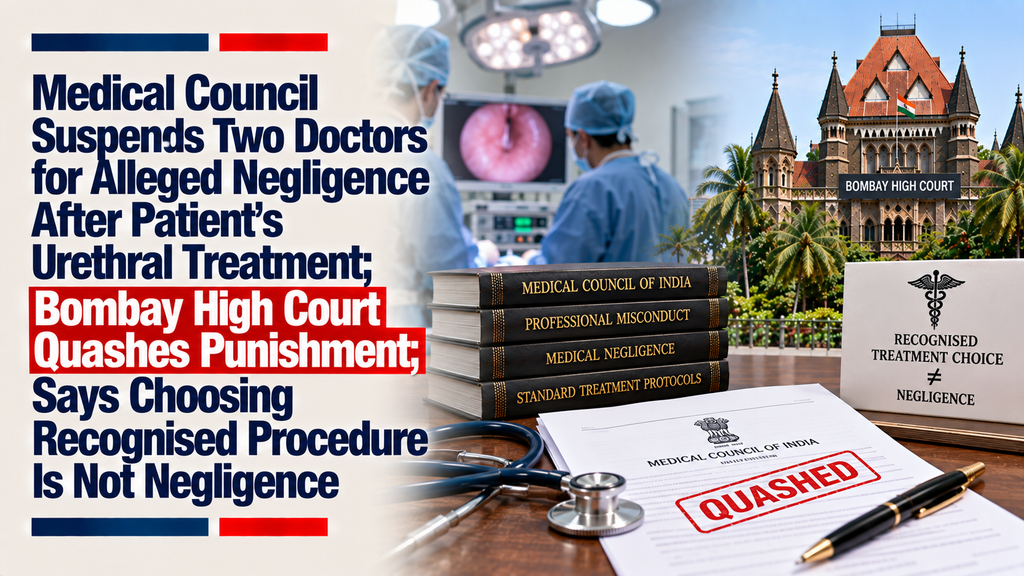
Medical Council Suspends Two Doctors for Alleged Negligence After Patient’s Urethral Treatment; Bombay High Court Quashes Punishment, Says Choosing Recognised Procedure Is Not Negligence

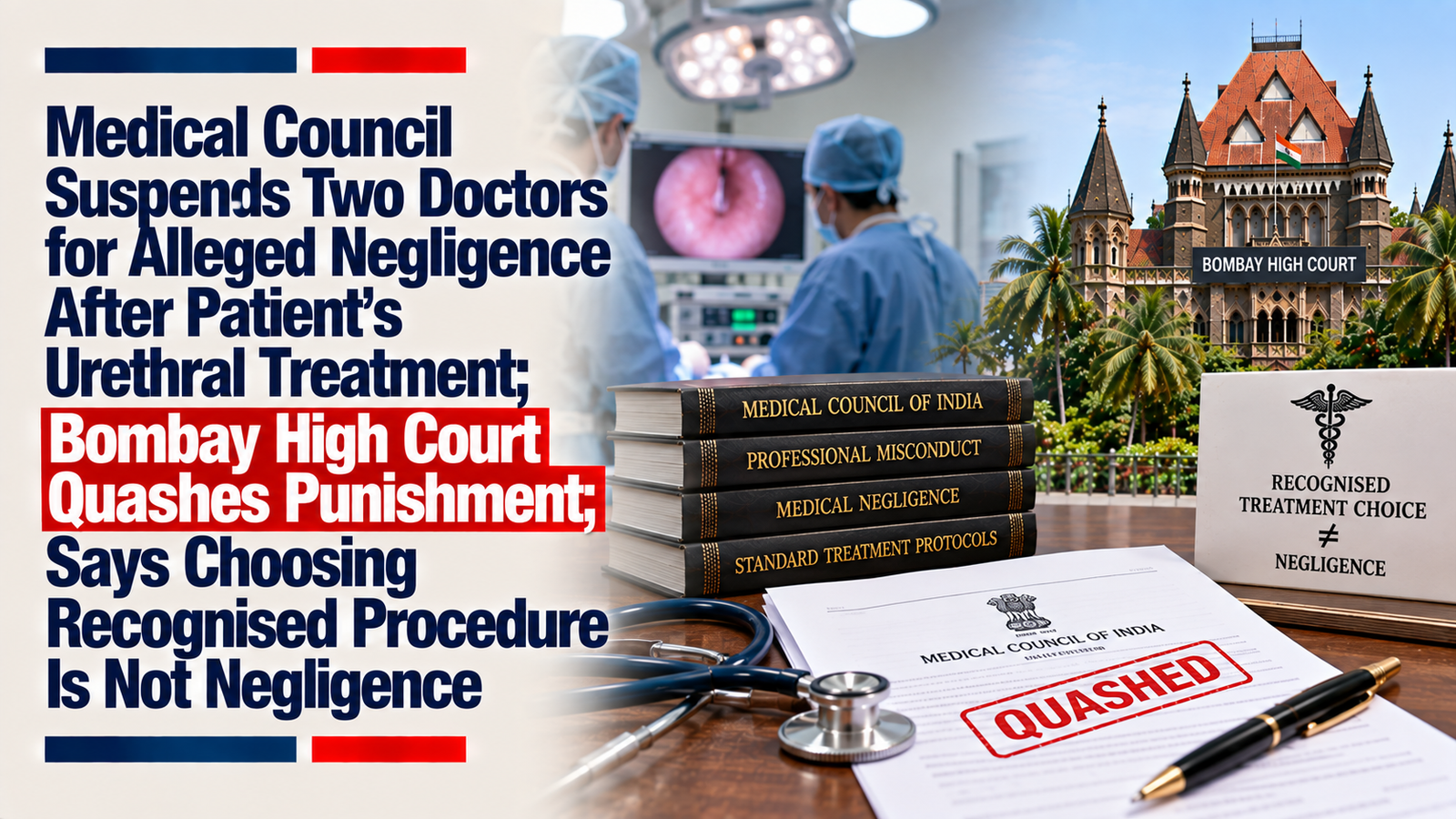
Doctor Uses Recognised Surgical Procedure as First Choice Instead of Preferred Alternative; Bombay High Court Says Choice of Treatment Is Not Medical Negligence
Facts
The petitions were filed by Dr. Jaydeep Arun Date and Dr. Munir Sufi Mhaskar, challenging a Medical Council of India (“MCI”) order dated 24 August 2013. The MCI had directed removal of Dr. Date’s name from the medical register for six months and Dr. Mhaskar’s name for three years on allegations of medical negligence.
The complainant, Murad Hasan Mulla, had suffered persistent urinary problems and narrowing of the urinary tract and had consulted several doctors. He alleged negligence in the treatment provided by the two petitioners.
Dr. Mhaskar treated the complainant in 2005 for a ureteric stone and subsequently detected bladder-neck obstruction and urethral stricture. He performed procedures including cystoscopy, dilatation and bladder-neck incision. He maintained that these procedures were within his qualification and training as an MS General Surgery doctor.
Dr. Date subsequently treated the complainant for a high bulbomembranous stricture. In 2006, he used a midline scrotal skin flap to enlarge the blocked urinary passage. After recurrence, he performed Buccal Mucosa dorsal onlay urethroplasty in October 2007 and later referred the complainant to a specialist.
The Maharashtra Medical Council (“MMC”) initially exonerated both doctors, finding that the complainant’s urethral narrowing was chronic, appropriate treatment had been given and no 100% success had been promised.
On the complainant’s appeal, however, the MCI reversed that decision and imposed the respective six-month and three-year removals from the medical register.
Issues
The Court considered two principal questions:
First, whether the MCI disciplinary proceedings violated principles of natural justice, particularly because the doctors were not supplied the appeal papers, subsequent Ethics Committee meetings occurred without them, and the Committee had no urologist.
Second, whether the MCI’s findings of medical negligence could survive the settled Supreme Court principles governing professional negligence where a doctor chooses one recognised course of treatment over another.
Petitioners’ Arguments
The doctors argued that they received notice of the hearing but were not supplied copies of the complainant’s appeal or supporting documents.
They were heard on 23 March 2013, but the Ethics Committee subsequently met on 24 and 25 May 2013 without giving them notice. The recommendations emerging from those proceedings ultimately formed the basis of the punishment.
Another significant objection was that not a single member of the Ethics Committee was a urologist, despite the dispute turning upon specialised urological procedures.
On merits, Dr. Date relied upon Jacob Mathew v. State of Punjab, arguing that a doctor cannot be declared negligent merely because he selects one recognised method of treatment in preference to another.
Dr. Mhaskar maintained that cystoscopy, urethral dilatation and related procedures formed part of his training as an MS General Surgeon and that he had sufficient practical experience to undertake them.
Respondent’s Arguments
The complainant argued that Dr. Mhaskar performed a bladder-neck incision without obtaining specific written informed consent and that the procedure was not an emergency. Reliance was placed on Samira Kohli v. Dr. Prabha Manchanda on informed consent.
Regarding Dr. Date, it was argued that he wrongly chose the scrotal-skin procedure first and resorted to the mucosal graft only after complications arose, although the latter allegedly ought to have been the first choice.
The complainant also contended that the doctors had been given adequate opportunity to present their defence and had failed to establish actual prejudice from non-supply of the appeal memorandum.
Analysis of the Law
The High Court relied extensively on the Supreme Court’s jurisprudence beginning with Jacob Mathew v. State of Punjab.
The governing test is not whether another doctor might have adopted a better or different course of treatment. A medical professional may be found negligent where:
- the doctor did not possess the requisite skill professed to be possessed; or
- despite possessing that skill, the doctor failed to exercise it with reasonable competence.
The relevant standard is that of an ordinary competent professional exercising ordinary skill, not the highest possible degree of medical expertise.
The Court also applied Kusum Sharma v. Batra Hospital, Martin F. D’Souza v. Mohd. Ishfaq, Vinod Jain v. Santokba Durlabhji Memorial Hospital, and other Supreme Court authorities.
The principle emerging from these decisions was that a doctor does not become negligent merely because another professional would have chosen a different recognised treatment or because the treatment ultimately did not achieve the desired result.
Precedent Analysis
The Court particularly relied upon Jacob Mathew, which protects bona fide professional judgment where the doctor possesses and reasonably exercises the requisite skill.
In Martin F. D’Souza, the Supreme Court recognised that a doctor is not necessarily negligent merely because something goes wrong through mischance, misadventure, error of judgment or because one reasonable treatment is preferred over another.
Kusum Sharma reinforced that a medical professional is not negligent merely because his conclusion differs from that of another professional, provided the chosen course is recognised and undertaken with reasonable competence.
These principles became particularly important in Dr. Date’s case because the dispute was essentially over which recognised surgical procedure should have been selected first, rather than whether the procedure adopted was medically unknown or inherently impermissible.
Court’s Reasoning
1. Doctors Were Not Given the Appeal Papers
The Court found that the doctors’ assertion that they had never received copies of the complainant’s appeal and supporting documents was not denied.
MCI also produced no material showing that those papers had actually been served.
The Court held that this necessarily handicapped the doctors in effectively defending themselves.
2. No Urologist Was on the Ethics Committee
The Court treated this as a significant defect.
It was undisputed that not a single doctor on the Ethics Committee was a urologist, even though the complaint involved specialised urological procedures.
The Court observed that at least one member ought to have possessed specialist knowledge in urology for meaningful consideration of the rival medical positions. It found this circumstance also indicative of violation of natural justice.
3. Later Meetings Were Held Behind the Doctors’ Back
The doctors were notified about the hearing on 23 March 2013.
However, the Ethics Committee subsequently held meetings on 24 and 25 May 2013, without notice to them, and those proceedings contributed to the recommendations ultimately approved by MCI’s Board of Governors.
The High Court rejected the explanation offered for this procedure and held that the later meetings were conducted behind the doctors’ back, further violating natural justice.
4. Dr. Mhaskar Was Qualified for the Procedures
The material before the Court showed that urology formed part of the MS General Surgery curriculum during Dr. Mhaskar’s training and included training in diagnostic cystoscopy and urethral dilatation.
The Court also found evidence that MS General Surgeons treated urinary stones, bladder-neck obstruction and urethral strictures.
It therefore concluded that Dr. Mhaskar had sufficient qualification, training and experience for the procedure undertaken.
The fact that the patient’s urethral stricture subsequently recurred could not itself establish negligence, particularly when recurrence was a recognised feature of the condition.
5. Dr. Date Chose a Recognised Treatment
The central allegation against Dr. Date was essentially that he chose a scrotal skin procedure first and mucosal graft subsequently, whereas the complainant argued that the sequence should have been reversed.
But the Court found that the procedure selected by Dr. Date was itself a well-recognised surgical procedure for urethral strictures.
Accordingly, choosing that recognised procedure in preference to another could not, without more, establish medical negligence.
6. MCI’s Findings Were Cryptic
The Court found that the MCI had reversed the State Medical Council’s findings without adequately analysing the doctors’ qualifications, treatment decisions and supporting medical material.
Although the High Court acknowledged that a writ court ordinarily does not reassess the merits of findings of specialised medical bodies, interference was justified because there was both procedural irregularity and cryptic reasoning contrary to settled Supreme Court law.
Conclusion
The Bombay High Court allowed both writ petitions and quashed the MCI order dated 24 August 2013.
Thus, the six-month removal imposed upon Dr. Jaydeep Date and the three-year removal imposed upon Dr. Munir Sufi Mhaskar were set aside.
The judgment reinforces that an adverse result, recurrence of an ailment, or a doctor’s choice of one recognised treatment over another does not by itself establish medical negligence. The disciplinary process must also satisfy natural justice, particularly where specialised medical questions are involved.
Case Details
Case: Dr. Jaydeep Arun Date v. Medical Council of India & Ors., with Dr. Munir Sufi Mhaskar v. Medical Council of India & Ors.
Court: Bombay High Court
Case Nos.: Writ Petition No. 8830 of 2013 & Writ Petition No. 87 of 2014
Citation: 2026:BHC-AS:38678
Coram: Justice Manish Pitale & Justice Shreeram V. Shirsat
Reserved: 29 July 2026
Pronounced: 22 September 2026
Result: Both writ petitions allowed; MCI disciplinary order quashed and set aside.