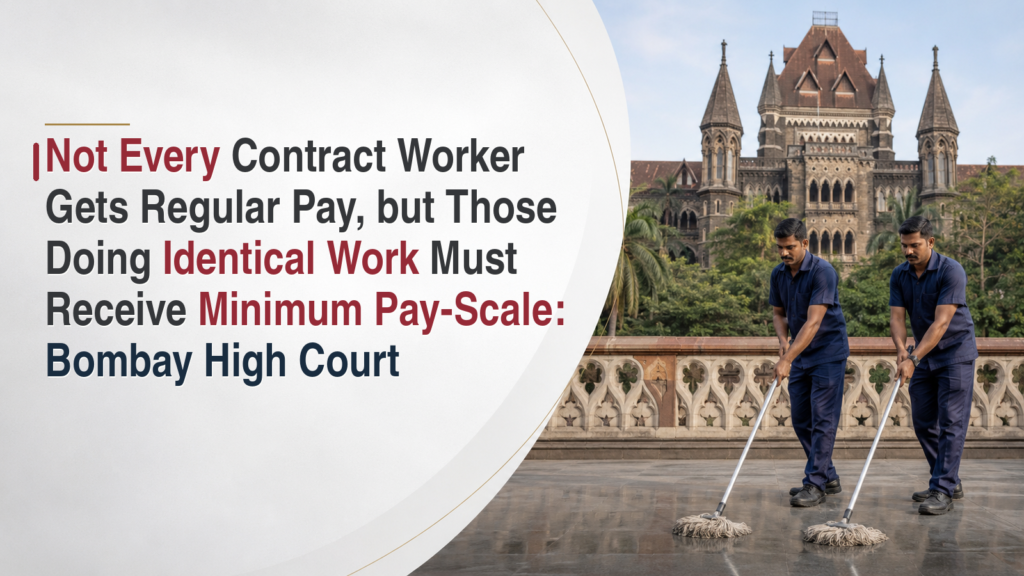
Not Every Contract Worker Gets Regular Pay, but Those Doing Identical Work Must Receive Minimum Pay-Scale: Bombay High Court

Contract Workers Performed Same Duties as Permanent Electricity Employees; Bombay High Court Grants Minimum Pay-Scale Parity
Facts
The Maharashtra State Electricity Distribution Company Limited had taken over the electricity-distribution undertaking of the erstwhile Maharashtra State Electricity Board.
The company was registered under the Contract Labour (Regulation and Abolition) Act, 1970.
The Government of Maharashtra had imposed a ban on fresh recruitment. Vacancies also arose due to retirement, promotion, restructuring and an increase in the number of electricity consumers.
To meet its manpower requirements, the company awarded contracts to different agencies for supplying skilled, semi-skilled and unskilled workers.
These contract workers assisted regular employees in technical and non-technical positions, including:
- Linemen;
- Meter readers;
- Drivers;
- Up-Kendra Sahayyaks;
- Vidyut Sahayyaks;
- Office assistants; and
- Peons.
The Bhartiya Kamgar Karmachari Mahasangh represented two groups comprising 40 and 49 contract workers.
On 5 April 2017, the Union demanded that the contract workers receive wages equal to those paid to permanent employees performing the same work.
After conciliation proceedings failed, the Additional Commissioner of Labour referred the disputes to the Industrial Tribunal, Thane:
- Industrial Tribunal Reference Number 12 of 2018 concerned 49 workers.
- Industrial Tribunal Reference Number 16 of 2020 concerned 40 workers.
By separate awards dated 24 April 2024, the Industrial Tribunal held that the workers were entitled to wages at the minimum of the regular pay scale applicable to permanent employees performing similar work.
The Tribunal directed payment of wage differences:
- From December 2016 in Reference Number 12 of 2018; and
- From May 2016 in Reference Number 16 of 2020.
The Maharashtra State Electricity Distribution Company Limited challenged both awards before the Bombay High Court.
Issues
- Whether workers supplied through contractors were entitled to the principle of “equal pay for equal work.”
- Whether the contract workers performed the same kind of work as the company’s permanent employees.
- Whether Rule 25(2)(iv)(b) of the Maharashtra Contract Labour (Regulation and Abolition) Rules, 1971, created a statutory right to equal wages.
- Whether the absence of a direct employer-employee relationship defeated the workers’ claim.
- Whether the Supreme Court’s decision in Municipal Council, Nandyal Municipality v. K. Jayaram barred wage parity for workers supplied through contractors.
- Whether the Industrial Tribunal was justified in granting arrears from May and December 2016.
Petitioner’s Arguments
The Maharashtra State Electricity Distribution Company Limited argued that:
- The workers were employed by independent contractors and not directly by the company.
- There was no employer-employee relationship between the company and the contract workers.
- The company merely paid the contract amount determined through a competitive tender process.
- The contractors were responsible for deciding and paying the workers’ wages.
- Contract workers could not be compared with permanent employees recruited through a prescribed and transparent selection process.
- The principle laid down in State of Punjab v. Jagjit Singh applied to temporary workers directly engaged by an employer, not workers supplied by third-party contractors.
- The Union failed to produce sufficient documentary evidence proving that contract workers performed duties identical to those of permanent employees.
- The Industrial Tribunal incorrectly applied Rule 25 of the Maharashtra Contract Labour Rules.
- The Supreme Court’s later decision in Municipal Council, Nandyal Municipality v. K. Jayaram recognised the distinction between direct contractual employees and workers supplied through contractors.
- The Industrial Tribunal’s awards should therefore be set aside.
Respondent’s Arguments
The Union argued that:
- The contract workers were engaged because the company could not recruit permanent employees due to the government-imposed recruitment ban.
- They were effectively filling vacancies caused by retirement, promotion and shortage of permanent manpower.
- They performed the same duties and carried the same responsibilities as permanent employees.
- Evidence establishing the similarity of work was produced before the Industrial Tribunal.
- The company was registered under the Contract Labour (Regulation and Abolition) Act, 1970, and was therefore bound by the Maharashtra Rules.
- Rule 25(2)(iv)(b) expressly required contract workers performing the same work as permanent employees to receive the same wage rates.
- The principle of equal pay for equal work recognised in Jagjit Singh supported their statutory entitlement.
- The decision in Municipal Council, Nandyal Municipality arose from different facts involving regularisation and payment of annual increments.
- That decision did not examine the statutory wage protection under Rule 25 applicable in Maharashtra.
Analysis of the Law
Contract Labour (Regulation and Abolition) Act, 1970
Section 21 places the primary responsibility for payment of wages on the contractor.
However, if the contractor fails to pay the wages legally payable to its workers, the principal employer becomes responsible for making the payment.
Rule 25 of the Maharashtra Contract Labour Rules, 1971
Rule 25(2)(iv)(a) provides that wages paid by a contractor cannot be lower than:
- The minimum wages prescribed under law;
- The wages fixed through an agreement, settlement or award; or
- The higher rate where more than one wage standard applies.
Rule 25(2)(iv)(b) specifically provides that where a contract worker performs the same kind of work as a worker directly employed by the principal employer, the contract worker must receive the wage rate payable to the directly employed worker.
The Court held that this provision imposed a statutory duty to pay equal wages where similarity of work was established.
Equal Pay for Equal Work
The principle of equal pay for equal work ordinarily applies where workers perform substantially identical duties and responsibilities.
The Supreme Court has extended this principle to temporary, daily-wage, ad hoc, casual and contractual employees. Such workers are entitled to wages at the minimum of the regular pay scale applicable to permanent employees holding corresponding posts.
However, the Bombay High Court clarified that every worker supplied by a contractor does not automatically become entitled to the regular minimum pay scale.
The worker must establish:
- Similarity in the nature of work;
- Comparable duties and responsibilities; and
- Applicability of the statutory wage-protection provisions.
Precedent Analysis
State of Punjab v. Jagjit Singh, (2017) 1 Supreme Court Cases 148
The Supreme Court held that temporary employees performing the same duties as regular employees were entitled to wages at the minimum of the regular pay scale.
The Bombay High Court observed that Jagjit Singh primarily concerned workers directly engaged by the employer. Nevertheless, its principle supported the workers’ claim as an additional consideration.
The workers’ primary entitlement in the present case arose independently under Rule 25(2)(iv)(b).
Sabha Shanker Dube v. Divisional Forest Officer, (2019) 12 Supreme Court Cases 297
The Supreme Court reaffirmed that temporary workers performing the same work as regular employees were entitled to the minimum of the applicable regular pay scale for as long as they remained in service.
The decision supported the principle that the nature of duties, rather than the label attached to employment, was material.
Municipal Council, Nandyal Municipality v. K. Jayaram and Others, Special Leave Petition (Civil) Number 17711 of 2019, decided on 16 December 2025
The Supreme Court distinguished between:
- Workers directly engaged by the principal employer; and
- Workers supplied through an independent contractor.
It set aside directions granting minimum time-scale pay and annual increments to contractor-supplied workers.
The Bombay High Court distinguished that decision because:
- It arose from a claim for regularisation and annual increments.
- It was decided in peculiar factual circumstances.
- The Supreme Court did not consider a statutory rule requiring equal wages for identical work.
- The Maharashtra State Electricity Distribution Company Limited was expressly governed by Rule 25(2)(iv)(b).
Therefore, the decision did not override the contract workers’ statutory wage entitlement in the present case.
Union of India v. Tarsem Singh, (2008) 8 Supreme Court Cases 648
The Supreme Court held that payment of lower salary may constitute a continuing wrong, but limitation continues to apply to the recovery of arrears.
The Bombay High Court relied upon this principle to restrict the retrospective wage liability.
Court’s Reasoning
The Industrial Tribunal had conducted a factual inquiry and found that the contract workers performed the same work as permanent employees.
The High Court held that such a factual finding could not be disturbed in writ jurisdiction unless it was perverse or unsupported by evidence.
The company’s own pleadings admitted that contract workers were engaged because:
- Fresh recruitment had been prohibited;
- Vacancies had arisen from retirement and promotion;
- Consumer numbers had increased; and
- Additional manpower was necessary for day-to-day work.
These admissions showed that contract workers were engaged to perform work ordinarily assigned to permanent employees.
The work orders also showed that contract workers were deployed as drivers, Vidyut Sahayyaks, office assistants, peons and in other regular operational positions.
Accordingly, Rule 25(2)(iv)(b) applied with full force. The workers were entitled to wages at the minimum of the regular pay scale applicable to permanent employees performing the same work.
The Court clarified that they were not entitled to increments accumulated by permanent employees based on length of service. A permanent employee with several years of service might therefore continue to earn more.
The Court further clarified that its judgment did not establish an absolute rule that every contractor-supplied worker must receive the regular pay scale. The relief was based on:
- Proven similarity of work;
- The recruitment ban;
- Use of contract workers to fill regular operational requirements; and
- The statutory protection under Rule 25.
Modification of Arrears
The demand for equal wages was first raised on 5 April 2017. The Court found no basis for granting arrears from May or December 2016.
It therefore modified the Tribunal’s awards as follows:
- Workers covered by Reference Number 12 of 2018 would receive wage differences from 16 March 2018.
- Workers covered by Reference Number 16 of 2020 would receive wage differences from 18 March 2020.
The wage differences would remain payable only for the period during which the concerned workers remained employed through contractors with the electricity company.
Conclusion
The Bombay High Court upheld the Industrial Tribunal’s declaration that the contract workers were entitled to wages at the minimum of the regular pay scale applicable to permanent employees performing the same work.
However, it modified the retrospective period for payment of arrears:
- In Reference Number 12 of 2018, arrears were restricted to the period beginning 16 March 2018.
- In Reference Number 16 of 2020, arrears were restricted to the period beginning 18 March 2020.
- Payment would continue only until the workers remained or had remained engaged through contractors with the company.
Both writ petitions were partly allowed and disposed of. No order as to costs was passed.
The company’s request for a four-week stay of the judgment was also rejected.
Case Details
Case: Maharashtra State Electricity Distribution Company Limited v. Bhartiya Kamgar Karmachari Mahasangh
Neutral Citation: 2026:BHC-AS:29905
Court: High Court of Judicature at Bombay, Civil Appellate Jurisdiction
Case Numbers: Writ Petition Number 3170 of 2025 with Writ Petition Number 3172 of 2025
Judge: Justice Sandeep V. Marne
Reserved On: 14 July 2026
Pronounced On: 21 July 2026
Result: Petitions partly allowed; minimum regular pay-scale parity upheld, commencement dates for arrears modified, four-week stay refused and no order as to costs.