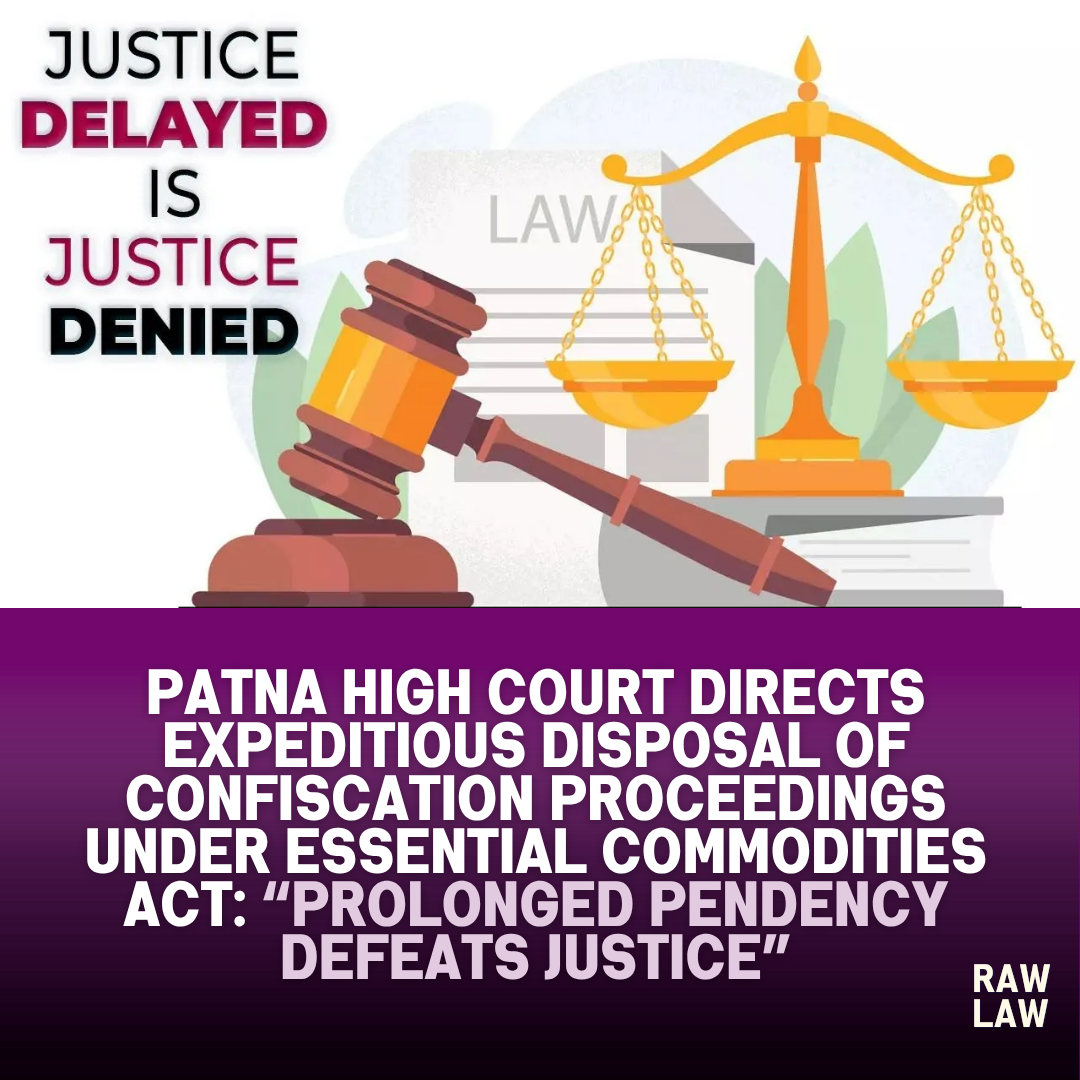
Patna High Court Directs Expeditious Disposal of Confiscation Proceedings Under Essential Commodities Act: “Prolonged Pendency Defeats Justice”

Court’s Decision
The Patna High Court, presided over by Justice G. Anupama Chakravarthy, disposed of a writ petition filed by a tractor owner challenging the confiscation of his vehicle and food grains under the Essential Commodities Act, 1955, holding that continuing confiscation proceedings indefinitely violates principles of fairness and efficiency.
The Court directed the District Magistrate-cum-Collector, Purnea to dispose of the pending confiscation case within four months, observing that the petitioner’s tractor, trailer, and food grains had already been released pursuant to an earlier interim order.
Reiterating the principle that confiscation under the Essential Commodities Act must be exercised cautiously, the Court noted:
“When the seized food grains are not controlled items and the vehicle and commodities have already been released, the authority must conclude the confiscation proceedings expeditiously to prevent injustice.”
Facts
The petitioner, a resident of Purnea district, was the registered owner of a tractor and trailer that were seized along with 23.55 quintals of wheat, 72 quintals of rice, and 8.02 quintals of maize and paddy by the local police in Rauta Police Station Case No. 103 of 2018, registered under Section 420 of the Indian Penal Code and Section 7 of the Essential Commodities Act, 1955.
The seizure was made on suspicion that the food grains were public distribution system (PDS) commodities being black-marketed. The petitioner denied this, claiming the grains were privately procured for personal trade and not part of the subsidized PDS supply chain.
A confiscation proceeding (E.C. Act Case No. 308/2018) was initiated by the District Magistrate-cum-Collector, Purnea. The petitioner then filed a writ petition seeking:
- Quashing of the confiscation notice dated 7 December 2018, on the ground that the seized goods were privately owned; and
- Release of the tractor, trailer, and food grains, contending that the initiation of confiscation without proof of PDS involvement was unlawful.
An interim order dated 20 February 2019 was passed by the High Court directing provisional release of the vehicle and food grains, subject to the petitioner furnishing registration documents and a surety bond equivalent to the assessed value. The District Magistrate complied, releasing the property.
However, the confiscation proceedings remained pending, prompting the petitioner to seek final disposal of the case.
Issues
- Whether the confiscation proceeding initiated under the Essential Commodities Act could be sustained when the seized food grains were privately procured and not part of PDS commodities.
- Whether the prolonged pendency of the confiscation proceeding, despite interim release, violated the petitioner’s rights.
- Whether the Collector was bound to expedite proceedings under judicial supervision.
Petitioner’s Arguments
The petitioner argued that the entire confiscation process was initiated on mere suspicion and that there was no material evidence linking him to any illegal diversion or sale of PDS commodities. He stressed that the food grains were privately procured and thus not covered under the category of “essential commodities” as controlled items.
It was contended that the registration of an FIR under Section 7 of the E.C. Act, by itself, could not give rise to a presumption of guilt, especially when no investigation report established any contravention. The petitioner further pointed out that the investigation in the criminal case was incomplete even months after seizure, rendering the continuation of confiscation proceedings without proof premature and unjustified.
He relied on the Court’s previous orders directing provisional release of goods in similar circumstances, arguing that confiscation cannot be pursued in the absence of a substantiated offence under the Act. The petitioner undertook to fully cooperate with the authorities and requested that the confiscation case be disposed of expeditiously.
Respondent’s Arguments
The State, represented by the learned Standing Counsel, submitted that the confiscation proceedings were validly initiated following a seizure made by competent officers under the Essential Commodities Act. The authorities were within their rights to verify whether the seized grains formed part of the PDS network.
However, the State conceded that the confiscation proceedings had been delayed due to pending investigation in the criminal case, and assured the Court that the matter would be concluded in accordance with law once the investigation was complete.
The State maintained that confiscation and criminal proceedings operate independently, and that the mere release of property pursuant to an interim order did not terminate the confiscation jurisdiction vested in the District Magistrate.
Analysis of the Law
The Court examined the scope of Section 6A of the Essential Commodities Act, 1955, which empowers the Collector to confiscate essential commodities, packages, and conveyances involved in contravention of control orders issued under the Act. However, the Court clarified that such confiscation must be preceded by a finding of contravention, not mere suspicion or unsubstantiated allegations.
It relied on the judicial interpretation in Shambhu Dayal Agarwala v. State of West Bengal (1990) 3 SCC 549, where the Supreme Court held that confiscation proceedings are quasi-judicial in nature and cannot proceed arbitrarily. The authority must first determine whether there has been an actual violation of a control order.
Further, the Court observed that prolonged pendency of confiscation proceedings undermines the rule of law, especially when the property has been released and no final determination has been made. Citing State of Bihar v. Arvind Kumar (2022 SCC OnLine Pat 1763), the Court reiterated that “confiscation proceedings must be completed within a reasonable time to avoid miscarriage of justice.”
Precedent Analysis
- Shambhu Dayal Agarwala v. State of West Bengal (1990) 3 SCC 549 – Established that confiscation is not automatic and requires a clear finding of contravention.
Reference: Relied upon to hold that the mere suspicion of black-marketing does not justify continuation of confiscation proceedings. - State of Bihar v. Arvind Kumar (2022 SCC OnLine Pat 1763) – Held that prolonged pendency of confiscation proceedings amounts to procedural unfairness.
Reference: Applied to emphasize the need for timely conclusion of the petitioner’s case. - Krishna Traders v. State of Bihar (2016 SCC OnLine Pat 5855) – Clarified that privately procured commodities are not subject to confiscation unless they form part of the controlled supply chain.
Reference: Reinforced the petitioner’s argument that non-PDS food grains cannot attract Section 6A proceedings.
Court’s Reasoning
The Court observed that the interim order of 20 February 2019 had already facilitated the release of the petitioner’s tractor, trailer, and food grains, acknowledging that the commodities were not controlled items. Since more than six months had elapsed after seizure without conclusion of inquiry, the Court found no justification for keeping the confiscation proceedings pending.
Justice Chakravarthy held that the confiscation authority must act reasonably and within a defined time frame, particularly when the seizure was based on unverified suspicion and the property had been released. The Court underscored that the essence of procedural fairness lies in timely adjudication:
“When confiscation proceedings remain pending for years without conclusion, they lose their very purpose and become an instrument of harassment rather than regulation.”
Accordingly, the Court directed the District Magistrate-cum-Collector, Purnea, to conclude E.C. Act Case No. 308/2018 within four months from receipt of the order and pass a reasoned decision based on evidence.
Conclusion
The Patna High Court disposed of the writ petition, directing that the confiscation case be finalized within four months. The Court emphasized that undue delay in confiscation proceedings amounts to administrative indifference and causes unnecessary prejudice to the affected party.
Justice G. Anupama Chakravarthy concluded:
“The seizure of private commodities and vehicles based on unverified suspicion cannot be perpetuated through indefinite confiscation proceedings. Fairness demands timely closure in accordance with law.”
Implications
This judgment reinforces the principle that confiscation under the Essential Commodities Act must be exercised judiciously and promptly. It underscores that private property cannot be held hostage to bureaucratic delays and that procedural safeguards under Section 6A must be respected.
The decision also highlights that non-PDS commodities cannot be presumed to be controlled items, placing the burden on the State to establish actual contravention before initiating confiscation.
FAQs
1. Can food grains that are not part of the Public Distribution System be confiscated under the Essential Commodities Act?
No. Only food grains forming part of the controlled PDS supply chain can be confiscated. Privately procured commodities cannot be seized without proof of contravention.
2. What is the time limit for disposal of confiscation proceedings?
While no specific statutory limit exists, courts consistently direct that such proceedings be completed within a reasonable period, usually four to six months, to ensure fairness.
3. Does release of seized property terminate confiscation proceedings?
No, but it limits the scope for continuation unless evidence establishes an actual violation. Authorities must still pass a final order within a reasonable time.