Patna High Court Quashes FIR Against Iraqi Engineer Held Under Foreigners Act: “No Offence Made Out, Deportation Is the Proper Course of Action”

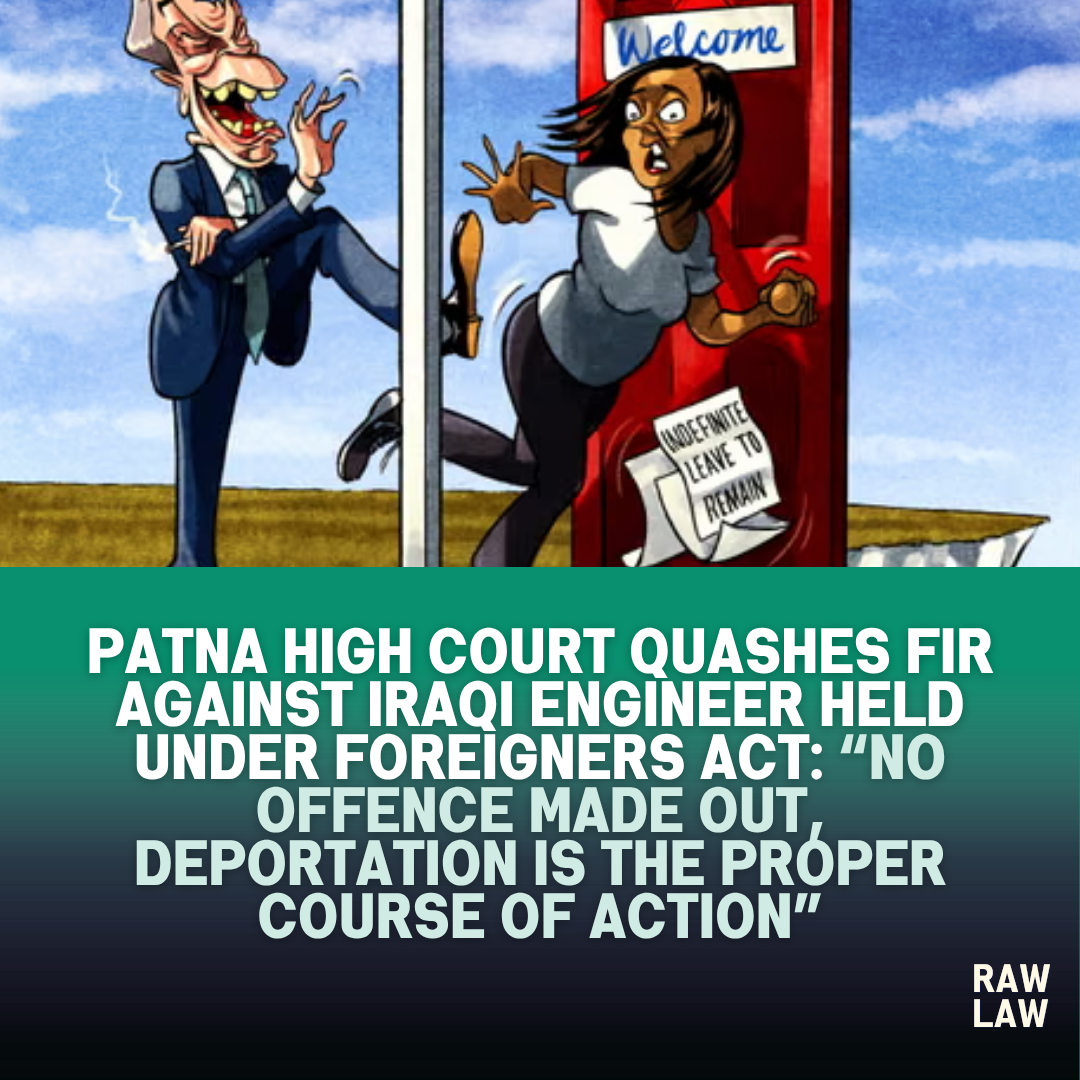
Court’s Decision
The Patna High Court quashed the FIR lodged against an Iraqi national under Sections 3(2)(a), 14(a), and 14(b) of the Foreigners Act, 1946, holding that no offence was made out and his detention amounted to abuse of process of law. The Court directed that he be deported to his native country, Iraq, within two weeks, in coordination with the Embassy of Iraq at New Delhi, if not required in any other case.
Justice Arun Kumar Jha observed that since the petitioner held a valid passport and entered India mistakenly while enquiring about his visa application, he could not be treated as a criminal. The Court emphasized that “a foreigner found without a visa but holding a valid passport should be deported, not prosecuted.”
Facts
The petitioner, an Iraqi national employed as a Senior Technical Manager with Granada Europe Construction in Dubai, entered India from Nepal in June 2025. He possessed a valid Iraqi passport and a double-entry visa to India valid from April to October 2025. Having already used both entries (Mumbai–Kolkata and Delhi visits), he approached the Indian Immigration Office at the India–Nepal border on 21 June 2025 to enquire about a multiple-entry business visa, as his employer had secured permissions from India’s Ministry of External Affairs (MEA) for recruitment of Indian workers.
However, he was arrested on 22 June 2025 and an FIR was registered at Haraiya Police Station (East Champaran) under Sections 3(2)(a), 14(a), and 14(b) of the Foreigners Act, 1946, alleging illegal stay in India without a valid visa. The petitioner remained in custody for nearly four months before approaching the High Court seeking quashing of the FIR and his release.
Issues
- Whether the petitioner’s entry into India constituted a violation of the Foreigners Act, 1946?
- Whether the FIR registered against him was legally sustainable?
- Whether deportation, rather than criminal prosecution, was the appropriate course of action?
Petitioner’s Arguments
The petitioner contended that he held a valid Iraqi passport and visa, and was lawfully deputed by his Dubai-based employer for recruiting Indian manpower under agreements approved by India’s MEA. He had previously entered India twice within his visa validity and had approached the immigration office only to clarify matters regarding a multiple-entry business visa, following an approval email from the Indian Embassy.
He argued that his entry into India was inadvertent and bona fide, not intentional or clandestine. Since he neither overstayed beyond his visa term nor committed any act in violation of visa conditions, the FIR was misconceived. The counsel further contended that under Section 5 of the Passport (Entry into India) Act, 1920, a person found without a visa but holding a valid passport should be deported, not criminally prosecuted.
Reliance was placed on:
- Fadi Fadel v. State of Bihar (2018) 2 PLJR 400, where a Lebanese national who entered India by mistake was released and deported instead of being prosecuted.
- Williams Rebecca v. State of Bihar (2022) 4 BLJ 710, where the FIR against a Canadian citizen who mistakenly crossed the Indian border was quashed and deportation ordered.
- Kasparek Petr v. State of Bihar (2025) and Farida Malik @ Sana Akhtar v. State of Bihar (2024) 4 BLJ 71, where similar relief was granted, emphasizing deportation as the correct remedy.
Respondent’s Arguments
The State and Union of India opposed the writ, asserting that the petitioner had entered India illegally after availing both entries under his visa, thereby violating Sections 3(2)(a), 14(a), and 14(b) of the Foreigners Act, 1946. It was argued that his presence in Indian territory without a valid visa amounted to a statutory contravention.
However, the Union of India’s counsel candidly conceded that, in light of previous precedents such as Fadi Fadel and Williams Rebecca, deportation rather than prosecution could be a permissible course.
Analysis of the Law
The Court examined the provisions of Sections 3(2)(a), 14(a), and 14(b) of the Foreigners Act, 1946:
- Section 3(2)(a) empowers the Central Government to regulate the entry of foreigners into India.
- Section 14(a) penalizes staying in India beyond the visa’s permitted period.
- Section 14(b) penalizes violation of conditions of a valid visa.
Justice Arun Kumar Jha clarified that these provisions apply only to persons who have a valid visa but overstay or breach its conditions. A person who no longer holds a valid visa cannot be charged with violating its terms; at most, such a person may be treated as an unauthorized entrant subject to removal under the Passport (Entry into India) Act, 1920.
The Court emphasized that Section 5 of the 1920 Act empowers the government to remove or deport foreigners who enter India without a valid visa or passport, rather than subjecting them to criminal prosecution.
Precedent Analysis
- Fadi Fadel v. State of Bihar (2018) 2 PLJR 400) – The Division Bench quashed an FIR against a Lebanese national holding a valid passport and Nepal visa, ruling that he should be deported, not prosecuted.
Reference: The present case followed this principle to conclude that no offence was made out under the Foreigners Act. - Williams Rebecca v. State of Bihar (2022) 4 BLJ 710) – The High Court quashed proceedings against a Canadian citizen who inadvertently entered India, ordering deportation instead.
Reference: Applied to support that mere inadvertent border entry without intent does not attract criminal liability. - Kasparek Petr v. State of Bihar (2025) – The Court held that a foreigner with a valid passport should be deported rather than convicted for illegal entry.
Reference: Reinforced the remedy of deportation in mistaken entry cases. - Farida Malik @ Sana Akhtar v. State of Bihar (2024) 4 BLJ 71) – The proceedings were quashed against a U.S. citizen with multiple passports, reaffirming that holding valid identification negates criminal intent.
Reference: Used to establish that bona fide possession of a valid passport negates culpability.
Court’s Reasoning
The Court found that the petitioner’s entry was not clandestine but the result of an administrative process for multiple-entry visa issuance. It held that:
“If the petitioner was not having any valid visa, there is no question of violating the conditions of such visa.”
Further, since he possessed a valid Iraqi passport and was in the process of complying with visa formalities, Sections 3(2)(a), 14(a), and 14(b) of the Foreigners Act were inapplicable. The FIR, therefore, lacked any legal basis.
Justice Jha observed:
“The institution of the FIR against the petitioner is an abuse of process of law, and the criminal proceeding on the basis of such FIR cannot be allowed to proceed.”
The Court held that the correct course was deportation under Section 5 of the Passport (Entry into India) Act, 1920, rather than imprisonment or prosecution.
Conclusion
The Patna High Court quashed the FIR under Sections 3(2)(a), 14(a), and 14(b) of the Foreigners Act, 1946 and directed the Central and State Governments to:
- Deport the petitioner to Iraq within two weeks, coordinating with the Iraqi Embassy.
- Release all seized documents and articles belonging to the petitioner within one week.
The judgment reaffirms that foreigners inadvertently entering India with valid passports should be deported, not criminally prosecuted, unless there is evidence of malicious intent or security concerns.
Implications
This ruling clarifies that the Foreigners Act, 1946, penalizes overstaying or breach of visa conditions, not bona fide mistaken entry. It reinforces the deportation-over-detention principle and directs authorities to act with proportionality and sensitivity in cases involving inadvertent or administrative lapses. The judgment serves as an important precedent balancing national security concerns with humanitarian and legal fairness for foreign nationals.
FAQs
1. Can a foreign national be prosecuted for entering India without a valid visa?
Only if the entry is intentional or involves forged documents. If the foreigner holds a valid passport and enters mistakenly, deportation—not prosecution—is the correct remedy under the Passport (Entry into India) Act, 1920.
2. What does the Foreigners Act, 1946 penalize?
It penalizes overstaying or violating conditions of a valid visa. It does not apply where no valid visa exists or where entry is unintentional.
3. What should authorities do if a foreigner is found without a valid visa?
They should deport the individual under Section 5 of the Passport (Entry into India) Act, 1920, rather than initiate criminal prosecution, unless security concerns justify otherwise.