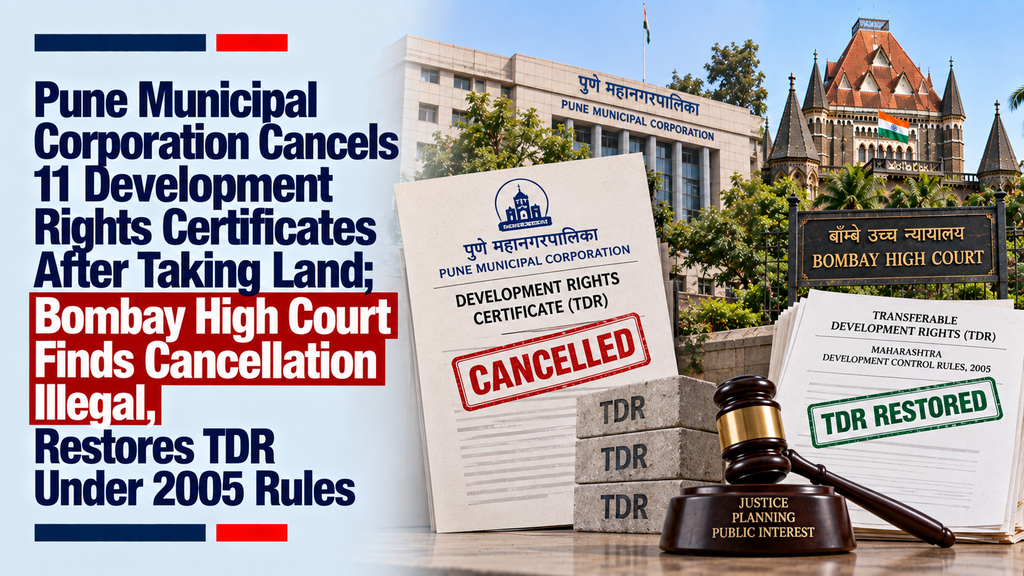
Pune Municipal Corporation Cancels 11 Development Rights Certificates After Taking Land; Bombay High Court Finds Cancellation Illegal, Restores TDR Under 2005 Rules

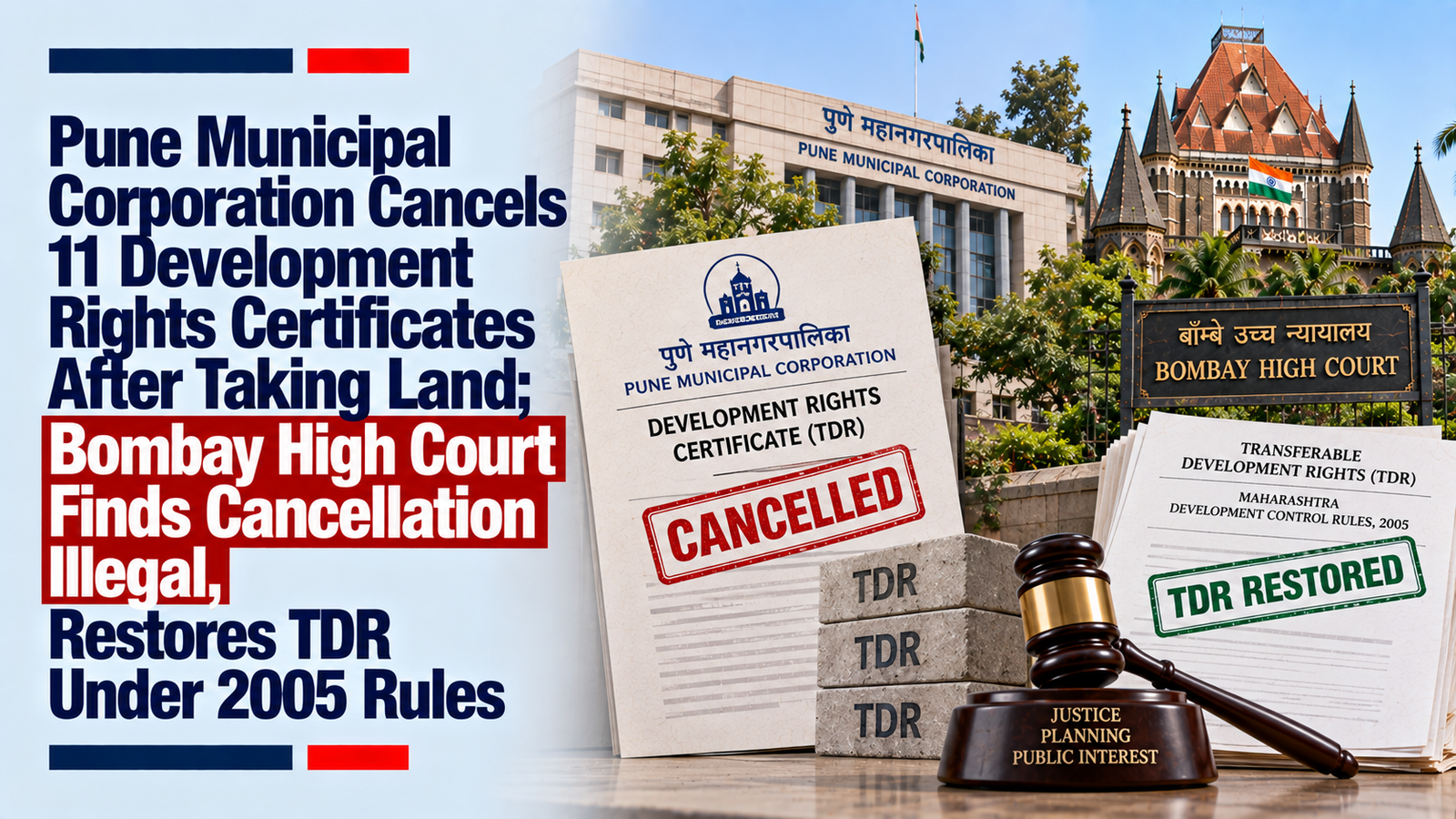
PMC Took Land, Mutated Its Name and Issued TDR, Then Disputed Area: Bombay High Court Restores Cancelled Development Rights Certificates
Facts
The dispute concerned land bearing Survey No. 6A/1 at Bopodi, Pune, belonging to petitioner Jayant Maniklal Lunawat. Pune Municipal Corporation (“PMC”) required the land for construction of a Sewage Treatment Plant (STP).
The land was not acquired through compulsory acquisition proceedings. Instead, it was surrendered to PMC by agreement against compensation in the form of Transferable Development Rights/Development Rights Certificates (TDR/DRCs).
On 17 October 2000, PMC issued two possession receipts covering 13,117 sq. metres and 220 sq. metres, aggregating to 13,337 sq. metres. On 16 November 2000, PMC issued 27 DRCs, bearing Nos. 2667 to 2693, corresponding to 13,117 sq. metres.
PMC subsequently caused its name to be entered in the 7/12 extract for the entire 13,337 sq. metres. Its own internal records also acknowledged possession of the land.
A dispute later arose over the actual area physically occupied/utilised for the STP. PMC eventually contended that only a substantially smaller area had actually been taken into possession.
The Municipal Commissioner, by order dated 8 July 2005, decided to cancel 11 DRCs aggregating to 3,690.01 sq. metres. The City Engineer communicated the cancellation on 9 December 2005. The petitioner alleged that this was done without hearing him and without reasons.
The petitioner also claimed DRC entitlement for the additional 220 sq. metres for which PMC had issued a possession receipt but had never issued corresponding DRCs.
Earlier High Court and Supreme Court Proceedings
The Bombay High Court initially allowed the petition on 1 August 2023 and quashed PMC’s cancellation.
Both sides approached the Supreme Court.
On 22 November 2024, the Supreme Court appointed a Court Commissioner to conduct a fresh measurement. The Commissioner’s report dated 17 January 2025 found 9,948 sq. metres to be utilised by PMC but identified disputes concerning two strips of land.
The Railways claimed one disputed portion, while the Irrigation Department claimed another was a riverbed. Since these authorities had not been parties before the High Court, the Supreme Court on 17 February 2025 remanded the matter for reconsideration.
After remand, however, the position materially changed: Central Railways, the State Government and Maharashtra Krishna Valley Development Corporation all stated that they claimed no right, title or interest in the property.
The controversy was therefore essentially left between the petitioner and PMC.
Issues
The principal questions before the Bombay High Court were:
- Whether PMC could cancel 11 DRCs already granted as compensation after the petitioner had surrendered his land.
- Whether PMC could subsequently dispute its own possession receipts and revenue entries by contending that only 9,948 sq. metres had actually been utilised.
- Whether cancellation of the DRCs without adequate legal basis and opportunity of hearing could be sustained.
- Whether the petitioner was entitled to DRCs for the additional 220 sq. metres admittedly covered by a separate possession receipt.
- After restoration, whether the 11 DRCs should be governed by the current development-control regime or by the regime prevailing when they were unlawfully cancelled in 2005.
Petitioner’s Arguments
The petitioner argued that the DRCs represented compensation for land already surrendered to PMC. Once the Corporation had taken the property and granted compensation through DRCs, it could not subsequently withdraw that compensation.
According to him, such unilateral deprivation violated his constitutional property rights under Article 300A of the Constitution.
He further argued that the 11 DRCs were cancelled without giving him an opportunity to contest PMC’s case and therefore in breach of natural justice. He also contended that there was no statutory provision empowering the Municipal Commissioner to cancel DRCs in this manner.
The petitioner relied heavily on PMC’s own documents. Two possession receipts showed surrender of 13,337 sq. metres; PMC had requested mutation of its name over the same area; the 7/12 entries were consequently changed; and several internal PMC communications acknowledged possession of 13,117 sq. metres.
As regards the additional 220 sq. metres, he argued that possession had admittedly been surrendered and separately acknowledged by PMC, but no DRC had ever been issued for that portion.
Finally, he argued that if the cancellation was found unlawful, he should not suffer because the litigation remained pending for more than two decades. The restored DRCs should therefore be usable under the development-control regime prevailing when they were cancelled in 2005, rather than the less advantageous current regime.
Respondent’s Arguments
PMC disputed that the entire 13,337 sq. metres mentioned in the possession receipts had actually been physically acquired and utilised.
It argued that the original possession receipts and DRCs were issued on the basis of the area reflected in revenue records without actual physical measurement.
According to PMC’s 2004 Plain Table Survey, only 9,218.96 sq. metres inside the compound had actually been utilised for the Sewage Treatment Plant.
PMC relied strongly upon the Supreme Court-appointed Commissioner’s later report, which found 9,948 sq. metres under its possession/utilisation. It contended that this later physical measurement demonstrated that the area actually possessed was less than the area appearing in the original possession receipts.
PMC also argued that subordinate officials had committed errors while issuing the possession receipts and DRCs and that there could be no estoppel against statute merely because administrative mistakes had earlier occurred.
It further invoked the Development Control Regulations concerning surrender of reserved land, levelling of the property and construction of a compound wall. PMC stated that it had incurred ₹16,80,025 in constructing the compound wall because the petitioner had only provided barbed-wire fencing.
PMC ultimately contended that only 101.01 sq. metres remained compensable on its calculation, since 21 DRCs corresponding to 9,846.99 sq. metres had already been utilised while PMC’s actual possession was 9,948 sq. metres.
Analysis of the Law
The Court rejected PMC’s attempt to treat the original possession receipts as mere administrative mistakes.
PMC had not simply issued two receipts. Its subsequent official conduct consistently corroborated the acquisition of 13,337 sq. metres.
The Corporation itself asked the Tahsildar to mutate its name in the 7/12 extract for 13,117 + 220 sq. metres. The revenue records were altered accordingly. The petitioner surrendered possession on 17 October 2000, received 27 DRCs and thereafter utilised those development rights until PMC suspended the disputed certificates.
Further, the City’s own Land Acquisition Department recorded on 23 October 2003 that possession of 13,117 sq. metres, rather than 9,218.96 sq. metres, had been taken for the STP.
Even more significantly, an Assistant Engineer’s internal communication dated 19 November 2005 confirmed that possession of 13,117 sq. metres had been taken according to the possession receipt and that the measurement tallied with the 7/12 extract. The Court regarded this as a crucial contemporaneous document for which PMC had offered no explanation.
The Court therefore held that PMC could not, years later, rely upon the location of its compound wall to undo the legal consequences of its own acquisition and documentation.
Precedent Analysis
The principal authority applied was the Supreme Court’s recent decision in Brihanmumbai Municipal Corporation & Ors. v. Vijay Nagar Apartments & Ors., 2026 SCC OnLine SC 904.
The Supreme Court had considered rights to FSI/TDR arising from surrender of land and emphasised that where the right to development compensation had already crystallised under an earlier regulatory regime, subsequent regulatory changes could not simply destroy that accrued entitlement.
The Bombay High Court particularly relied upon the Supreme Court’s proposition that where compensation is payable in the form of FSI/TDR, a duty is cast upon the State to pay such compensation to the land loser; otherwise, deprivation of property without compensation may offend Article 300A.
The Supreme Court judgment itself discussed and applied earlier TDR authorities including:
- Godrej & Boyce Manufacturing Co. Ltd. v. State of Maharashtra, (2009) 5 SCC 24;
- Godrej & Boyce Manufacturing Co. Ltd. v. Municipal Corporation of Greater Mumbai, (2023) 15 SCC 110;
- Municipal Corporation of Greater Mumbai v. Natvar Parikh & Co. Pvt. Ltd., (2024) 14 SCC 644; and
- the Kukreja Construction line of cases.
The important principle for the present case was that TDR was not a gratuitous benefit. It represented compensation for land surrendered for a public purpose.
Court’s Reasoning
The Court found PMC’s subsequent stand inconsistent with its own contemporaneous official record.
The petitioner had surrendered the property. There was admittedly no compulsory acquisition under the Land Acquisition Act; rather, the acquisition was consensual, against DRC compensation.
PMC issued possession receipts, caused its name to be entered in the revenue records, issued 27 DRCs and itself generated documents acknowledging the surrendered area.
The Court therefore held that it would be inequitable to deny the petitioner his right to utilise the DRCs merely because PMC subsequently claimed that the physical boundary of the STP enclosed a smaller area.
The Court went further and held that PMC was estopped from contending that its possession receipts were defective or did not correspond to the land actually handed over, particularly in light of its subsequent official acts and measurements.
The 220 Sq. Metres
The Court separately considered the deficit area of 220 sq. metres.
It found that this area had also been included in the possession surrendered to PMC, but the DRCs originally issued covered only 13,117 sq. metres.
Rather than directly issuing DRCs through the writ order, the Court permitted the petitioner to make a fresh application to PMC for DRCs corresponding to the 220 sq. metres.
Which TDR Regime Applies?
This became a significant aspect of the judgment.
PMC argued that even if the 11 DRCs were restored, their utilisation should be governed by the rules prevailing today.
The Court rejected this.
Once the cancellation itself was held to be “totally illegal without any basis of law,” the petitioner could not be placed at a disadvantage because PMC’s unlawful action prevented him from using the certificates when he otherwise could have done so.
Applying Vijay Nagar Apartments, the Court held that the logical consequence of quashing the cancellation was to restore the petitioner to the position he would have occupied had the illegal cancellation never occurred.
Accordingly, the restored DRCs were permitted to be used according to the regulatory regime prevailing in 2005—the year of their cancellation—not the present regime.
Conclusion
The Bombay High Court allowed the writ petition and restored all 11 Development Rights Certificates, namely DRC Nos. 2667, 2676, 2677, 2680, 2686, 2687, 2688, 2689, 2691, 2692 and 2693, which PMC had cancelled.
The Municipal Commissioner’s order dated 8 July 2005 and the City Engineer’s communication dated 9 December 2005 were quashed and set aside.
Crucially, the Court permitted the restored DRCs to be utilised under the development-control regime applicable in 2005, and granted the petitioner one year from the date of judgment to utilise them.
For the additional 220 sq. metres, the petitioner was permitted to apply to PMC within eight weeks. PMC must decide that application within a further eight weeks.
The Court expressly left open PMC’s claim regarding sharing the expenditure incurred for construction of the compound wall. No order as to costs was passed.
Case Details
Case: Jayant Maniklal Lunawat v. Pune Municipal Corporation & Ors.
Court: High Court of Judicature at Bombay, Civil Appellate Jurisdiction
Case Number: Writ Petition No. 3816 of 2004
Bench: Justice M. S. Karnik and Justice Sandesh D. Patil
Reserved On: 3 September 2026
Pronounced On: 16 September 2026
Neutral Citation: 2026:BHC-AS:37819-DB
Result: Petition allowed; 11 cancelled DRCs restored and permitted to be utilised under the 2005 regime; petitioner permitted to apply separately for DRCs for the additional 220 sq. metres.