

Anush Agarwalla Seeks Inclusion in Asian Games Dressage Team Through Higher Germany Score; Delhi High Court Rejects Plea
Facts
The petitions concerned the selection of India’s Dressage team for the 20th Asian Games scheduled to be held in Aichi-Nagoya, Japan, from 19 September to 4 October 2026.
The Equestrian Federation of India, acting through its Ad-hoc Committee, issued a selection list dated 16 June 2026. Six horse-rider combinations were shortlisted, with four riders placed in the main team and two as reserves.
Anush Agarwalla was placed as Reserve No. 1, while Sudipti Hajela was placed as Reserve No. 2. Both challenged the selection and sought inclusion in the principal four-member team.
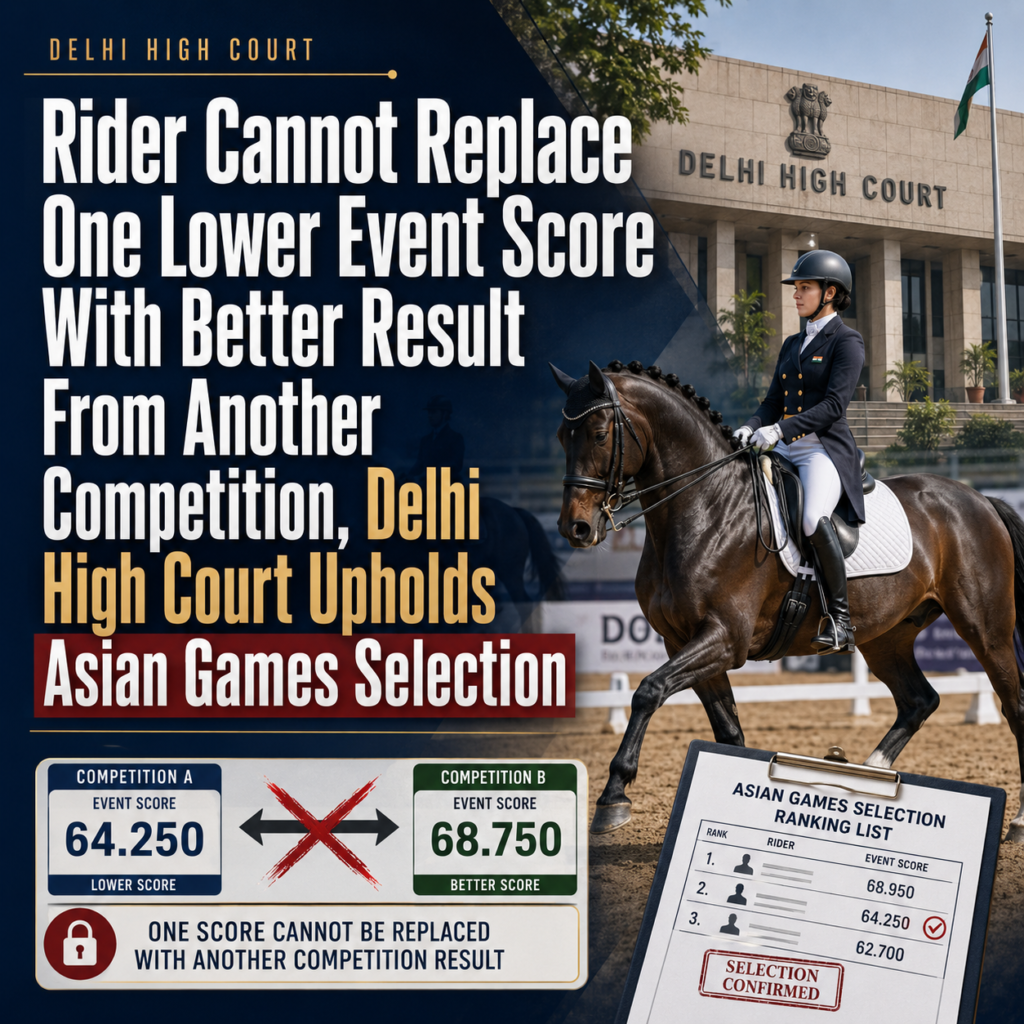
Anush Agarwalla argued that his higher Prix St. Georges score from an event at Hagen, Germany, should have been combined with scores from another competition for calculating his Minimum Eligibility Requirement. According to him, using that score would have moved him into the top four. He also alleged bias because a person involved in the selection process had pending disputes with him or his family.
Sudipti Hajela argued that the Federation had wrongly used cumulative scores across team and individual qualification categories. She contended that Team MERs should first have been separately considered for ranking, followed by individual scores.
The dispute therefore centred on the interpretation of the Federation’s Selection Criteria Version 4.0, the calculation of Minimum Eligibility Requirements, the ranking of riders and the limited scope of judicial review over decisions taken by sports-selection experts.
Issues
- Whether Anush Agarwalla’s Prix St. Georges score from the Hagen event could be combined with scores from another competition for calculating a valid MER.
- Whether the Federation had treated similarly placed riders differently by permitting other athletes to combine scores from different events.
- Whether Team MERs and Individual MERs had been ranked contrary to the Selection Criteria.
- Whether cumulative scores from all three Dressage tests could be used to determine comparative merit.
- Whether the failure to hold further competitions among the six shortlisted riders invalidated the final selection.
- Whether the selection process was arbitrary, irrational, procedurally improper or contrary to the Federation’s published criteria.
- Whether the allegation of bias or conflict of interest was sufficient to invalidate the selection.
- To what extent a writ court may interfere with the decision of an expert sports-selection body.
Petitioner’s Arguments
Anush Agarwalla
Anush Agarwalla argued that his higher Prix St. Georges score of approximately 70.941% achieved at Hagen, Germany, should have been used along with his Intermediate I and Intermediate I Freestyle scores from another event.
He submitted that, if this score was considered, his cumulative percentage would place him among the top four riders and entitle him to selection for the Asian Games team.
He contended that other riders, including Shruti Vora and Jai Sud, had been permitted to combine scores achieved at different competitions. Denying him the same opportunity was therefore alleged to be discriminatory and inconsistent.
He also challenged the notice requirement relating to overseas events and submitted that the amendments to the Selection Criteria had not been fairly applied.
Additionally, he alleged bias and conflict of interest because a member associated with the selection process was involved in litigation with him or his parents.
Sudipti Hajela
Sudipti Hajela argued that the Federation had misinterpreted the distinction between Team MERs and Individual MERs.
According to her:
- Riders who had obtained Team MERs should first have been ranked within that category.
- Individual MER scores should not have been used to displace riders holding valid Team MERs.
- The Federation had wrongly used aggregate scores across Prix St. Georges, Intermediate I and Intermediate I Freestyle.
- Some performances relied upon for ranking did not constitute valid MERs under the Selection Criteria.
Both petitioners also contended that the list of six riders was only provisional and that Clause 15 contemplated further competitions or assessment among the six probables before selecting the final four. Since no such inter se trial was held, they argued that the final selection was procedurally defective.
Respondent’s Arguments
The Equestrian Federation of India and its Ad-hoc Committee defended the selection as being strictly based on the published Selection Criteria and objective MER results.
They argued that a valid Dressage MER ordinarily required participation in all three prescribed tests:
- Prix St. Georges;
- Intermediate I; and
- Intermediate I Freestyle.
The relaxation permitting riders to combine scores from different events applied only where a particular competition did not offer all three tests.
In Anush Agarwalla’s case, the relevant competition at Lier, Belgium, included all three tests. Therefore, he could not discard the Prix St. Georges result from that event and substitute a better score from Hagen.
The respondents distinguished the cases of Shruti Vora and Jai Sud by explaining that the competitions attended by them did not offer all three tests. They were therefore permitted under Clause 8(e) to complete the missing test at a later competition.
The Federation further submitted that comparative merit had to be determined through the best two valid MER results and the highest cumulative percentage across the three Dressage tests.
Individual MER combinations were expressly entitled to rank above combinations having only Team MERs.
Regarding further trials, the Federation submitted that all six riders were based in different parts of Europe and that another competition was not practically feasible. The Selection Committee and Ad-hoc Executive Committee had examined the MER results, fitness, competitive form and relevant records before finalising the list.
The respondents denied bias and submitted that no timely objection had been raised against the composition of the Selection Committee before completion of the process.
Analysis of the Law
Limited Judicial Review in Sports Selection
The High Court held that courts do not ordinarily reassess the comparative sporting merit of athletes.
The selection of sportspersons for international competitions is primarily entrusted to:
- National sports federations;
- Expert selection committees;
- Coaches; and
- Technical bodies familiar with the discipline.
Judicial review is therefore directed at the legality of the decision-making process rather than the correctness of the sporting decision itself.
A court may interfere where the selection is shown to be:
- Manifestly arbitrary;
- Mala fide;
- Capricious;
- Perverse;
- Contrary to the governing criteria; or
- Affected by serious procedural impropriety.
A mere disagreement with score calculation or the possibility of another reasonable interpretation is insufficient.
Meaning of a Valid MER
The Selection Criteria required compulsory participation in all three prescribed Dressage tests.
For riders based abroad, scores from different events could be combined only where the original event did not include one or more of the required tests.
The Court found that the Lier competition in which Anush Agarwalla participated contained all three tests. Accordingly, the results from that competition had to be treated as a complete unit for determining the relevant MER.
He could not retain the Intermediate I and Freestyle scores from Lier while replacing only the Prix St. Georges score with his better result from Hagen.
Different Treatment of Other Riders
The Court rejected the allegation of unequal treatment.
The records and score charts showed that other riders were allowed to use scores from later events only because their earlier competition did not offer all three required tests.
For example:
- A missing Intermediate I result could be completed at a subsequent event.
- A missing Intermediate I Freestyle result could similarly be obtained later.
Those riders were therefore not similarly situated to Anush Agarwalla, whose Lier event contained all three tests.
Team MER and Individual MER
The Court examined the Selection Criteria and held that Individual MER combinations were expressly placed above combinations having only Team MERs.
The criteria required comparative merit to be assessed through the two best valid MER results and the highest cumulative percentage scores.
The provisions did not support the argument that riders with Team MERs must first be ranked independently by using only the Prix St. Georges or team-event component.
Cumulative Scores Across Three Tests
The Court accepted the Federation’s explanation that cumulative scores across all three tests reflected complete international competitive preparedness.
Dressage at the Asian Games involved both team and individual events. Assessing performance across all three tests was therefore consistent with the objective of selecting riders capable of competing for both team and individual medals.
Absence of Further Trials
The Court held that failure to conduct another trial among the six probables did not automatically invalidate the selection.
Clause 15 authorised the Selection Committee and Executive Committee to consider unforeseen circumstances and take a final decision.
The Court accepted the Federation’s explanation that the riders were based across different parts of Europe and that holding another common competition was not feasible.
Moreover, the requirement of current form and competitive readiness had substantially been met because at least one MER had to be achieved during the recent mandatory period from 17 April to 15 June 2026.
Allegation of Bias
The Court found no sufficient material to establish that the selection had been affected by bias.
Apart from a WhatsApp exchange, there was no document showing that Anush Agarwalla had timely objected to the concerned person’s participation or formally sought reconstitution of the Selection Committee.
The Court held that a participant who knew of the alleged conflict but continued through the process without raising a proper objection could not ordinarily challenge the result only after being unsuccessful.
Precedent Analysis
Swastika Ghosh v. Table Tennis Federation of India, 2022 SCC OnLine Del 1817
The Delhi High Court held that judicial review in sports selection is confined to the decision-making process.
A court cannot substitute its own choice for that of an expert committee merely because another view is possible. Interference is warranted only where the process is illogical, arbitrary or procedurally improper.
Shumel v. Union of India, 2010 SCC OnLine Del 4706
This decision held that the evaluation of athletes’ comparative merit is best left to experts.
Past reputation alone does not determine selection; current form, consistency and competitive readiness are legitimate considerations.
Sushil Kumar v. Union of India, 2016 SCC OnLine Del 3660
The Court reiterated that the decision as to who should represent India in an international sporting event lies primarily with the concerned National Sports Federation.
A writ court should interfere only where discretion is exercised arbitrarily, capriciously, perversely or contrary to settled principles.
Karamjyoti v. Union of India, 2016 SCC OnLine Del 6766
This judgment reaffirmed that courts lack the technical expertise to rank sportspersons or replace the assessment made by specialised selection bodies.
Paralympic Committee of India v. Naresh Kumar Sharma, 2018 SCC OnLine Del 8443
The Court held that sports-selection bodies may consider several factors rather than rely on a single performance.
Judicial review should remain confined to detecting manifest arbitrariness or mala fides.
Manini Kaushik v. National Rifle Association of India, 2024 SCC OnLine Del 3629
This decision held that where selection criteria have been framed by experts, applied in good faith and are reasonable, the writ court must not act as an appellate authority over the selection.
Yamini Mourya v. Indian Olympic Association, 2023 SCC OnLine Del 6213
The Court reiterated that expert criteria and sporting evaluations should not be disturbed unless shown to be perverse, unreasonable or mala fide.
Manak Lal v. Dr. Prem Chand Singhvi, (1957) 1 SCC 260
The Supreme Court recognised that an allegation of bias may be waived where the concerned party knew of the relevant circumstances but did not raise a timely objection.
The Delhi High Court applied this principle while rejecting the belated challenge to the composition of the Selection Committee.
Court’s Reasoning
The Court found that Anush Agarwalla’s proposed calculation was inconsistent with the plain language and purpose of the Selection Criteria.
The exception allowing scores from different competitions could be used only to complete a test unavailable at the original competition. It could not be used to selectively replace a lower score from an event that already offered all three tests.
The score charts showed that the other selected riders were treated in accordance with this exception and had not received an arbitrary advantage.
The Court also rejected Sudipti Hajela’s proposed distinction between Team and Individual MER ranking. The criteria clearly preferred Individual MER combinations and required cumulative comparison of the best two valid results.
The merit chart reflected the following broad ranking structure:
- Riders having two Individual MERs;
- Riders having an Individual MER along with a Team MER;
- Riders having two Team MERs, ranked by cumulative scores.
The Court found this consistent with the notified criteria.
It further held that the Federation’s inability to organise additional trials did not invalidate the result because the Selection and Executive Committees had reviewed the entire process, considered the detailed evaluation sheets and unanimously approved the recommendations.
No material established favouritism, mala fides, perversity or violation of the published Selection Criteria.
The Court consequently declined to substitute its assessment for the technical judgment of the expert sports bodies.
Conclusion
The Delhi High Court upheld the selection list dated 16 June 2026 for India’s Dressage team for the 2026 Asian Games.
It rejected Anush Agarwalla’s request to substitute his Hagen Prix St. Georges score for the score obtained at Lier while retaining the other Lier results.
It also rejected Sudipti Hajela’s contention that Team MERs had to be ranked separately before considering Individual MERs.
The Court held that:
- The selection was made in accordance with the notified criteria;
- The score calculations were neither irrational nor arbitrary;
- The treatment of other riders was distinguishable and valid;
- Absence of additional trials did not vitiate the final selection;
- The allegation of bias was unsubstantiated and belated; and
- No ground existed for judicial interference with the expert body’s decision.
Both writ petitions and the connected applications were dismissed.
Case Details
Case: Sudipti Hajela v. Equestrian Federation of India & Others; Anush Agarwalla v. Ad-hoc Committee for Governance of Equestrian Federation of India & Others
Court: High Court of Delhi at New Delhi
Case Number: W.P.(C) 8329/2026 and W.P.(C) 8290/2026
Neutral Citation: 2026:DHC:5180
Judge: Hon’ble Ms. Justice Mini Pushkarna
Date: 29 June 2026
Result: Petitions challenging the Indian Dressage team selection for the 2026 Asian Games dismissed; selection list upheld and petitioners continued as reserves.

Read Also: Bail Granted Days After Arrest in Three-Year-Old Child’s POCSO Case Set Aside by Delhi High Court